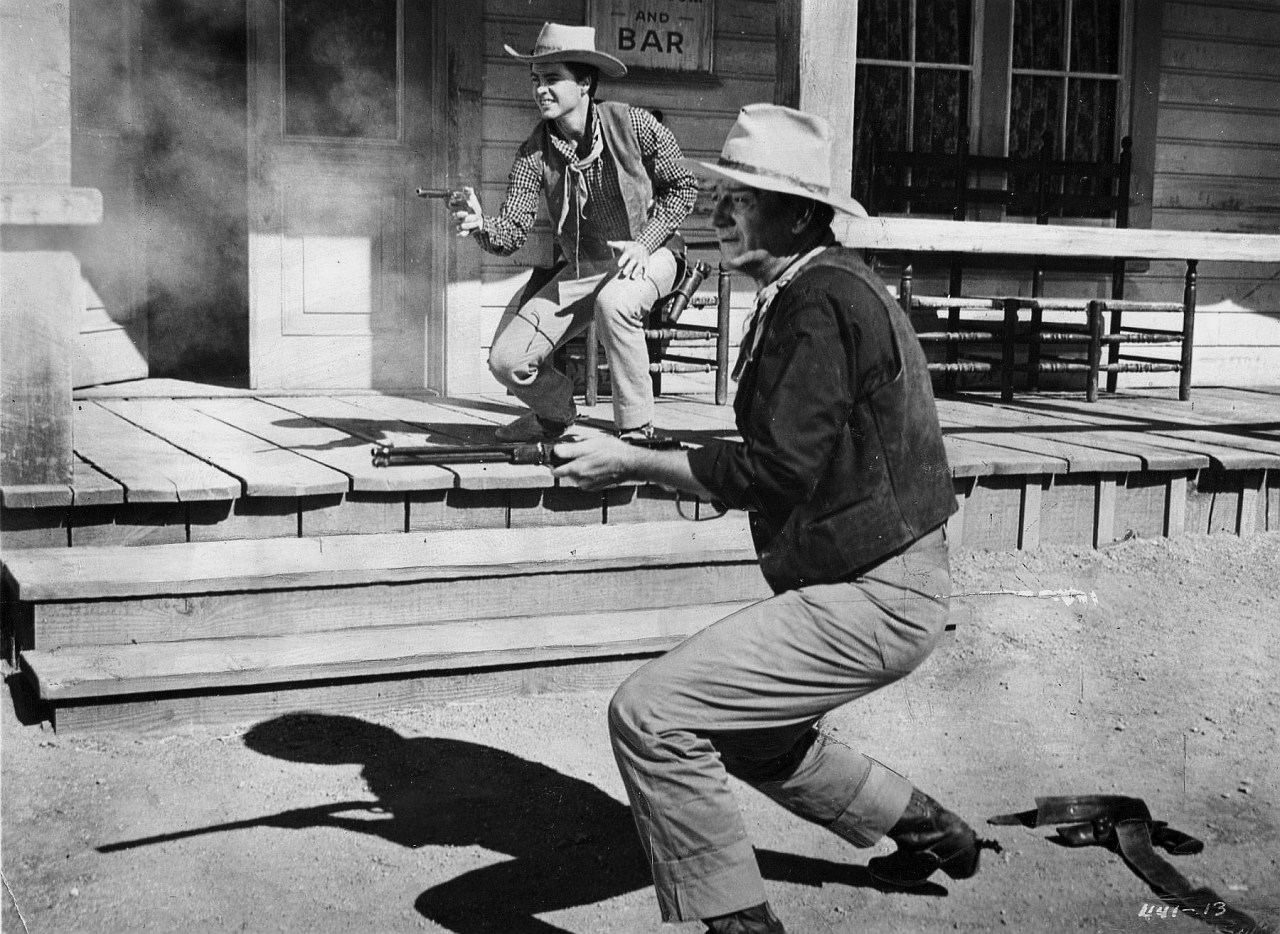
RIO BRAVO was a box office hit in 1959, a $16,400,000 domestic gross marking the year’s 11th most popular picture. Indolent critics wrote it off as just a lollygag for director-producer Howard Hawks and merely the latest western from John Wayne. Unlike snap judgments from self-anointed ‘experts’, some things age well, whether by design intent, intrinsic quality or evolving tastes.
‘John T. Chance’ (The Duke), sheriff of Presidio, Texas, has several problems. He’s arrested the brother of the local land baron for murder; the rancher has enough hired guns to bottle up the little town. One kills Chance’s close friend after he offers assistance. The sheriff is able and determined but outnumbered, besieged in the jail and nearby ‘Hotel Alamo’. What shaky help he has comes from a deputy with a drinking problem and a partially disabled, cranky old cuss who guards the prisoner. They’re later joined by a callow teenager, and the hotel owner is sympathetic, but the odds are still stacked. A fresh visitor in town, a lady gambler (nicknamed ‘Feathers’) is a fetching distraction between repeated attempts by the rancher’s gunmen to ambush Chance and his pals.
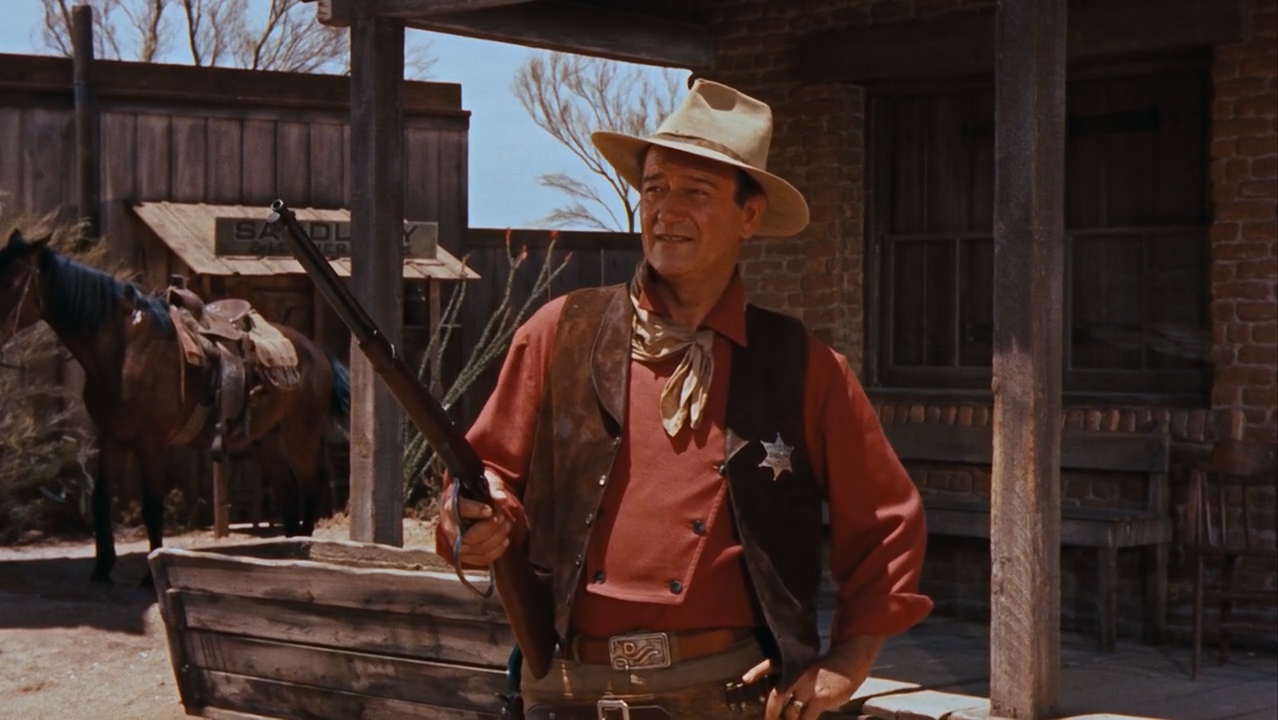
Hawks’ daughter Barbara conceived the story, Jules Furthman and Leigh Brackett crafted it into a screenplay. After the financial and critical disappointment of his Ancient Egypt epic Land Of The Pharaohs (behold, we like it!) Hawks took a four-year break. Following The Searchers, Wayne’s non-western ventures (The Wings Of Eagles, Jet Pilot, Legend Of The Lost and The Barbarian And The Geisha) didn’t rake hay, so director and star wised up to reteam, back in the saddles they’d ridden to glory across another rio, Red River. Between that 1948 classic (a huge boost to Wayne’s status and one of Hawks biggest hits) and Rio Bravo no less than 83 western series stampeded across TV to compete with all those on the big screen. So the pros reverted to formula, backstopped by shrewd casting picks, adding a backhand to High Noon, a movie neither liked. *
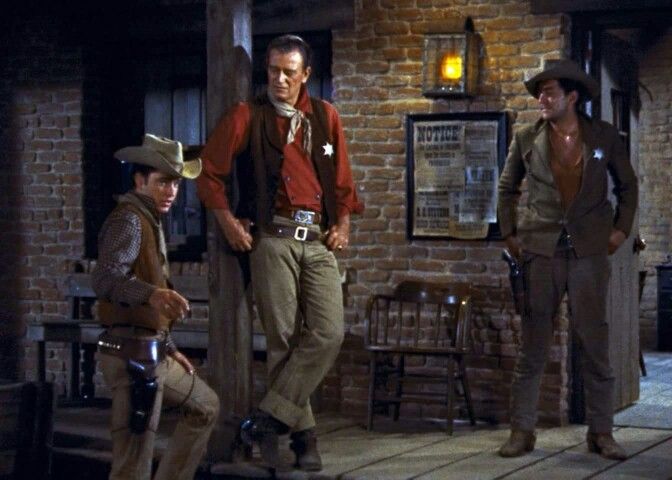
Though punctuated by five exciting action sequences, they’re brief, and the show (done in the ready-made sets of ‘Old Tucson’ left over from 1940’s Arizona) doesn’t rely on sweeping vistas. The relaxed amble of Dimitri Tiomkin’s score sets the tone for unhurried 141 minutes that Quentin Tarantino dubs “a hangout movie”, where mutually supportive character interaction is key. That not only was groove-fit to Hawks’ styling but draws a bead on why many television westerns were durably popular: audiences enjoyed them less for their episodic stories than for the characters and actors who were in them, borne out by Cheyenne, Maverick, The Rifleman, Gunsmoke and a pistol-packing passel of others. The assured star was backed by a popularity contest of types and talents, veteran and fresh, an early example of audience-draw acumen, with four supporting players who had big followings on the small screen (one was a teen idol), a singer making a switch-up into dramatic roles, and a slinky new entry in the director’s gallery of tough cookies.
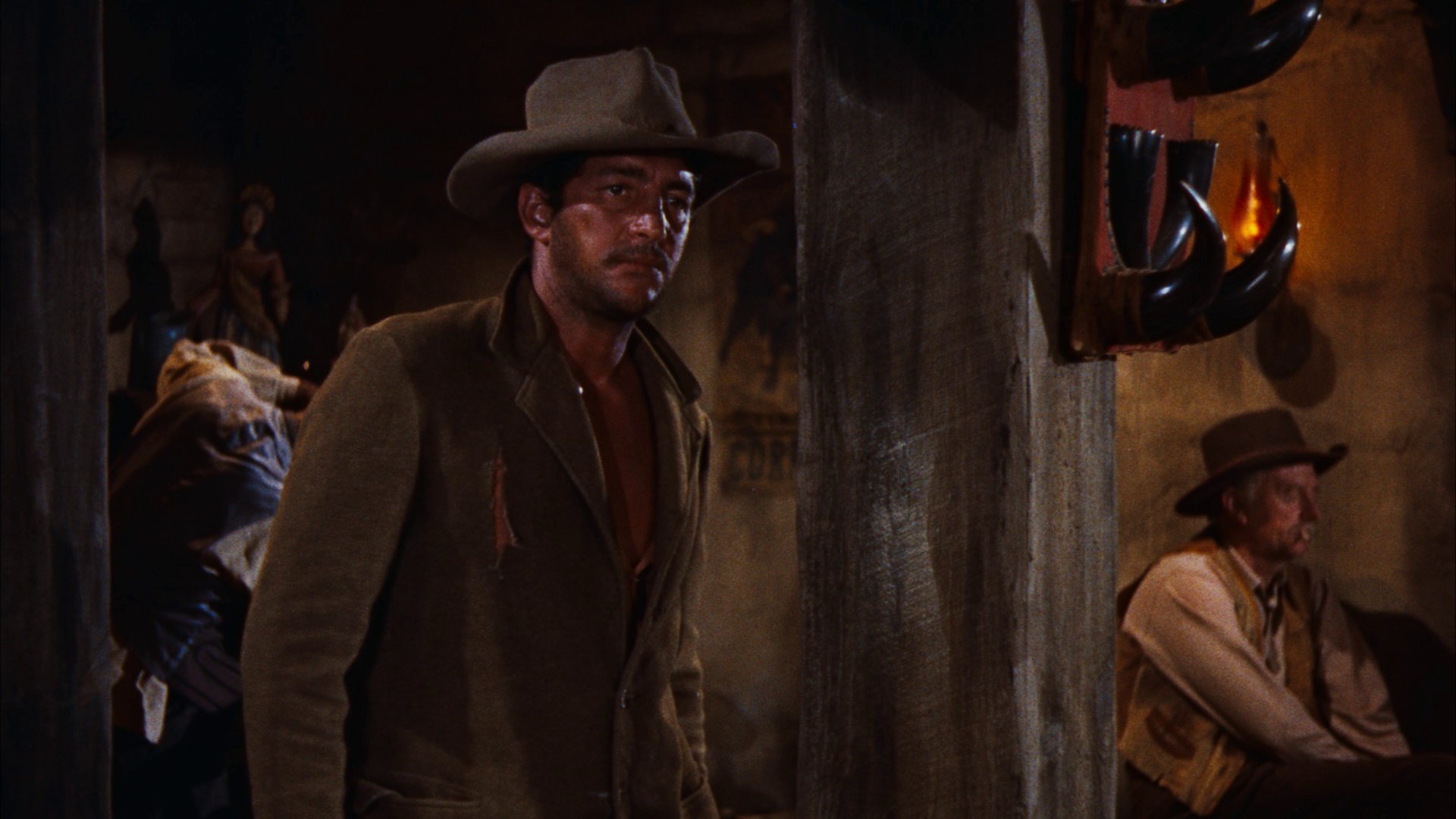
Shrugging off his recent misfires, Wayne easily commands attention but generously doesn’t hog it so as to lopside an ensemble. Chance is one of his most likable characters, the ‘tough but fair’ posture not overbearing, marked by concern for his issue-taxed friends and his flustered attraction to one who poses a different sort of challenge. At 51, he saunters into his next career chapter, one that would see many of his most popular pictures. Chance/Duke fights the good fight with ‘Dude’ (Dean Martin), ‘Colorado’ (Ricky Nelson), ‘Feathers’ (Angie Dickinson), ‘Stumpy’ (Walter Brennan), ‘Pat’ (Ward Bond) and ‘Carlos’ (Pedro Gonzalez Gonzales). Leading the nasty opposition are ‘Nathan Burdette’ (John Russell) and his thuggish brother ‘Joe’ (Claude Akins).
Martin, 41, a few years out of a decade partnership with Jerry Lewis, was making a move into serious acting in Some Came Running, The Young Lions and Career (also ’59). Other than the comedy duo’s lark Pardners this was Dean’s first genuine western: he liked the genre enough to do nine more. The best of those came with Wayne again, The Sons Of Katie Elder, none matched his borachon deputy and Rio Bravo: shaky, booze-battered Dude stands as his top dramatic performance. At 18, thanks to his family’s TV show and hit songs like “Poor Little Fool” Nelson had a huge fan base: the Ricky Nelson International Fan Club had 9,000 chapters worldwide. With Elvis in the Army (his manager wanted too much money and top billing—Col. Parker muffs it again), Ricky was bigger than Frankie Avalon or Fabian (they were up next in Wayne pillars The Alamo and North To Alaska), so a legion of ponytailers joined family-packed station wagons on a pilgrimage to the drive-in.
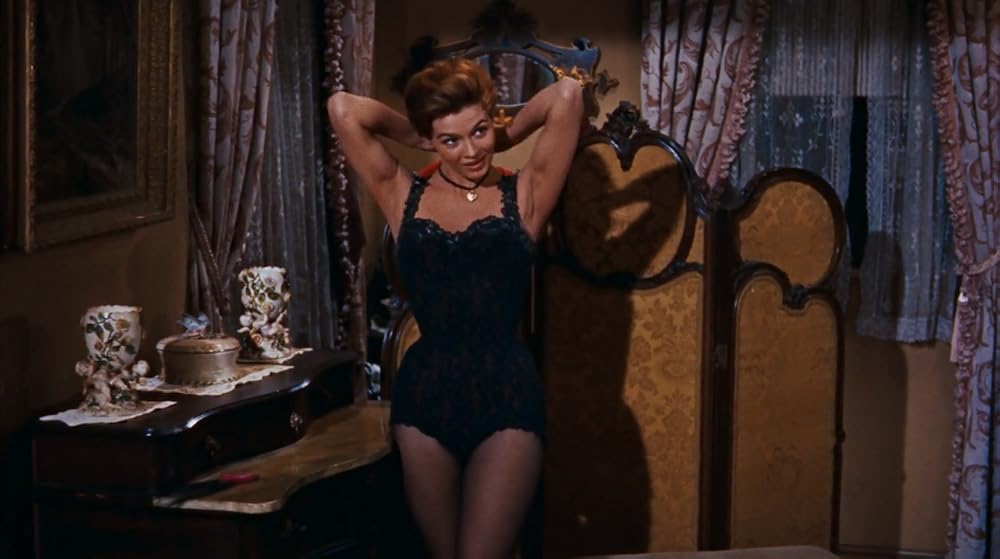
Since 1954 Angie Dickinson had appeared in 37 TV series and 13 movies (eight were westerns), but it was card-sharping Feathers who moved her livelihood out of the doldrums; 26, she not only looks to kill but more than holds her own facing off with Wayne, joining Hawks company of hard-wired but soft-souled troupers like Katherine Hepburn, Rita Hayworth, Rosalind Russell, Lauren Bacall and Ann Sheridan. It helps to know how & when to throw a flower pot thru a window. **
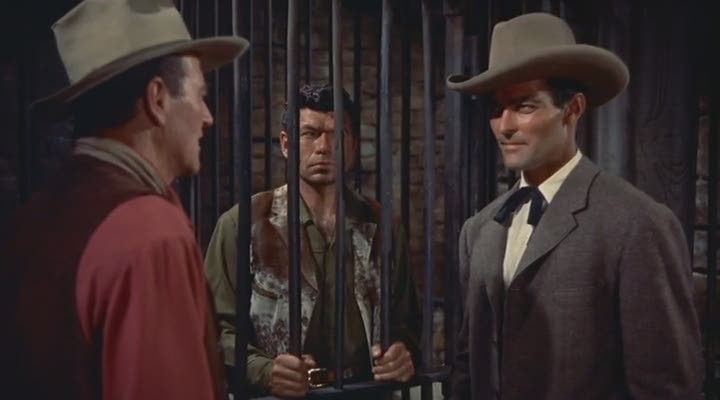
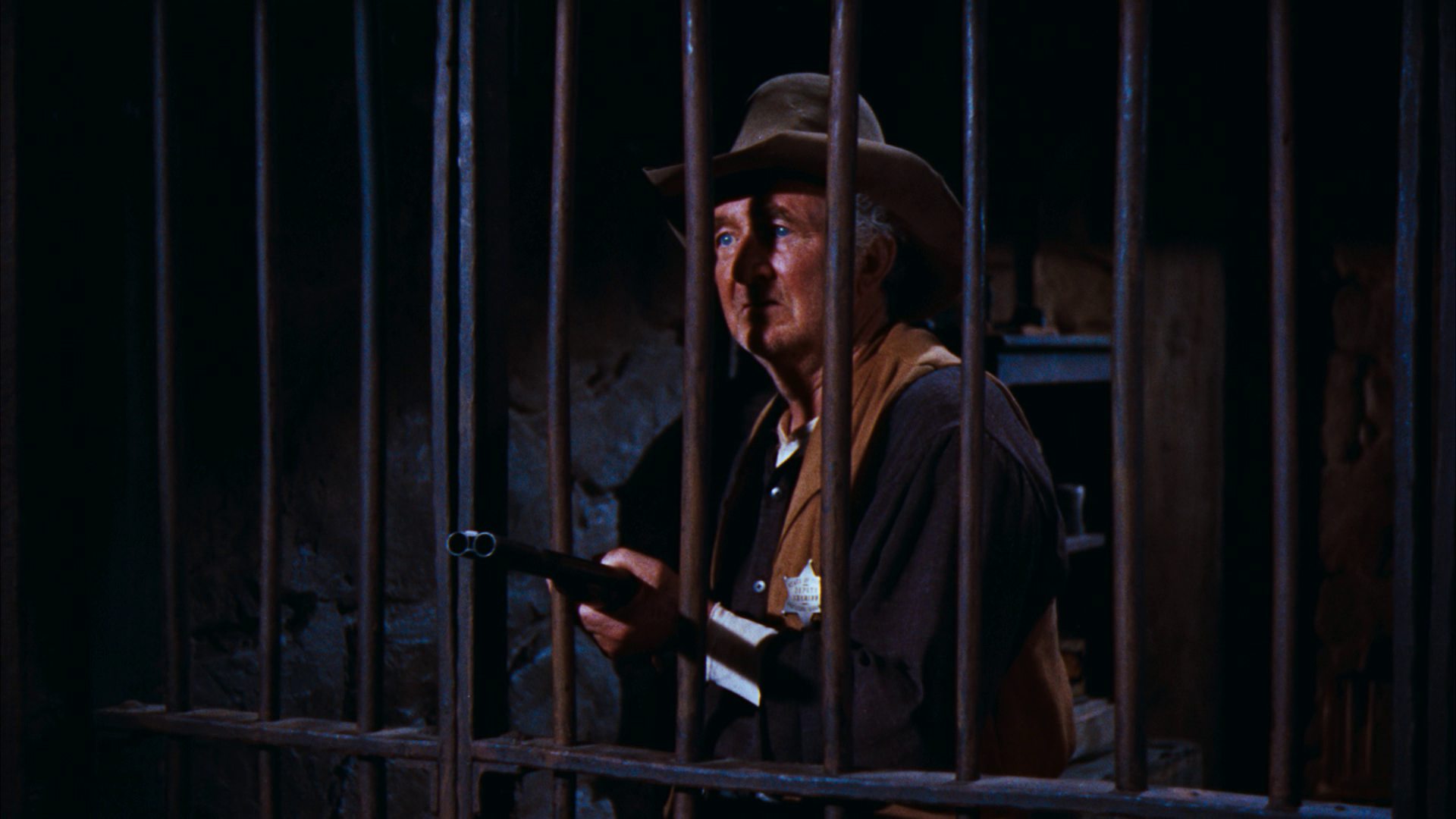
Much of the comic relief comes from Walter Brennan, 63, taking a break from his TV series The Real McCoys (love that theme song!) to do the game-legged Stumpy as the topper in his long line of cantankerous coots. Also visiting from television (Wagon Train) is Wayne’s roistering lifelong buddy Ward Bond, 55, in the last of 22 times they worked together. Pedro Gonzalez Gonzalez, 33, was a Duke amigo since 1954’s The High And The Mighty (he’d later turn up in Hellfighters and Chisum). Leading the mean team with style are John Russell, 37, striding in from his series (Lawman) and Claude Akins, 32, who was mixing snarling heavies with amiable slobs; both men have the gravitas to face off as adversaries to Wayne and make their threats resonate as viable.
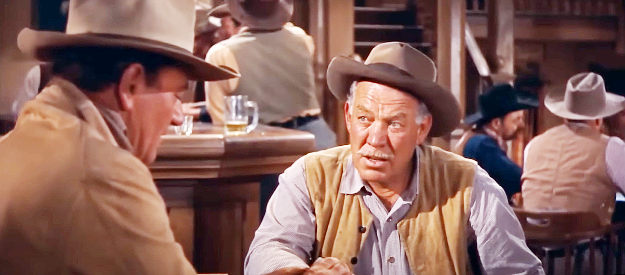
All have to prove themselves in one fashion or another, the deceptively casual buildup is suspenseful, the handicaps & support, danger & humor are shared, the action insertions timed for effect. Tiomkin’s quiet score tosses in a hint of Wayne’s upcoming The Alamo, and the ballad Dean & Ricky split is a laid back adaptation of the surging main theme Tiomkin had rolled out a decade earlier for Red River.
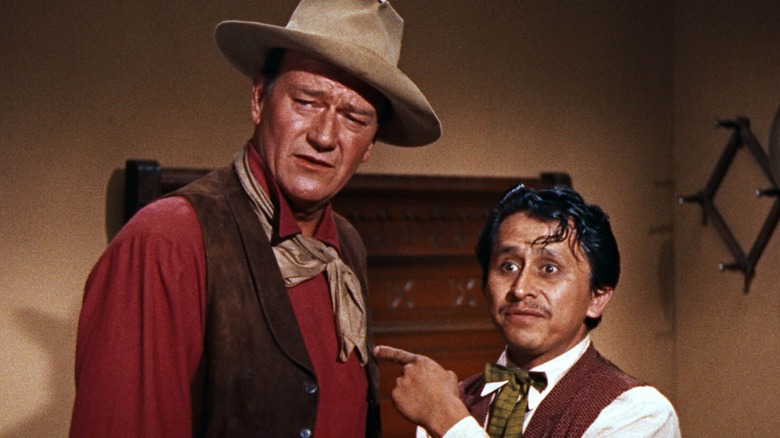
Does it matter when Dean starts crooning “My Rifle, My Pony and Me” that its amplification is obviously studio miked? That Ricky can’t act worth beans? That Angie’s gam flaunt is more Rio Carnival float than stage coach approved? Nope. They’re the good guys, and they seem like good guys (and gals, don’t forget Carlos’s wife ‘Consuela’)—and the Hawksian ethos of stand & deliver professionalism is reassuring. In the current haywire clime where every other person acts like a twerp, a jerk or a harpy, we admire the unforced easygoing manliness (Dude’s drinking problem not burdened with the neurosis angle so cine-prevalent in the shrink-rapped decade; he/they just ‘deal with it’) and we’re bestirred by confident femininity sparked with spice instead of spoiled by spite.
With Estelita Rodriguez (33, delightful as no-nonsense firebrand Consuela: lucky Carlos), Myron Healey (who will regret sneering at Dude), Walter Barnes, Bob Steele, Fred Graham and Bing Russell. ***
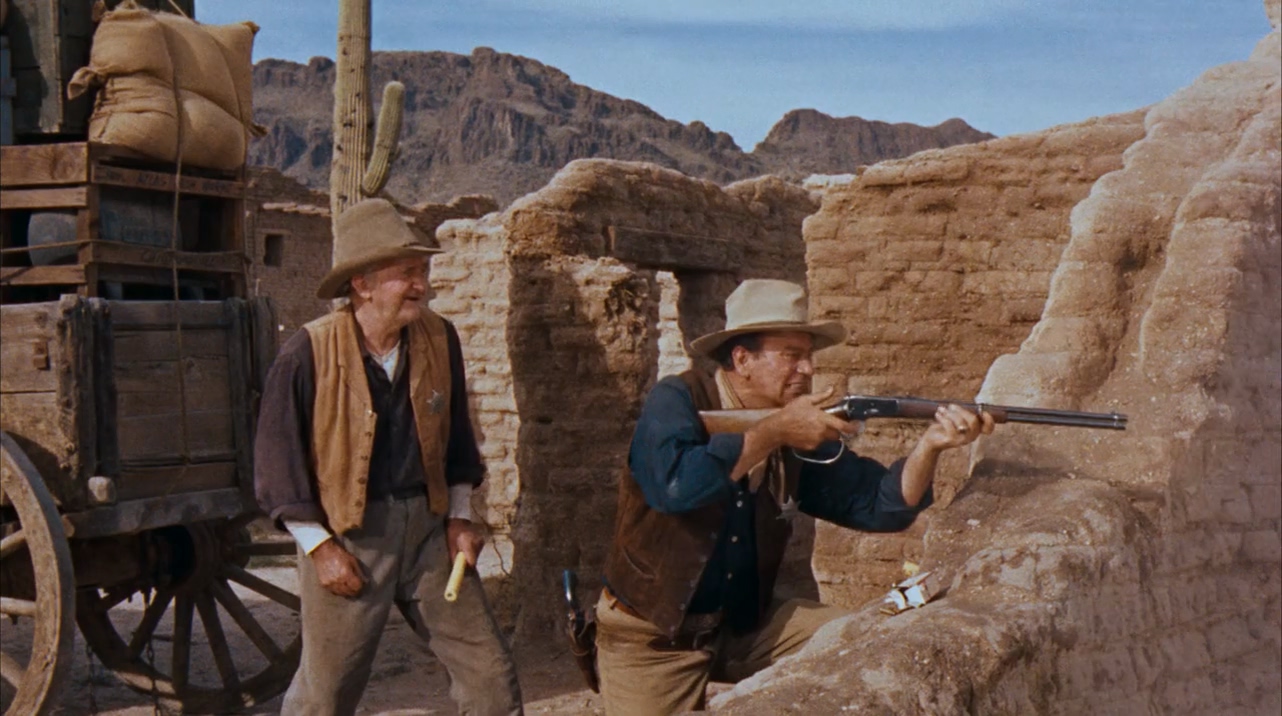
* Keeping dusty company in 1959 were no less than 22 feature film westerns and more than two dozen TV series set in those days. Big screen choices went from excellent (The Hanging Tree, The Wonderful Country) to good (Ride Lonesome, Yellowstone Kelly, Last Train From Gun Hill, No Name On The Bullet) to okay (Warlock, They Came To Cordura, Day Of The Outlaw, The Gunfight At Dodge City), down to serviceable (Alias Jesse James, These Thousand Hills, The Jayhawkers!), into lame (The Hangman, Westbound, Face Of A Fugitive, Escort West, Cast A Long Shadow, Good Day For A Hanging (three with ‘hang’ in the title?), The Oregon Trail, The Young Land) to camp hilarious (Thunder In The Sun).
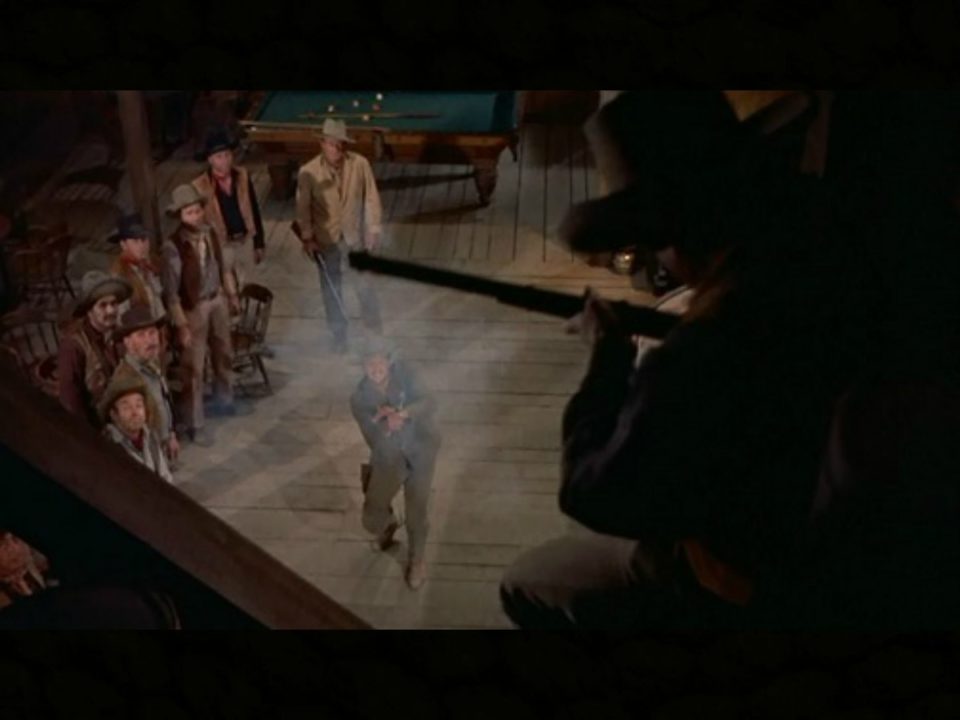 As for the Rio-Noono brouhaha—we appreciate the excellently acted, edited and scored High Noon for intent as well as delivery, but for entertainment Rio Bravo takes it to the woodshed, dunking it in a horse-trough on the way.
** Dickinson v Duke: “It’s one of the roles where he is so different, in that he’s, how can we say, adorable? I think it’s a side of him we didn’t see in a lot of his movies. He’s not defending the fort, so to speak. He’s enjoying this young woman. And while he’s enchanted with her he’s also adorable with Walter Brennan. And he’s charming and loving with Dean Martin, and with Ricky Nelson. So we see a warmth and a cuteness about him that we don’t see in many of his other movies.” “Literally I don’t know where I would be if it weren’t for Rio Bravo, number one. But also the memory of Walter Brennan and John Wayne and Howard Hawks and Dean — memories sad and happy both. ” Angie, 95 in 2026.
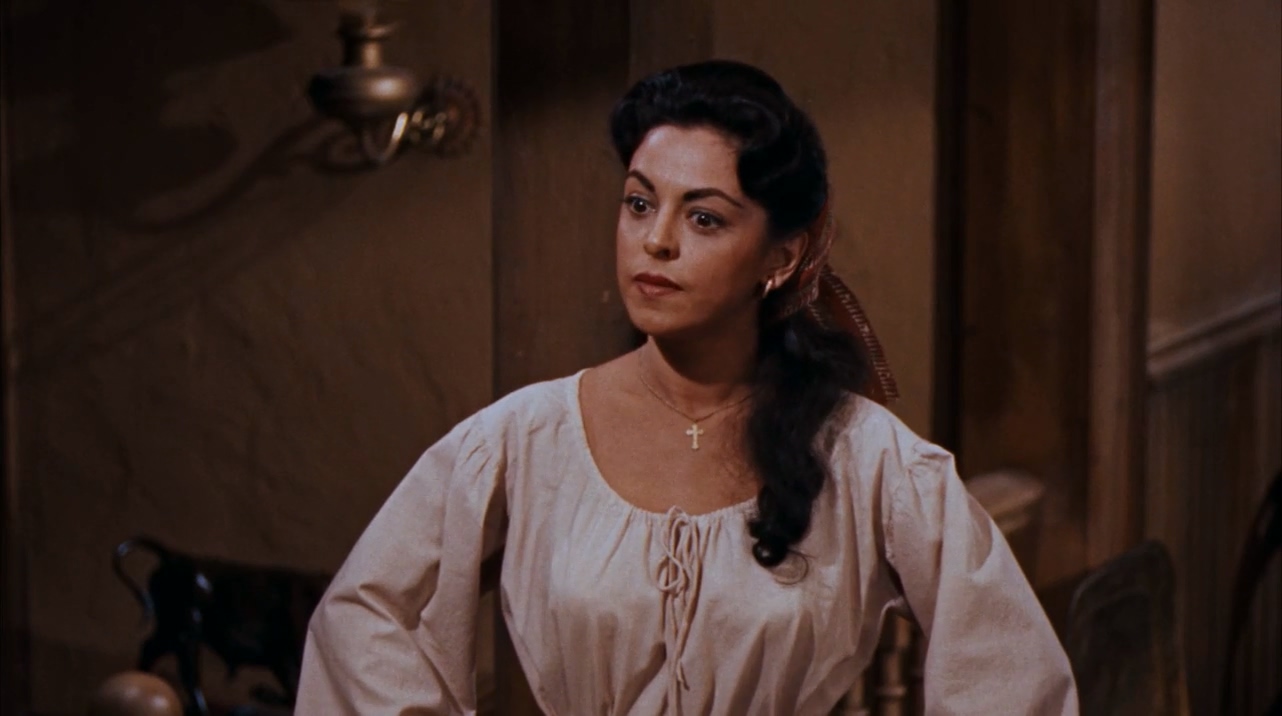 *** Estelita Rodriguez, 1925-1966. An overdue tip of the Stetson or sombrero to the Cuban singer/dancer/radio star/actress. Her vivacious personality and popularity in nightclubs transferred into 23 B-flix for Republic, nine with Roy Rogers, and some musical-comedies starred her in the lead (Belle Of Old Mexico, Cuban Fireball. Havana Rose). She’d been planning a movie about actress Lupe Velez (1908-1944) when at 41 she was found dead in her kitchen, apparently from the flu. No autopsy was performed, and, as with Velez, some mystery surrounds her passing. Her spark is part of the warmth from the campfire comfort of Rio Bravo.