
SAVE THE TIGER bites off more than it can chew with its script, but compensation for the angst overload is the stellar performance from Jack Lemmon, in literally every scene over the 100 minute running time as the tormented ‘Harry Stoner’, a winner who’s a loser. Harry has a ritzy house in Beverly Hills, a new Lincoln Continental to cruise to work in, and a track record of success in his highly competitive field, running an apparel company in Los Angeles. The embellishments and status come up snake eyes against constant pressure to deliver (‘Capri Casuals’ is in a money freefall, his marriage is flatlined) and overall dissatisfaction with changing (and decaying) social norms; strains on his spirit and conscience aggravated by distasteful survival choices he feels he must make and haunting memories from his service in World War Two that get so vivid he hallucinates them in public. Middle-age is not supposed to feel like The Middle Ages, right? *
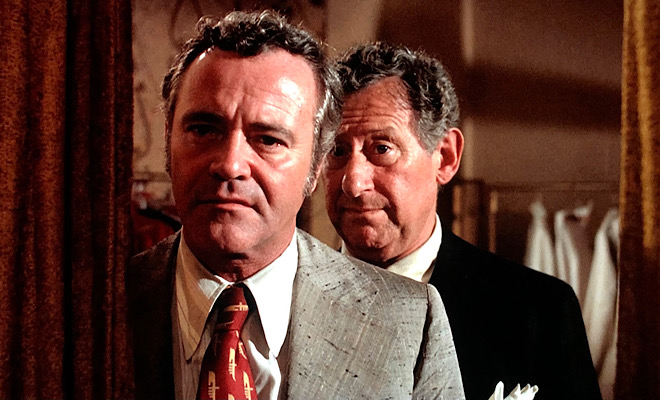
Lemmon, 47, was a master at capturing modern urban American male anxiety, both comic (The Apartment, Good Neighbor Sam, The Fortune Cookie, The Odd Couple) and dramatic (Days Of Wine And Roses, The China Syndrome, Missing), and he’s at the top of his game in this determinedly downbeat piece, a part he wanted badly enough that he worked for scale rather than his usual salary and also served as an executive producer. Once or twice when Harry nears manic meltdown it feels maybe a “little too much Jack” but that’s more the fault of the writing than the star. Overwhelmingly, conviction comes thru in the quieter moments of confusion and despair, resolution and revelation. The painful capture of ‘now what & what for?’ ennui won him an Oscar as Best Actor against a lineup of likewise showy examinations of men on the edge: Marlon Brando’s Last Tango In Paris, Jack Nicholson heading The Last Detail, Al Pacino as Serpico and Robert Redford completing The Sting.

Co-star Jack Gilford (Harry’s loyal, fretting partner ‘Phil Greene’) drew a nomination for Supporting Actor as did the screenplay written by Steve Shagan. The director was John G. Avildsen, who’d helmed a batch of cheapo exploitation duds and then had a surprise hit with one of them, 1970’s Joe; his improved work on Save The Tiger pulled him up the pathway to Rocky and The Karate Kid.
“I used to get goose bumps every time I looked at that flag. When I was a kid, sittin’ alone in a room playing the radio whenever they played the national anthem I stood up. All alone in the room I stood up at attention. Don’t SELL me America! Now they’re making jock-straps out of the flag.”
Shagan had one TV film to his credit (1971’s pretty good A Step Out Line) and over several years trying to shop Save The Tiger’s script, he turned it into a novel, 195 pages that came out a year before the movie. The issue with the script is that it’s a kitchen sink approach, throwing in too many subplots that individually are okay but collectively jam up the flow; there’s a gripe about everything but the weather. The ‘baseball as symbolic’ angle is done to ribbons and the garish imagery in the flashbacks to the GI casualties of Harry’s youth (the war over for 30 years) seem more calculated to reach then-contemporary Vietnam anguish than honoring the fallen from Anzio. **
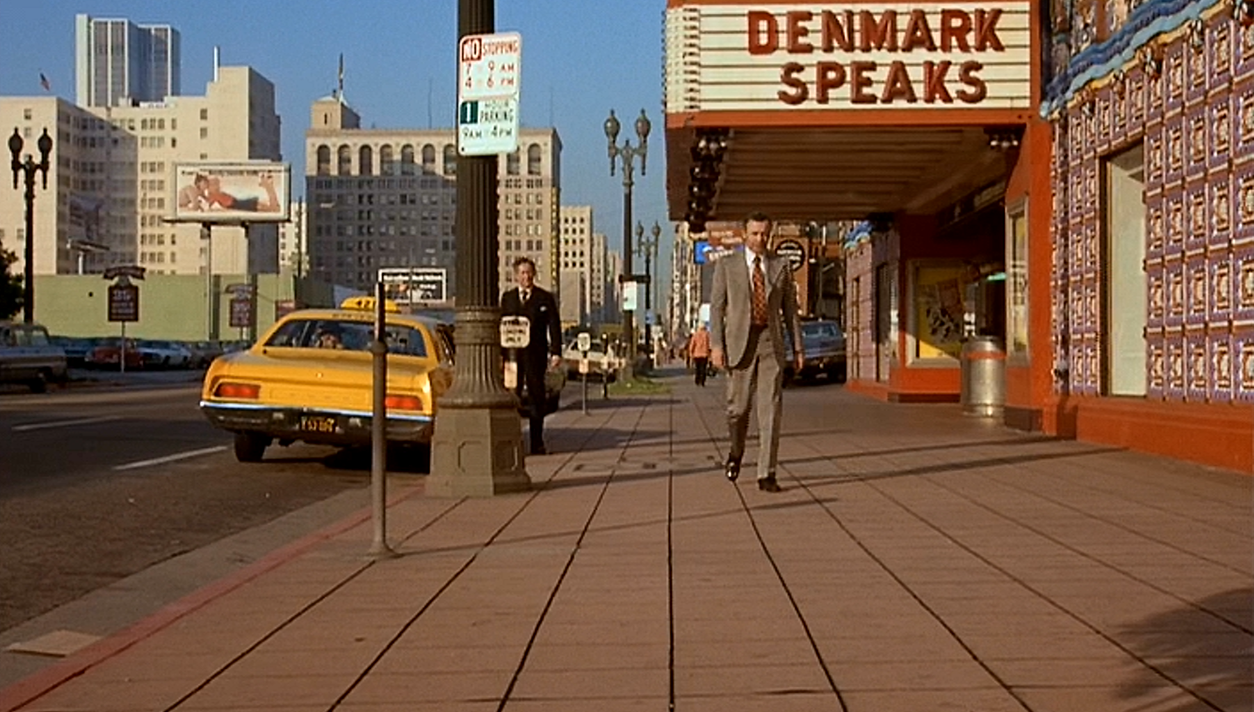
One shot says a lot: walking out of an “adults only” theater on a sunny California afternoon.
Gilford’s okay; a couple of the lower-case performances are more interesting. Lara Parker (from TVs Dark Shadows) is very good as the call girl who has an accident with the client Harry set her up with, and ever-weird Thayer David scores as the very calm, very cold arsonist ‘artist’ Harry and Phil meet with in one of the early porn theaters showing an ‘educational’ movie from Denmark. Laurie Heineman, 24, made a debut as a free-loving flower child (somewhat late in the game) who Harry gives a lift to, and gets one in return. She’s all right, though we can’t help wondering what the schmuck was thinking by picking up a hippie hitchhiker in the L.A. of the post-Manson days.
MYRA: “Are you OK? Do you want something?” HARRY: “Yes. I want that girl in a Cole Porter song. I wanna see Lena Horne at the Cotton Club – hear Billie Holiday sing fine and mellow – walk in that kind of rain that never washes perfume away. I wanna be in love with something. Anything. Just the idea. A dog, a cat. Anything. Just something.”
Box office ranking in 1973 was 47th, the gross $7,100,000, hardly a big hit, but not bad considering the budget for the movie was only about $1,000,000. With Norman Burton, William Hansen, Patricia Smith, Ned Glass, Harvey Jason, Liv Lindeland and Biff Elliot.
Just three guys in suits. Watching a porn flick. Planning an arson.
* Existential unhappiness of one sort of another—with self, with relationships and work, with society—was rife in 1973’s output: The Way We Were, Serpico, Scarecrow, Breezy (William Holden lucking out with a more appealing flower child in Kay Lenz), The Friends Of Eddie Coyle, The Long Goodbye, Summer Wishes Winter Dreams, The Iceman Cometh, Bang The Drum Slowly, Electra Glide In Blue, The Offence. The many crime thrillers and few westerns were extra-nasty and nihilistic (Magnum Force, Pat Garrett And Billy The Kid, High Plains Drifter, The Stone Killer, The Laughing Policeman, Charley Varrick, The Deadly Trackers). Soylent Green made the future look bleak. It only figured that the #1 hit was The Exorcist. Yes, American Graffiti was a ton of fun, but it was also a lament, making you wish it was 1962, when all we had to worry about was nuclear annihilation. Save The Tiger fit right in with the bummed-out crowd. If only they’d known what 2025 would feel like…
** Writer-producer Steve Shagan’s subsequent output varied between good (Hustle, Primal Fear), okay (The Formula, Voyage Of The Damned) and awful (Nightwing, The Sicilian).

We all need saving, just not from the predators that live in the natural—and safer—jungle.
 Movies ala Mark