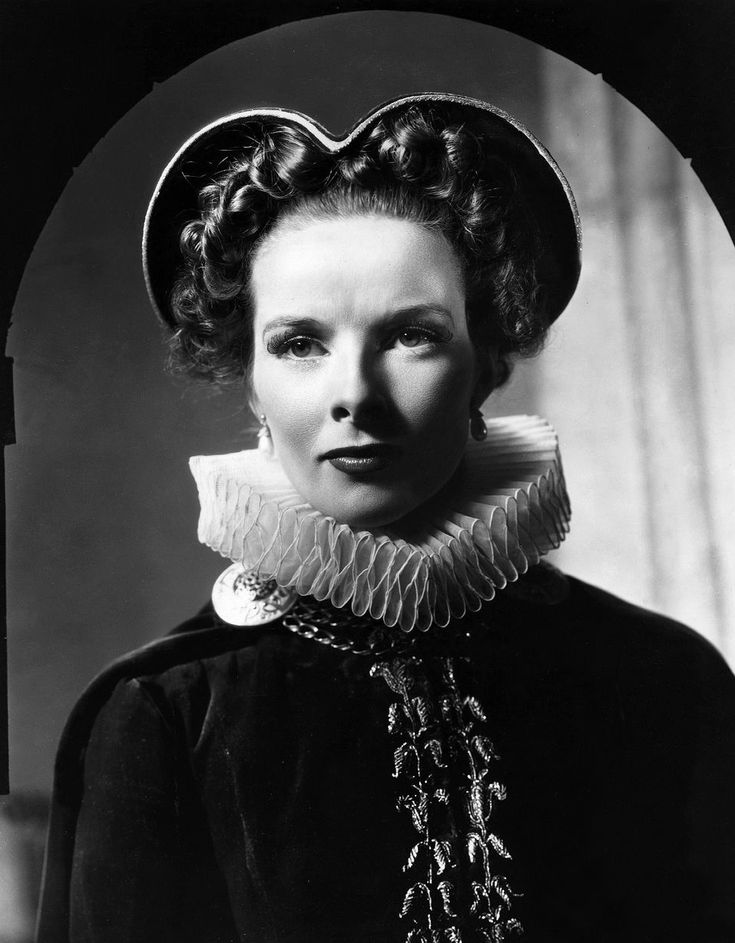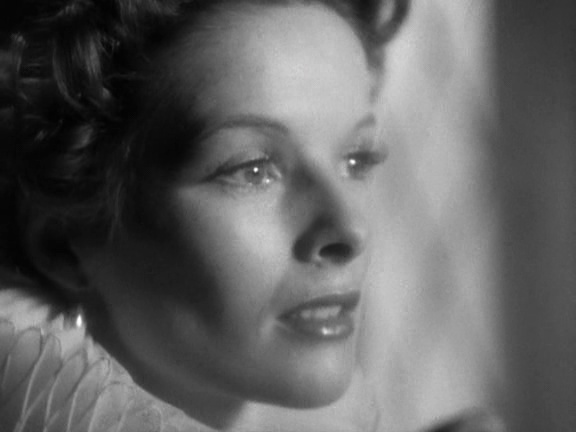
MARY OF SCOTLAND, the 1936 version of the 1550’s monarchical struggle between the queens of Scotland and England, has long carried a misleading rep as a dud. Standard rule on the money end of movie bizzing goes that the cost of a making a film (in this case $864,000) has to bring back 2.5 times that when the spending for advertising and prints is factored in. Cogerson reports a gross of $2,600,000, a good $440,000 in the clear. Critical response was qualified-positive but the tag as a flop lingers for several reasons. Placing 74th was considerably less than ideal, no awards were given or nominated and Hollychatter had the director and his leading lady unhappy with the result. Since they were John Ford and Katharine Hepburn (with Fredric March on hand) expectations had been elevated, plus they worked off a script Dudley Nichols adapted from Maxwell Anderson’s hit 1933 play. In modern Reviewerland, the ‘meh’ reaction is often cited as contributing to the actress being thumped as “box office poison”. That sniper shot actually came two years later (more on that below) and this picture, while it has its problems, has enough of value to recommend it. *
“War! Is that all you men know?”
1561. Widowed by France’s King Francis II, Mary Stuart (Hepburn, 28) returns to her native Scotland after thirteen years to assume the crown back home. Her returned presence and family ties pose a threat to England’s queen Elizabeth I, who fears Mary will claim the English throne (they’re cousins) if not directly, then thru an heir: Elizabeth, “the Virgin Queen’, is childless. Scheming by Scottish nobles, interference from clergymen, errs in judgment on her part (a bad husband pick in Lord Darnley, a the louse) and Elizabeth’s attitude and smarts end with Mary imprisoned, facing not just treachery and isolation but ‘the block’. A crown requires a head to rest upon.
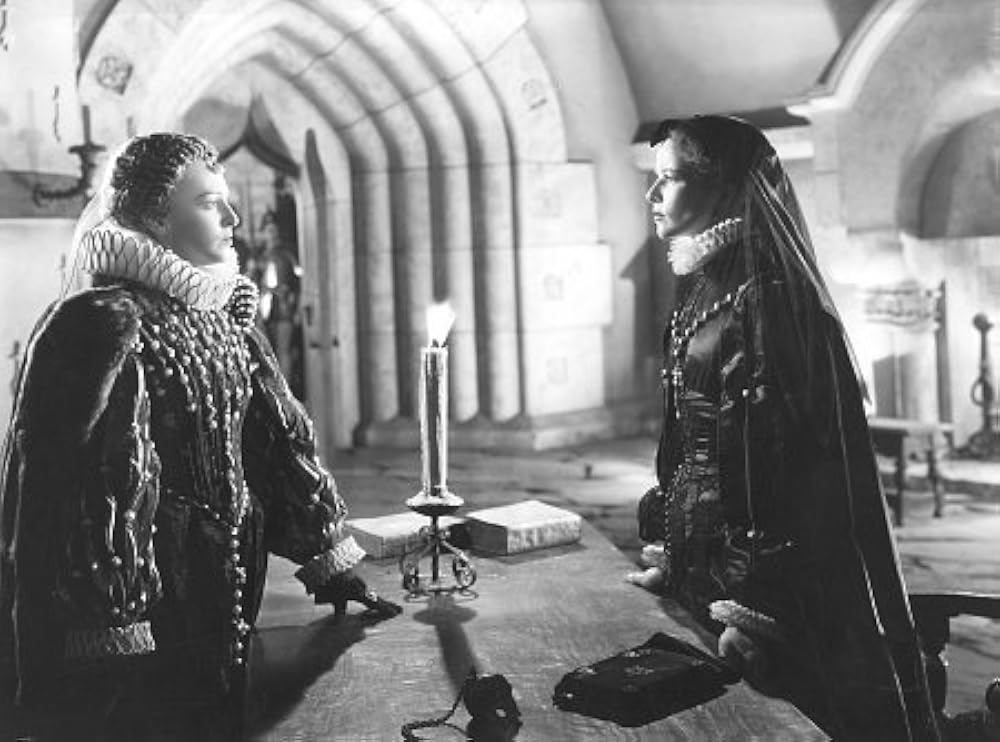
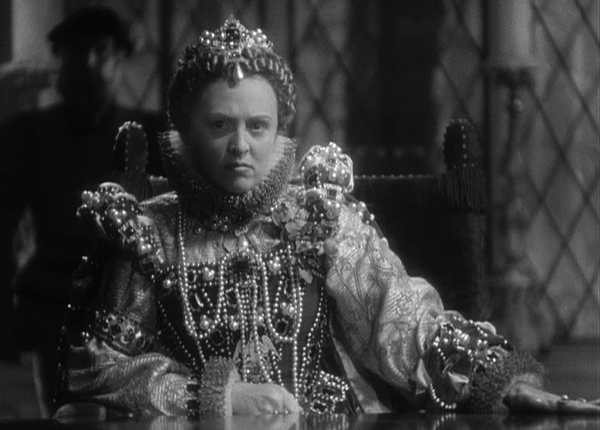
As per always, strict history is left to books, but the basic setup, roster of characters and high stakes drama come across. It’s a mid-sized production, set-bound, with no battles (one skirmish) or masses of extras. While the prickly director and haughty actress had a meeting of the minds (and more, flinging during the shoot) Ford, 41, wasn’t too enamored of the overall assignment, which has some hearty over-emoting from a number of supporting players, and bears Ford’s allegiance to Catholicism (never mind the off-set dallying) skewed in favor of Mary rather than Elizabeth. The decisive English icon, as played by Florence Eldridge, 35 (wife of co-star Fredric March) is pointedly harsher than the subsequent interpretations from Bette Davis (The Private Lives Of Elizabeth And Essex, The Virgin Queen), Flora Robson (Fire Over England, The Sea Hawk) and Jean Simmons (Young Bess). March, 38, repeats his role from play, as the Earl of Bothwell, husband #3, the man far better suited to Mary than Darnley. Normally, March is a forceful presence, but he lacks flavor and zest here, and his wave at a Scot accent is indifferent. **
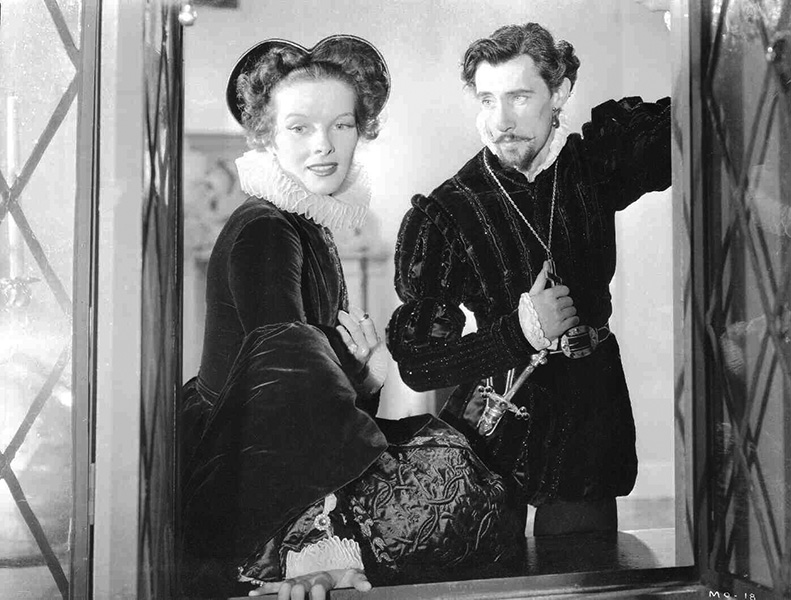
The two best turns in the second rank come from John Carradine and Moroni Olsen. As Mary’s faithful advisor David Rizzio, Carradine is very good in one of his rare sympathetic characters: cut him extra slack for wearing those tights, he must’ve had the skinniest legs outside of Rin Tin Tin. Authority figure go-to Olsen gets to rage fire & brimstone as hatter-mad Protestant preacher John Knox, one more reason to stay out of churches unless your thesis is on stained glass.
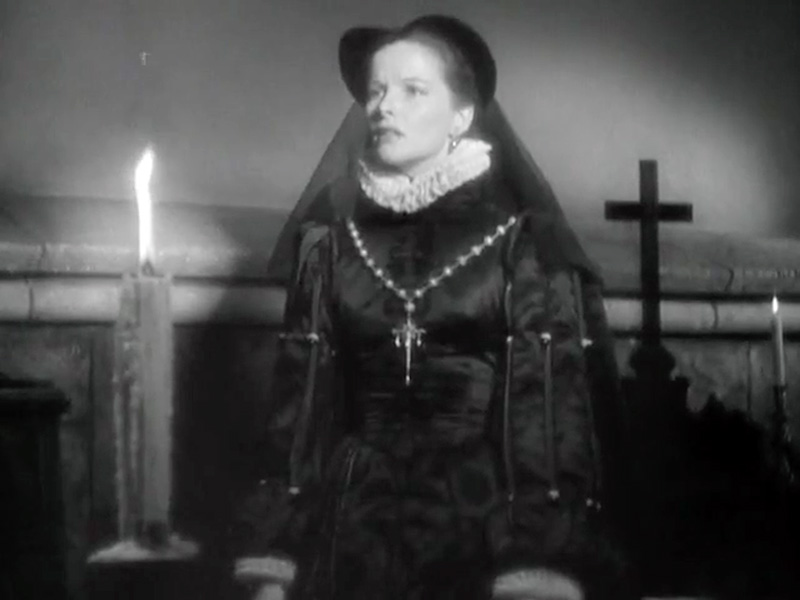
Hepburn’s performance isn’t usually mentioned when her biggies are listed, but she’s quite effective in a more contained, less-mannered and extravagant mode than usual, making the often on-the-point declarative dialogue lilt rather than lump. Ford may not have or may not have offered advice but his affection shows in how he conveyed the emotional look he wanted to cameraman Joseph H. August (The Informer, The Hunchback Of Notre Dame, Portrait Of Jennie), whose dramatic lighting and luminous closeups bathe her in black & white glory. For some reason there were only three pictures nominated in that category (Anthony Adverse, The General Died At Dawn, The Gorgeous Hussy), August’s should have been on the ballot. We’ll go further and suggest Hepburn was more deserving of inclusion than others up for Best Actress. ***
With Douglas Walton (Lord Darnley, Mary’s foppish hubby #2), Ian Keith (her rotten brother James), Alan Mowbray, Robert Barrat, Donald Crisp, Frieda Inescort, Anita Colby, Robert Warwick and a fair amount of bagpipes. 123 minutes.
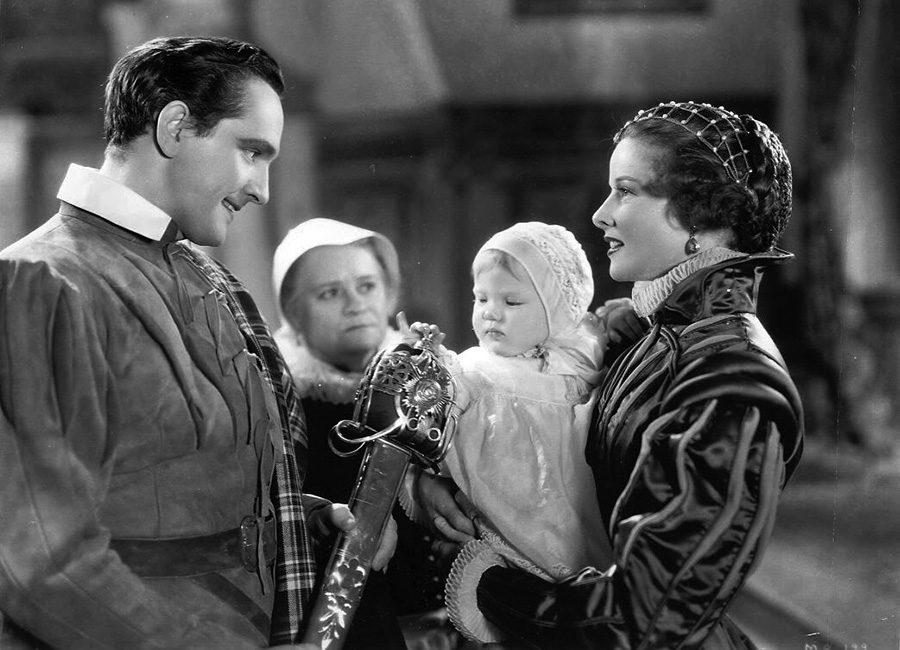
* P-Day, May 4, 1938—Harry Brandt, the President of the Independent Theater Owners Association, took out an ad in The Hollywood Reporter bemoaning box office results vs. studio expenditures on salaries for stars who didn’t draw big crowds. While Hepburn was mentioned along with Garbo, Dietrich and Crawford, the actual ‘drawn line’, as it were, was “Dietrich, too, is poison at the box office.” One of those on the diss list, Mae West, responded with “Why, the independent theater owners call me 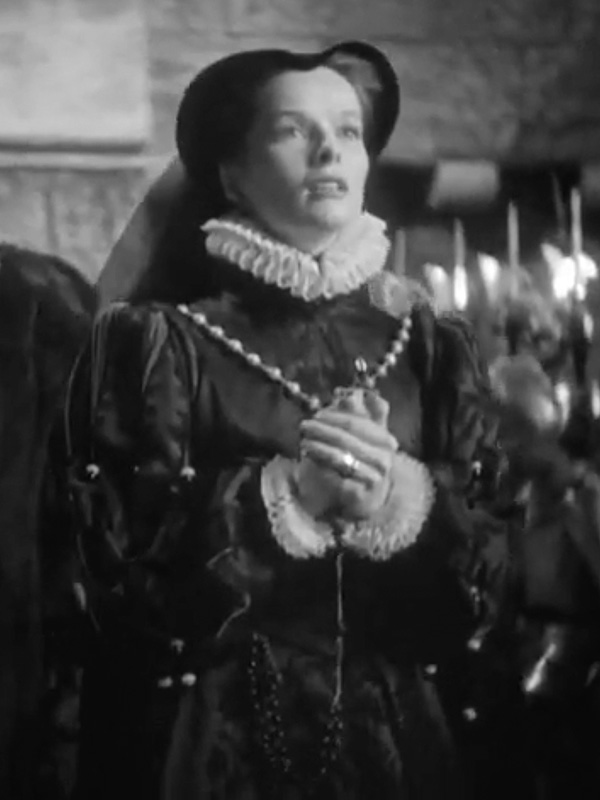 the mortgage-lifter..When business is bad they just re-run one of my pictures…The box-office business in the entire industry has dropped off 30%…The only picture to make real money was Snow White and the Seven Dwarfs, and that would have made twice as much if they’d had me play Snow White.”
** Having written, moves on—Dudley Nichols (1895-1960) had scripted five Ford films (Pilgrimage, The Lost Patrol, Judge Priest, The Informer—getting an Oscar—and Steamboat Round The Bend) and would continue with their collaboration on The Plough And The Stars, The Hurricane, Stagecoach, The Long Voyage Home, The Battle Of Midway and The Fugitive.
Ford had better luck that year with another historical piece about someone getting the shaft, The Prisoner Of Shark Island and March did well in the underrated WW1 drama The Road To Glory as well as headlining one of the heftiest hits of 1936, Anthony Adverse. Kate didn’t feel the love from her other entry A Woman Rebels, surrendering into 136th place.
Florence Eldridge (1901-1988) acted in 17 films between 1923 and 1960, seven with March, including Les Miserables, Christopher Columbus and Inherit The Wind.
*** Royal flush—thirty-two years later, Hepburn, then 60, suited up for another hassled highness in The Lion In Winter, ruling an Oscar as Eleanor of Aquitaine, 10th & 11th great-grandmother of Elizabeth and Mary. Ignored by the Academy for the 1936 roll call, we’d put Kate in over the now-dismissed Best Actress winner (Luise Rainer in the dreary The Great Ziegfeld) and nominee Norma Shearer, 33 playing 13 (thirteen? c’mon, Irving) in Romeo And Juliet. Forsueth me!