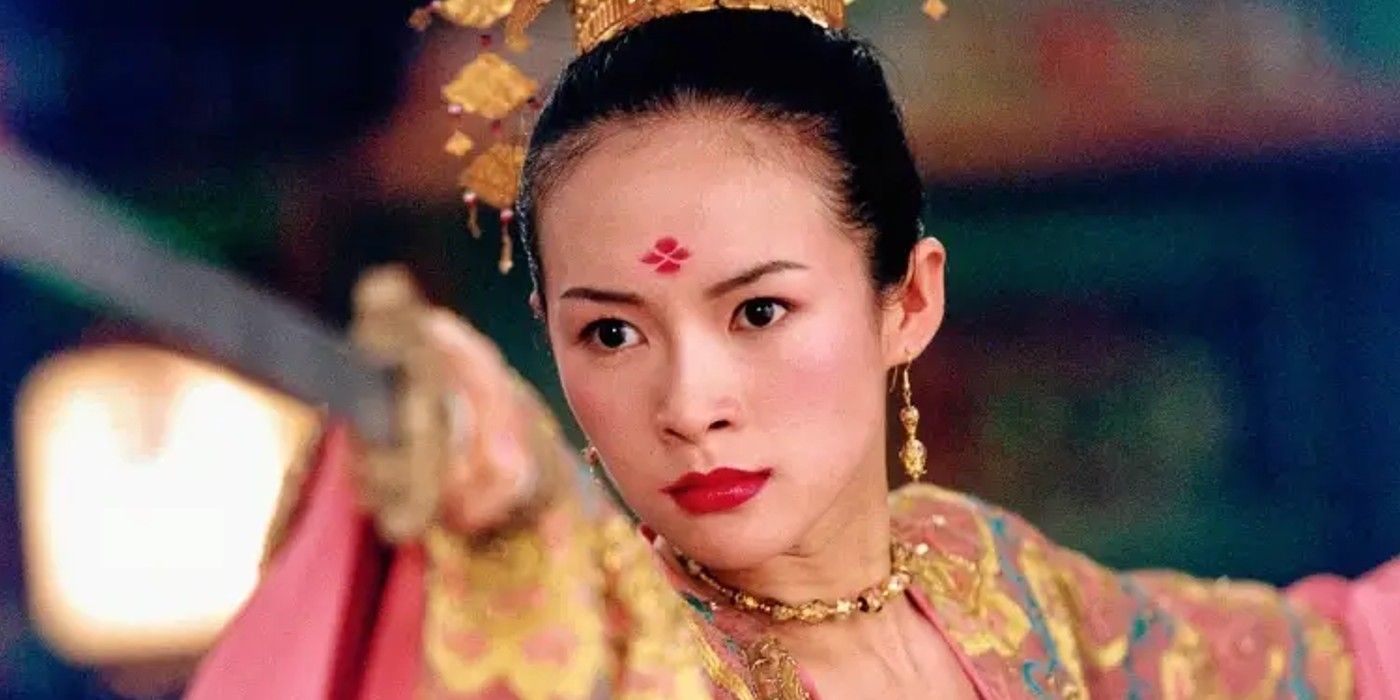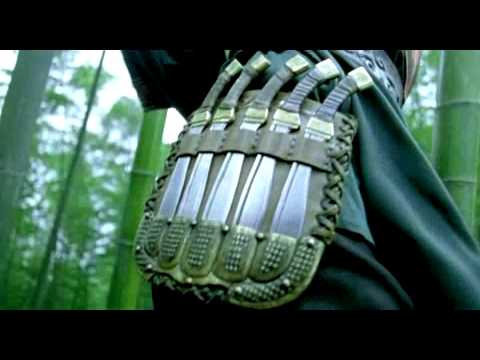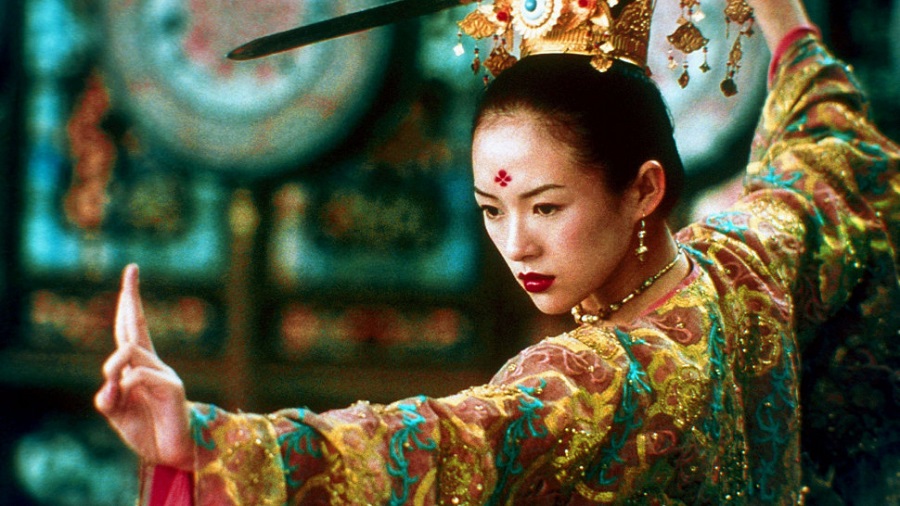
HOUSE OF FLYING DAGGERS—China in the year 859. With the Tang dynasty in decline, a leader among the rebel groups battling government corruption is the ‘House of Flying Daggers’, martial arts masters admired by the poor, feared by the powerful. Ordered to kill the new leader of the group, intense police captain ‘Liu’ (Andy Lau) directs captain ‘Jin’ (Takeshi Kaneshiro), expert archer and confident playboy, to infiltrate the Flying Daggers, using as pawn a young woman they remove from a brothel, believing she is the daughter of the deceased head of the House. ‘Mei’ (Zhang Ziyi) is a demure beauty, but her delicacy contrasts with her superlative fighting skills and sensory perceptions. She also happens to be blind. Fending off teams of attackers as they journey into the countryside, Jin’s and Mei’s feelings for each other transform. Duty passes thru deception and discovery to destiny. Add airborne knives.
“Do not pull this dagger out. I’m sending you back to keep spying for us. You will be more convincing with a dagger in your back.”
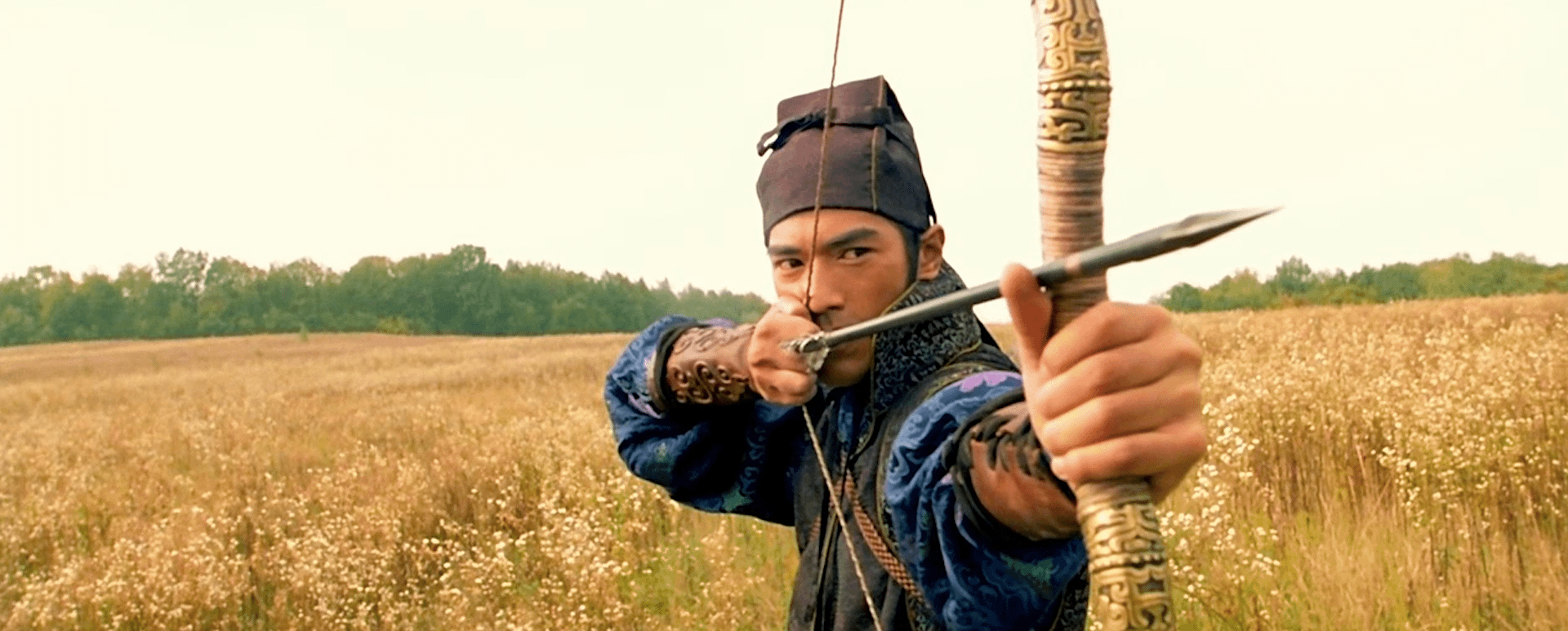
After Ang Lee’s Crouching Tiger, Hidden Dragon leapt into 2000 and took martial arts stories beyond kick-fests into epic territory, director Zhang Yimou delivered a trio of wuxia stunners, with this 2004 period adventure preceded by Hero (2002) and followed by Curse Of The Golden Flower in 2006. Zhang not only directed but co-wrote the screenplay with Feng Li and Bin Wang and co-produced the show for $12,000,000.
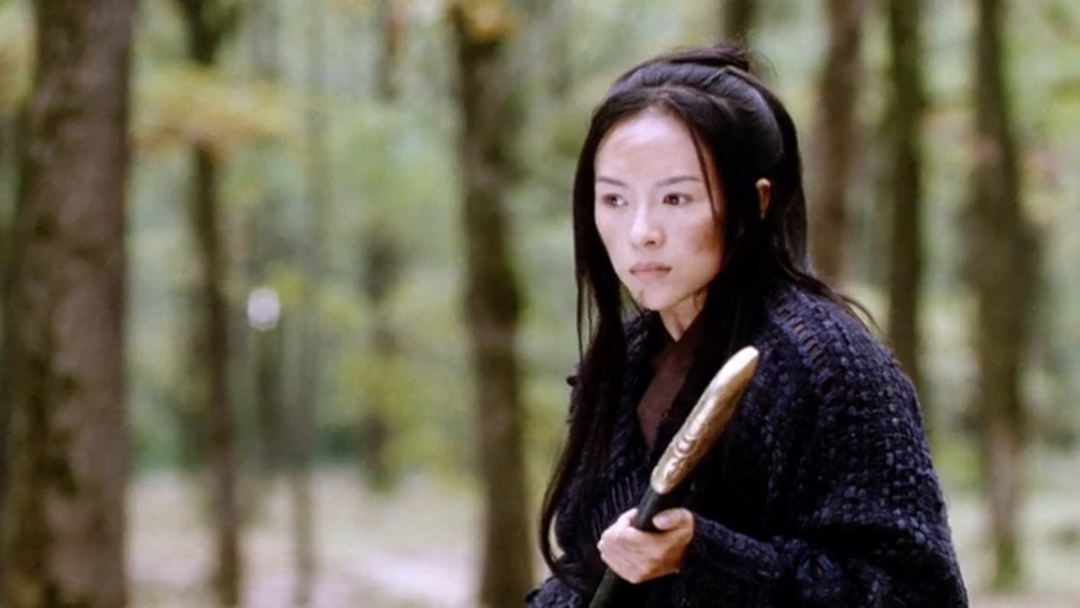
It was only partially shot in China, with most of the filming taking place in Hutsulshchyna National Nature Park, located in Ukraine’s section of the Carpathian Mountains. Instead of drug gangs and undercover cops punching each other across urban docks and warehouses, audiences could partake in culture-mining of wistful quasi-history, adding romance and nobility to the more base reason for watching a martial arts flick: armchair catharsis in seeing good-looking, cool-costumed heroes & heroines wiping the floor (and forests) with minions of evil, this time in pristine natural backdrops, with violins and oboes on the soundtrack instead of electric guitars.
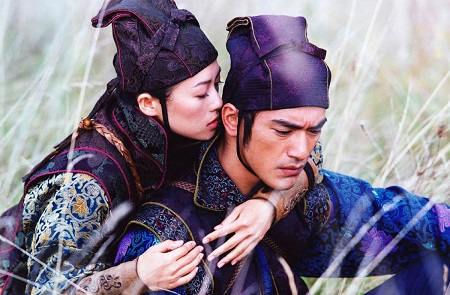
The stellar cinematography from Zhao Xiaoding (Curse Of The Golden Flower, The Great Wall) nabbed an Oscar nomination. What should not only have been nominated (and wasn’t) but deserved to win is the beautiful music score composed by Shigeru Umebayashi.
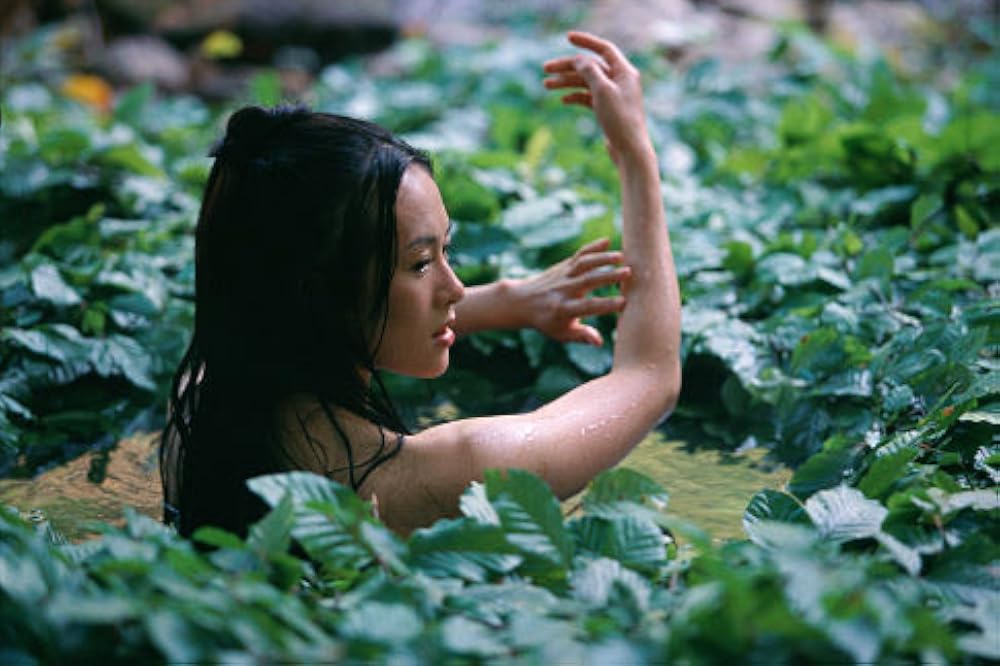
The actors are compelling. In her third film for Yimou (The Road Back, Hero) and after Crouching Tiger, Hidden Dragon, the captivating Ziyi at 24 was now an international star. Multifaceted Lau, 42, had been accumulating hits (in music as well as film) for twenty years. Pop star turned leading man Kaneshiro, 30, had racked a decade of popularity. The operatic action scenes, precise direction and editing, lush costuming, gorgeous camerawork, moving soundtrack and striking settings are seamless. The only weak component is the script, which keeps all the splendor moored in comic book territory. Dismiss its simplicity, the clumsiness of most of the dialogue and the pesky issue in films like this of accepting the corporeally impossible movements and just relax into the sensory stimuli and storybook make-believe.
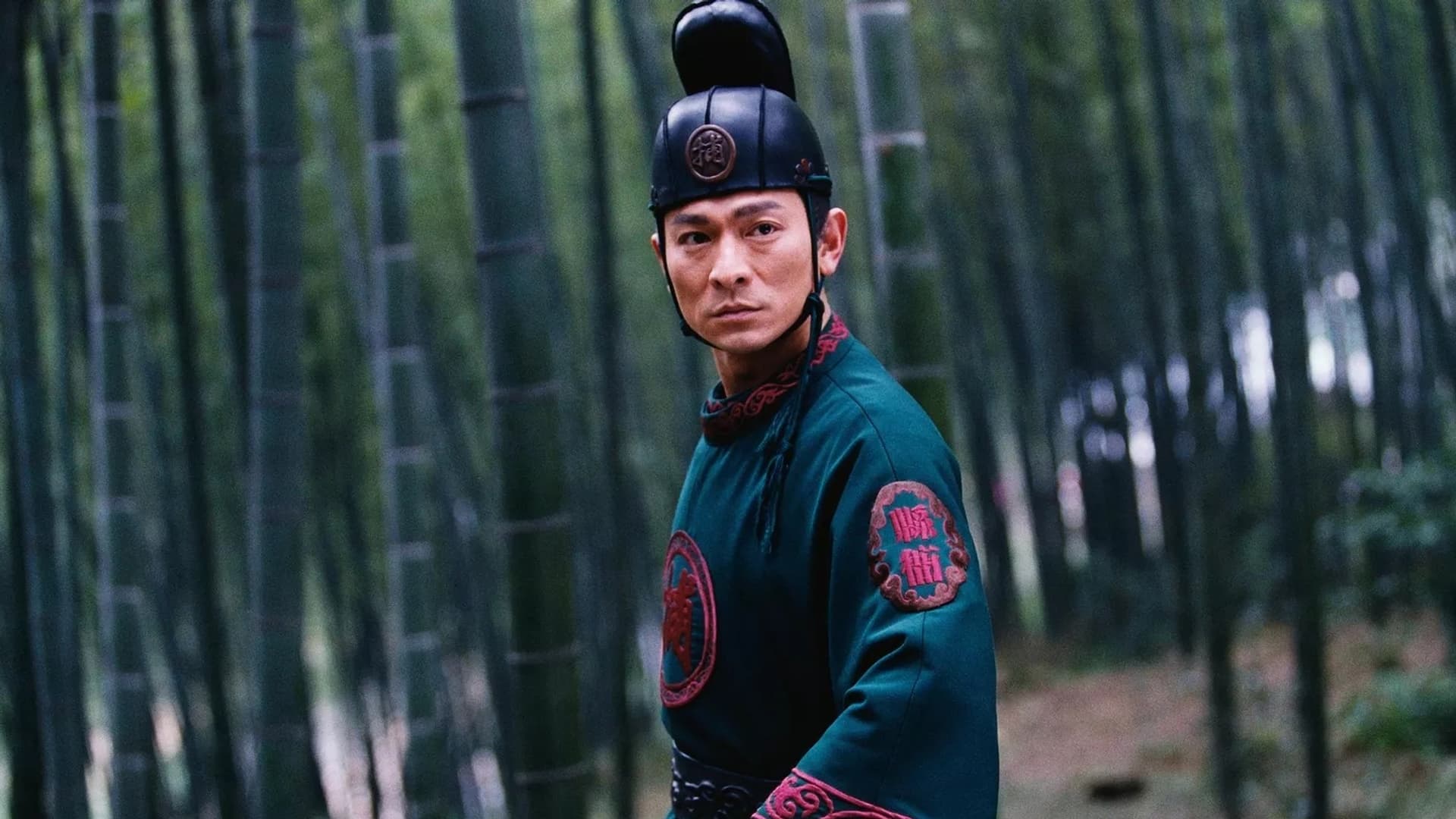
“I sacrificed three years for you. How could you love him after only three days?”
Public homage in North America tallied $11,050,094, with at least 50% more in home sales. The US/Canada take was part of the global gross of $92,801,097. 119 minutes, also featuring Song Dandan.