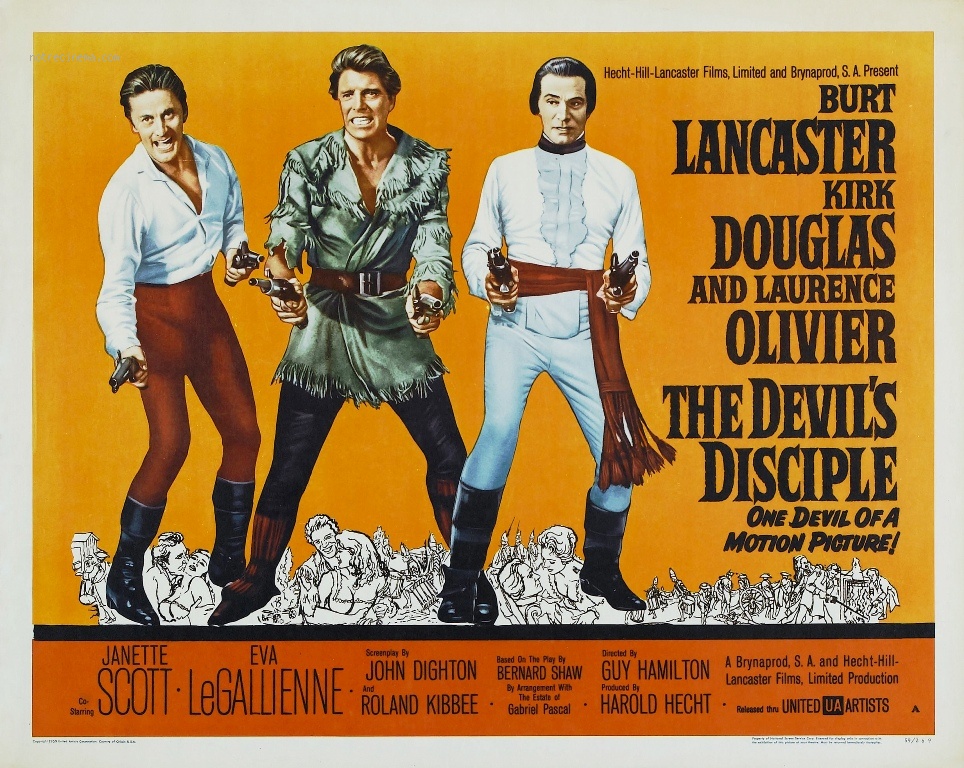
Wildly misleading poster art
THE DEVIL’S DISCIPLE shows his true colors during the third year of America’s struggle for independence from Great Britain. The New Hampshire town of Websterbridge is a fateful collision point for three distinct men and their opposing duties, missions and manners. When British troops hang an innocent man as a rebel, local minister ‘Anthony Anderson’ (Burt Lancaster) offers solace to the family (the hamlet is divided between those loyal to King George III and those aiming to fight him) while ‘Dick Dudgeon’ (Kirk Douglas), the deceased’s rascal son, raises ire and eyebrows when his pa’s will leaves everything to him, an outcast lecher. The redcoat grenadiers are under the command of General John Burgoyne (Laurence Olivier), sent to the region to join forces with General Howe and pincer crush the rabble. Level-headed Anderson’s reticence to get involved is tested. Dudgeon’s reputation as a scoundrel is challenged. Burgoyne’s patience is tried, as much thru the bumbling of his own men as by harassment from the colonials. Adding to the—cough, revolting—mix, Anderson’s sensually latent wife ‘Judith ‘(Janette Scott) finds herself shamefully attracted to the lusty Dick, who may be a smirking dastard but at least is more exciting than the bedroom-bashful reverend.
MAJOR SWINDON: “What will history say, sir?” GENERAL BURGOYNE: “History sir, will tell lies, as usual!”

The piece made its bow in 1897 as the eighth of 54 plays written by George Bernard Shaw, and was his first financial hit. Film rights were secured in 1938 by his friend, producer Gabriel Pascal, and while they enjoyed mixed luck with other Shaw works (Pygmalion, Major Barbara, Caesar And Cleopatra), after Pascal’s passing, his estate sold the piece to Burt’s production company, Hecht-Hill-Lancaster. The resulting 1959 film version, co-produced by Kirk’s production company, Bryna, paired the two stars for the third time, joined by Olivier, the trio a seeming lock for box office appeal. Behind-the-scenes it was a clash of intentions, styles and egos. No-one seemed to take into account that, with one notable exception (Drums Along The Mohawk), going back to the Silent Era movies about the colonial days and the Revolutionary War were rare for a reason: they just didn’t pull in the public. And this one had self-inflicted wounds to start with. *

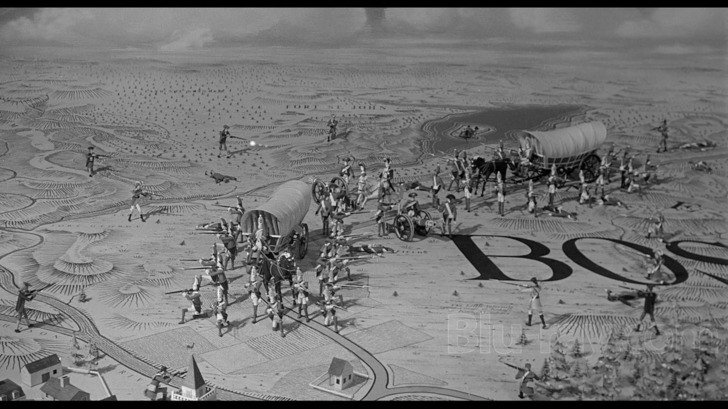
Shaw’s dramedy was a satire on social hypocrisy, military and religious dogma and how appearances or the perception of them can disguise character and hamstring truth. His skewering approach to cut & lied history lays down a satiric template from the opening narration, done to a scene that views a map from above as it’s being marched over by animated toy soldiers: “The year 1777 was one in which the passions roused by the breaking off the American colonies from England, more by their own weight than their own will, boiled up to shooting point. The shooting being idealized by minds in England as the suppression of rebellion. And in the colonies, as the defense of liberty. Both sides being therefore convinced that the most high-minded course for them to pursue was to kill as many of one another as possible.”
On a decade-long run of hits (and a few worthy misses) Lancaster & Co. opted for a slice of highbrow prestige via Shaw and Olivier, and got underway with a script from Roland Kibbee (Burt winners The Crimson Pirate and Vera Cruz) and direction by Alexander Mackendrick (Whisky Galore!, The Ladykillers) who had worked/dealt with HHL on Sweet Smell Of Success. The literally stage-bound source material would be opened up (exteriors, action scenes) to give it some cinematic air. Olivier, 51, signed on not just for a chance to gnaw a delicious piece of Shaw but in the hopes of getting Hecht-Hill-Lancaster to finance his hoped-for version of Macbeth, plus he needed money to cover his divorce from Vivien Leigh. Douglas was all-in for Lord Larry because he wanted him for his upcoming epic Spartacus. Mackendrick had the script redone by John Dighton (Kind Hearts And Coronets, Roman Holiday) and then his painstaking (as in slow) pace provoked Burt & Kirk boot him after a few weeks, replaced by faster-moving rising light Guy Hamilton (The Colditz Story, Manuela). With a budget of just $1,500,000, they opted to save by shooting in black & white rather than color and filming in England rather than the States. Morose over losing Leigh, and not keen on taking orders, Olivier was not a happy general, later sniping about Lancaster and Douglas “I didn’t care to be taught acting by those two.” Directing them all was a tightrope walk for Hamilton, who later said “The terrifying thing was that I found it so easy to be a ‘traffic cop’ with no ‘gut’ in the project. I’d never done it before and won’t do it again. All you can do is follow the blueprint.” Thus with two rebellious Yanks at the reins and a touchy all-Brit crew, it ironically mirrored the fraternal quarrel that it was set in.
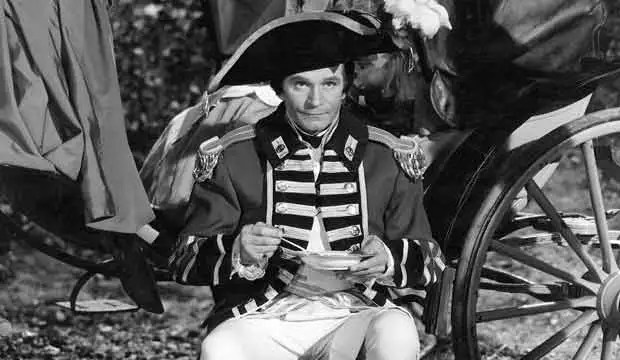
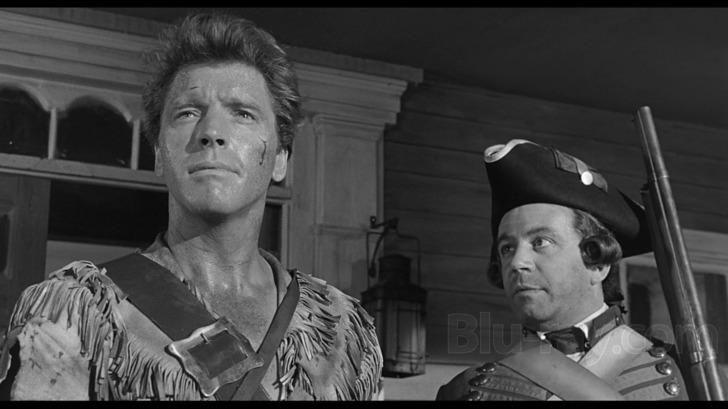
Even with an ace cameraman like Jack Hildyard on tap, the black & white palette not only doesn’t take advantage of the English rural locations around Hertfordshire but serves to highlight the chintzy sets. Tone wobble is present, the variation between poking fun and keeping enough drama on hand to care about anyone swings back & forth, collapsing in the finish with Burt’s preacher-turned-battler pulling one-man-army nonsense (“Minute Man!”) after being somnolent for most of the show. Douglas is lively from the onset—a bit overmuch; Kirk could sell intensity but roguish charm was not his strong suit. Olivier’s bemused sniping is a walk in the park; Burgoyne gets the best lines. All three are watchable but you don’t feel much; it’s actors professionally reciting lines (precisely sculpted) rather than believable characters speaking their truth. At 19, Janette Scott was popular in Britain—she’d been acting since she was four, debuting in Went The Day Well?, a 1942 smite-the-Jerries rouser. She was knocked for her performance here—a shrill too far—and the bland results of the high-profile project failed to further her international chances (though at least she decorated The Day Of The Triffids and Crack In The World) and she left feature films at 29, after something called Bikini Paradise: did anyone ever see that other than the people that made it?

Critics generally applauded Olivier and shrugged over the rest. The grosses came to $3,900,000, ranking a disappointing #68 for the year, which also saw John Paul Jones, in color and costlier, noisily take sail and then promptly roll over and nosedive to Davy Jones locker.
A clutch of familiar faces are bewigged in support: Harry Andrews, Basil Sydney, George Rose, Allan Cuthbertson, Neil McCallum, Eva Le Gallienne, Mervyn Johns, Erik Chitty, Percy Herbert and Steven Berkoff. Peter Leeds spoke the narration. 83 minutes.
* Funny clothes and too many speeches?—while westerns were always popular (vast landscapes, action, law ‘n’ order, leggy dance hall dames), historical movies set back East in “the early olden days” were few in number, even though the American Revolution and its bloody prequel & sequel (the French and Indian War and the War of 1812) were cataclysmic events stuffed with colorful characters and cinema-baiting battles. The  pre-sound days offered a smattering, the best known coming in 1924, D.W. Griffith’s epic America and William Randolph Hearst’s grandiose Janice Meredith. Sound and color on the scene, John Ford’s classic Drums Along The Mohawk did well in 1939. Then The Howards Of Virginia bombed out in 1940, even with Cary Grant on our side. In 1955 The Scarlet Coat failed to button up costs.
As a lad in the waning Ike Age/New Frontierland of JFK, aside from being taught the tune “Yankee Doodle”, the American Revolution came via Walt Disney (we’re not saying this as a slam) thru the youth-oriented Johnny Tremain (1957) and most memorably on Walt’s eight-episode TV fave The Swamp Fox, spread over 1959-61. We doff a tricorn hat to Disney’s stand-alone identifiable musket noises. One of the first playsets I had (after Marx’s must-have ‘Fort Apache’) was bought off an ad on the back page of comic books, little plastic figures about as substantial as a Sugar Frosted Flake: even as a pre-allowance tyke I recognized a ripoff (a decade before the word hit town).
Late model recruits include Revolution, a wet powder misfire in 1985, The Patriot in 2000 (sumptuous look, big battles, atrocious history) and Young Washington, limping into (pre-revolution?) 2026—the Magafried preview was enough to make me want to re-emigrate to Liverpool.
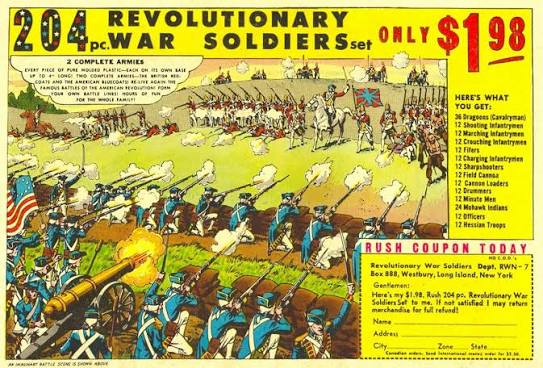
Click to enlarge for clarity: learn something old


Great review, well written and nice insight into the production.
cheers, Michael R – Filmycks.com (fellow CMBA member)