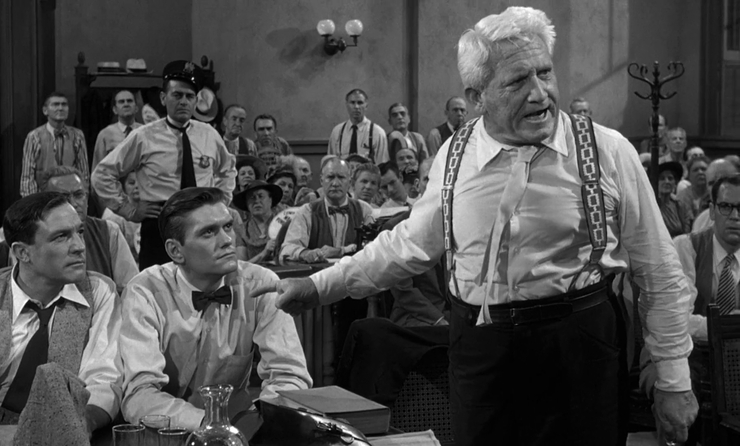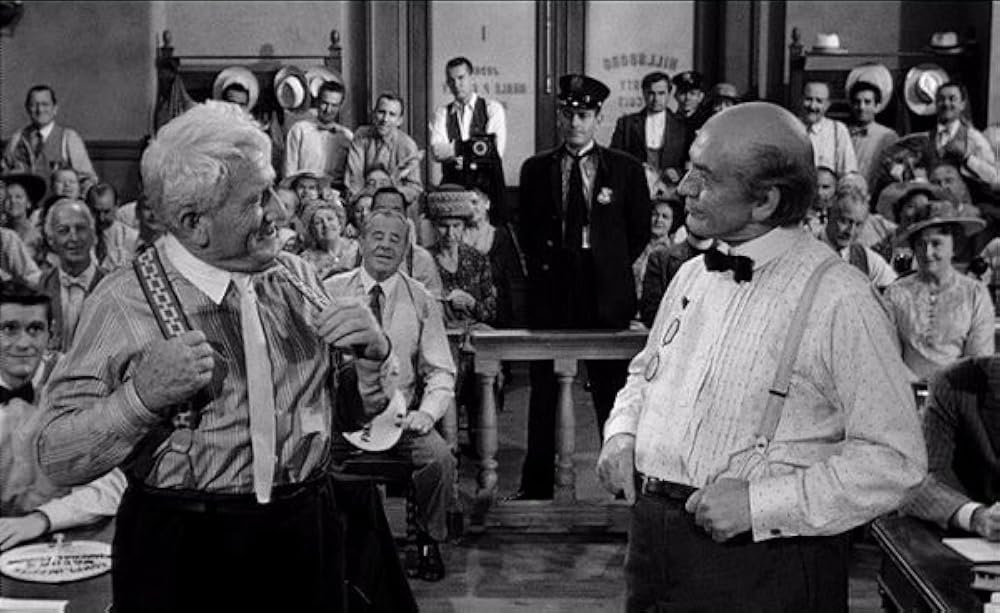
INHERIT THE WIND takes its title from the Old Testament’s Book of Proverbs, chapter 11, verse 29: “He that troubleth his own house shall inherit the wind.” A poetic way of saying that honest inquiry can ask for trouble if those questioned are unwilling to listen, disturbed by ideas to the point where they will shut down or stamp out their discussion. Right-wing stifling of creative expression (especially political and social alternatives) scoured the US from 1947 until the early Sixties. Smart writers and filmmakers found ways to critique the repression obliquely (and hire blacklisted writers under pseudonyms). Using an earlier instance of ignorance trumping intelligence, Jerome Lawrence and Robert Edwin Lee wrote a 1950 play about a furor from the 1920’s; opening in 1955, it ran 806 performances on Broadway. Five years later Nedrick Young and Harold Jacob Smith adapted it for the screen. Splendidly cast, tautly directed by Stanley Kramer, the powerhouse acting in the 1960 film not only hasn’t dimmed, it burns brighter than ever. With virulent strains of illogic, fear and hate fraying the USA (ironically and blatantly using scientific advances and wizard technology to bed down with gospel-warping religious intolerance) the mid-20th Century material feels prescient and timely in the trembling 21st. *
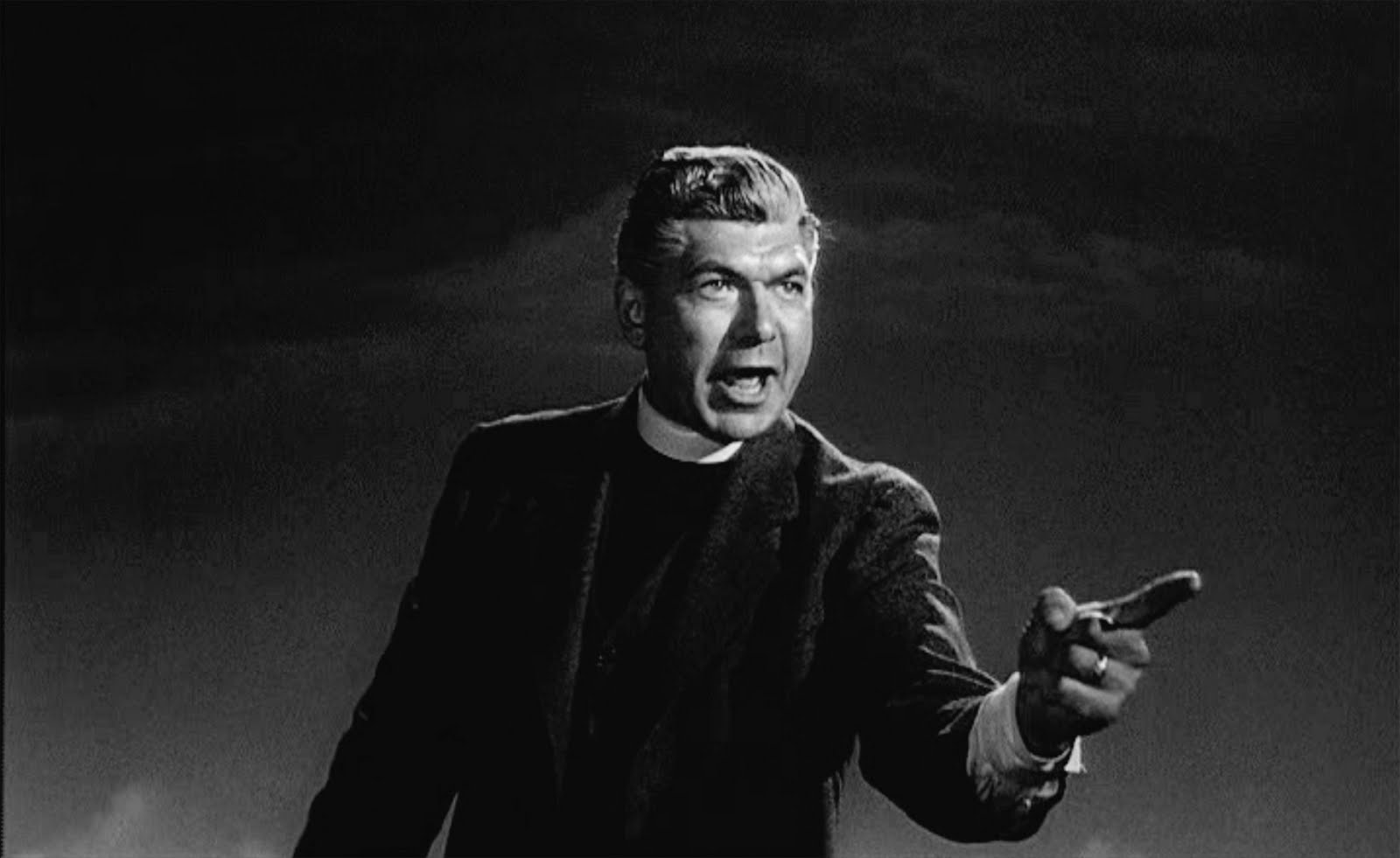
Akins afire with heaven-sent hell
“The Bible is a book. It’s a good book, but it is not the only book.”
Taking acceptable liberties, the play/script is a fictionalization of the world-publicized “Scopes Monkey Trial” in 1925. Held in the small Tennessee town of Dayton, young high school teacher John Scopes was on trial for teaching Darwin’s theory of evolution. Legendary 3-time Presidential candidate William Jennings Bryan, 65, took the State’s side. Famed defense attorney Clarence Darrow, 68, fought for Scopes. With journalist H.L Mencken, 44, among those covering the trial, millions listened in on the first legal tussle ever covered by the still-fresh gizmo called radio.
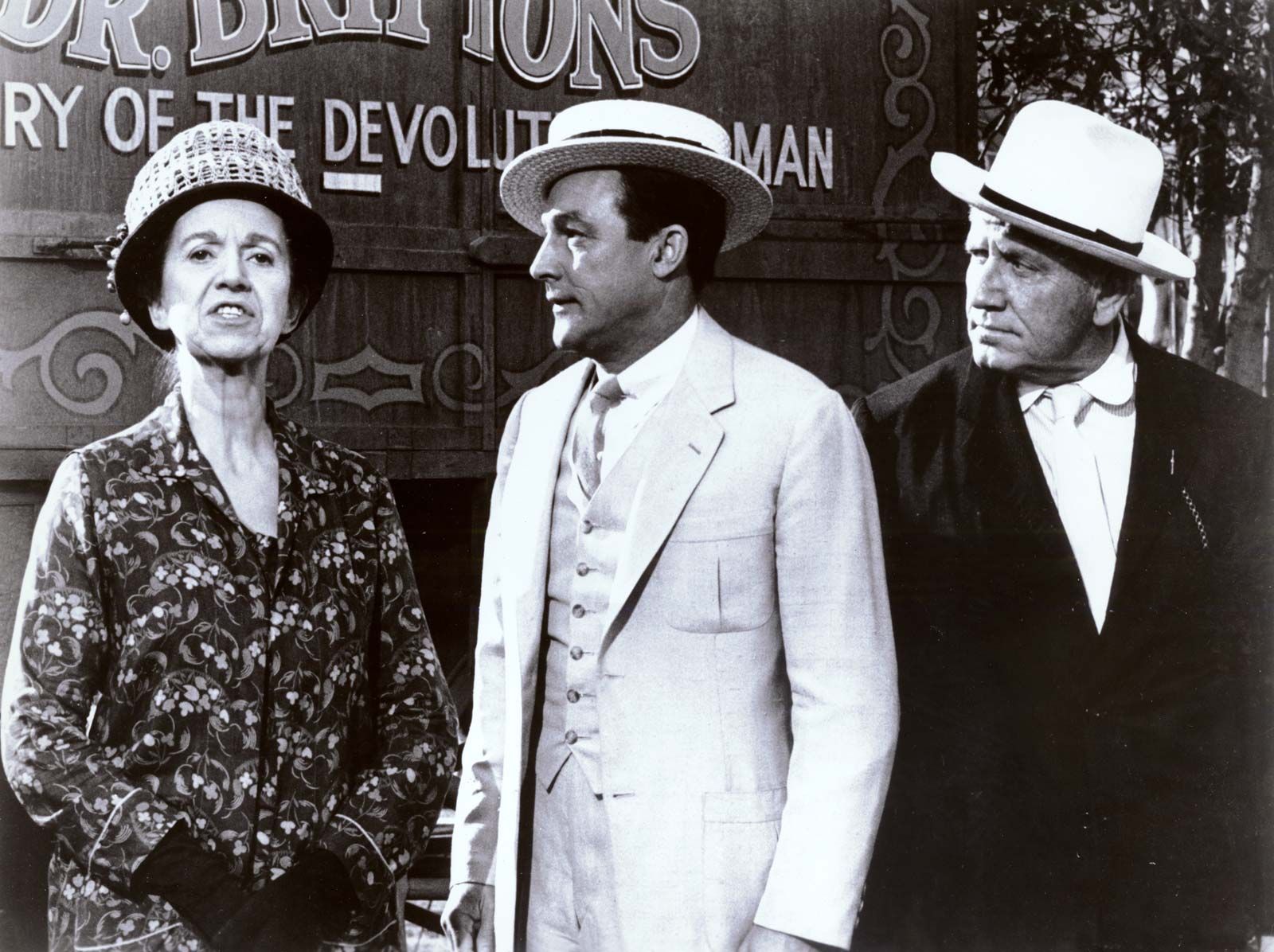
Hope Summers, 1902-1979, home-schooling city slickers on the old-time theory of attack as a defense. Darwinian?
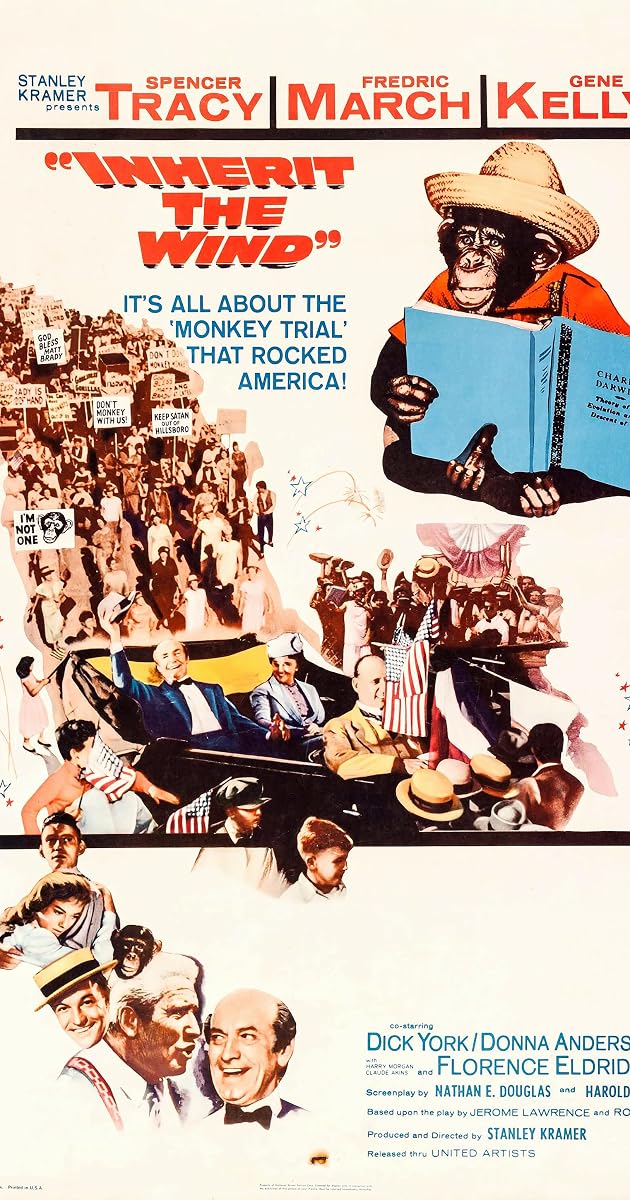
Dayton becomes ‘Hillsboro’. Spencer Tracy, 59, is ‘Henry Drummond’ aka Darrow. Fredric March, 61, is ‘Matthew Brady’ aka Bryan. Gene Kelly, 46, is ‘E.K. Hornbeck’ aka Mencken. Dick York, 30, is ‘Bertram Cates’ aka Scopes. In her last feature film, Florence Eldridge, 58 (and March’s wife), does Brady’s spouse ‘Sarah’ aka Mary Bryan, 64.
Stellar writing, dynamic acting. Tracy came away with an Oscar nomination as Best Actor (7th of nine, two wins) for his beautifully modulated work as the liberal ‘conscience’ of the piece, gentle and respectful but no pushover (attention, spineless pols), unwinding with forceful passion when the moment calls for it. While his whole performance holds his usual gravitas, it was probably the rousing one-take summation speech that nailed his nomination. March didn’t get one, but deserved it; his full-steam-ahead populist charmer is a play-it-big triumph, the finest of his late career work, a proud, unyielding, ultimately pitiful spellbinder who time has caught up with and is passing him by right under his nose. Watching two of the finest actors from the Golden Age go head-to-head is a treasure. Kelly takes his practiced confidence and turns it into sarcastic arrogance as a sort of cynical Greek Chorus to the mob hubbub and clash of beliefs. A welcome and surprise coup comes from Claude Akins, delivering righteous wrath as a hellfire & damnation preacher. At 33, his hair colored to make him appear older, it’s an unsung career highlight; Kramer had previously deployed him to effect in The Caine Mutiny and The Defiant Ones. The always reliable Claude warranted a nomination but was overlooked. Besides Tracy’s, the Academy Awards had nominee spots for Screenplay, Cinematography (Ernest Laszlo) and Film Editing (Frederick Knudston, eight Kramer pix). **
“He’s the only man I know who can strut sitting down.”
Holy warfare was vigorously thumped that year by Elmer Gantry, and trials tasking intolerance were held in the okay Sergeant Rutledge, the very good The Trials Of Oscar Wilde and the terrific La Vérité. Gantry was a very popular ticket churner (#15), the others didn’t draw well, and despite strong reviews and the eventual Oscar buzz Inherit The Wind (which premiered in Dayton!) only stirred 71st place. With a production cost of $2,000,000, the $3,500,000 gross had United Artists mark a loss of $1,700,000. Maybe they should’ve had the pastor of a mega-church do the books.
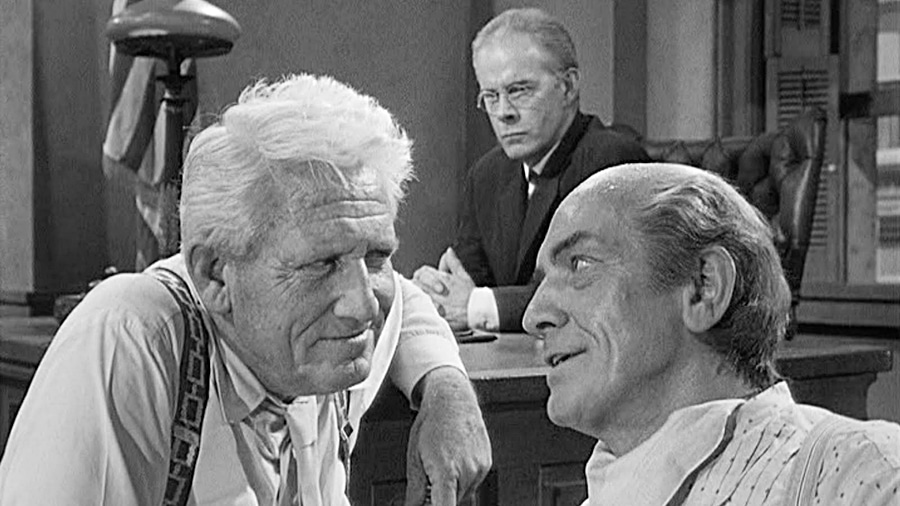
CATES: “They look at me as if I was a murderer.” DRUMMOND: “In a way you are. You killed one of their fairy tale notions.”
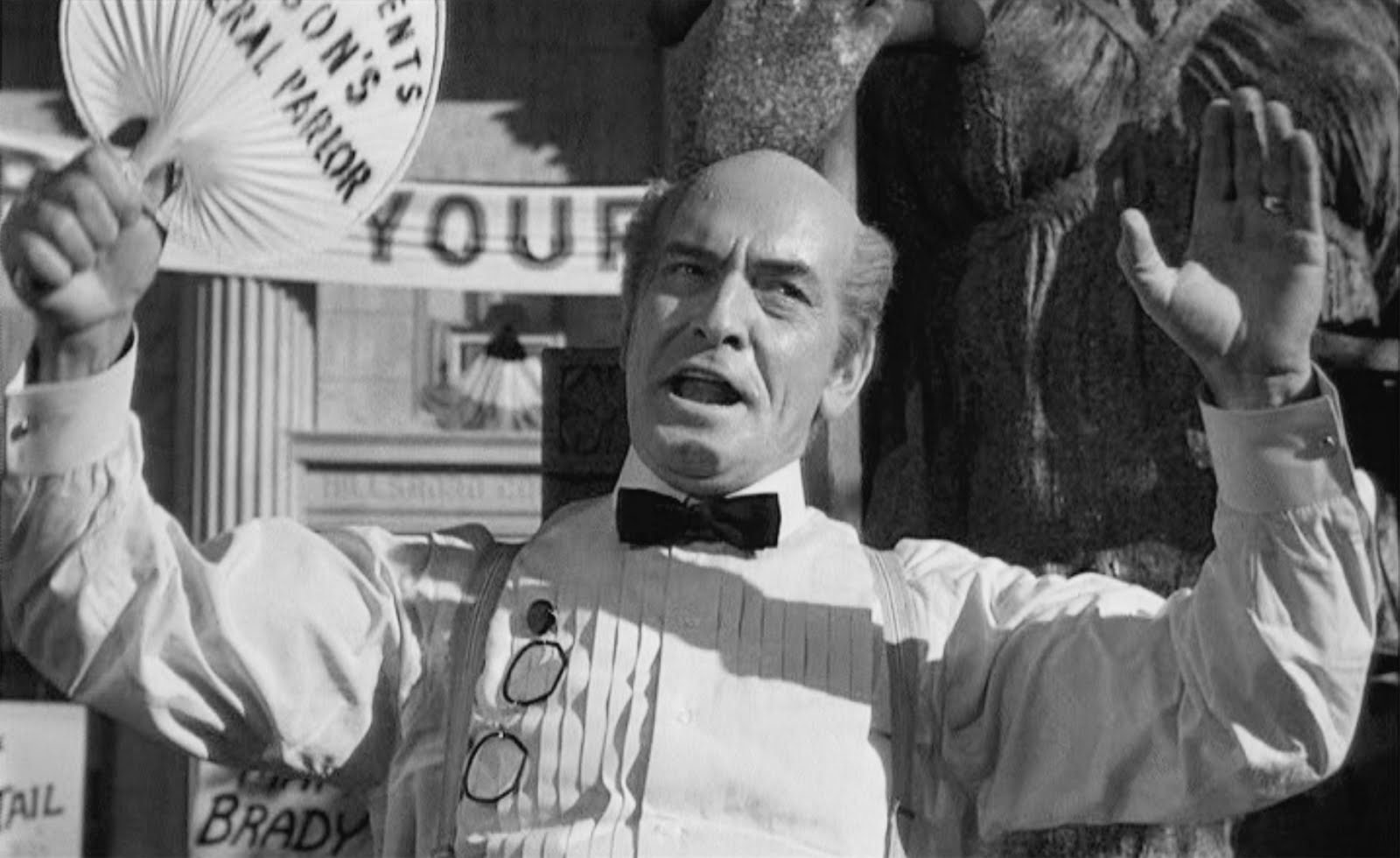
128 minutes, with Donna Anderson (just okay, as Cates fiancee, a fictional entry), Harry Morgan (the patience-tried judge, based on John T. Raulston, who in reality was partisan to the prosecution), Elliott Reid, Paul Hartman, Philip Coolidge, Jimmy Boyd, Ray Teal (in good form as a puffed-up yokel blowhard), Noah Beery Jr. (a decent farmer, to show they weren’t all clods), Hope Summers (sparky as an eager smiter of the unholy) Earle Hodgins (a delightful bit as a hawker with a trained monkey–“Quit lookin’ at me, will ya, son“), George Dunn, ever able Will Wright (with 240 credits) and Norman Fell. Leslie Uggams, 16, made her film debut, not acting, but singing “Old-Time Religion” over the title credits and closing the show with “Battle Hymn Of The Republic.” ***
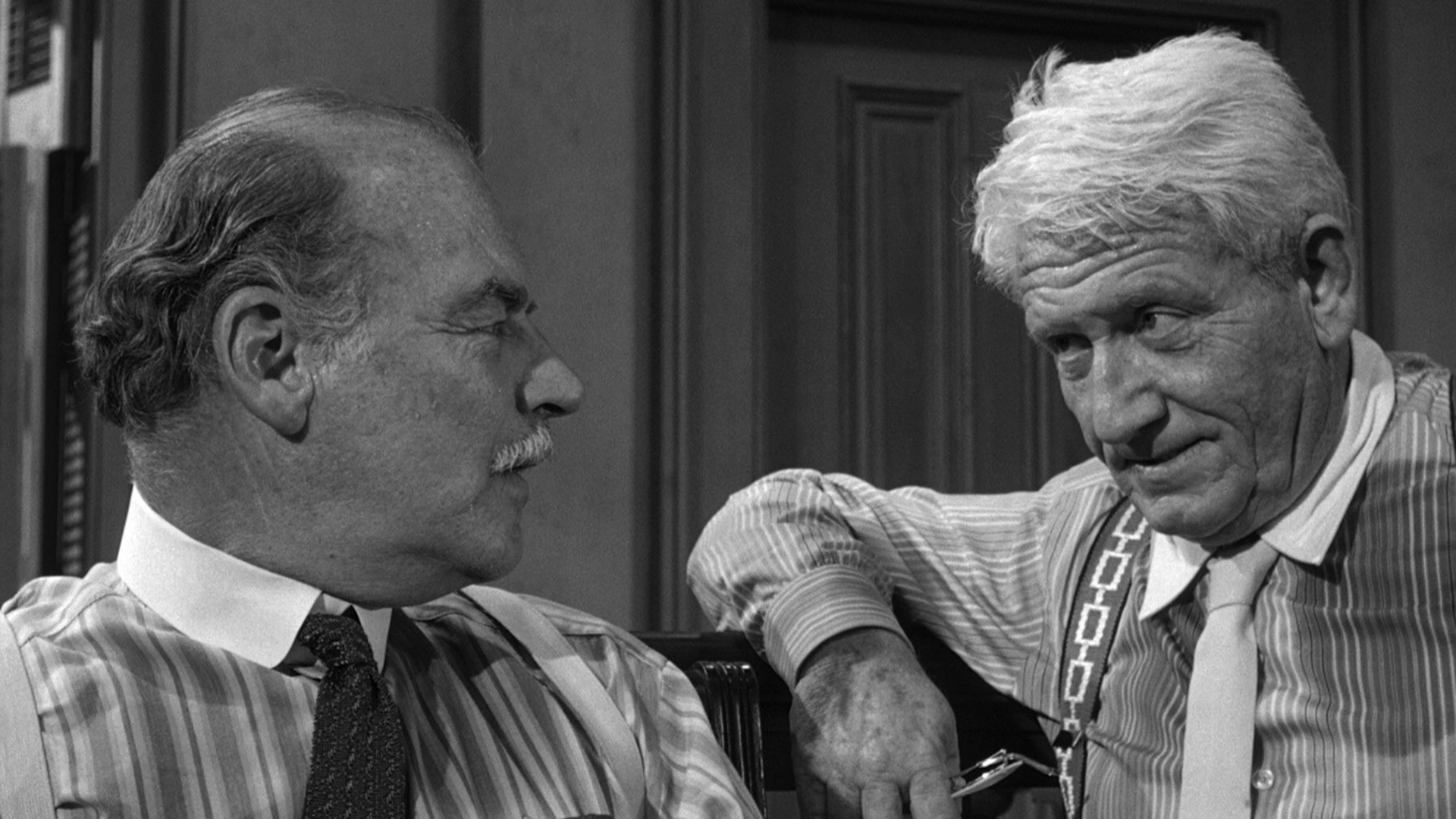
Ray holds his own against Spence, no mean feat
* Judge not—blacklisted at the time, Nedrick Douglas wrote under the pseudonym Nathan E. Douglas. He and co-scenarist Smith had worked for Kramer on The Defiant Ones, netting an Oscar for it. Kramer produced as well as directed Inherit The Wind, and had secured the rights back in 1956 for a whopping two hundred grand ($2,247,000 in 2026).
 ** Schomskers—while no-one was going to beat Burt Lancaster for Elmer Gantry and Peter Ustinov in Spartacus, from from our side of the juris-pew-dence we think March and Akins deserved to be in the ballot box. Were this heathen among the select selectors I would’ve dropped Laurence Olivier’s mincy The Entertainer for March’s dynamic blusterbuss and pulled Jack Kruschen’s gimme-a-cliche supporting bid from The Apartment and swapped in holy roller Akins. Kramer was so impressed by Tracy that he replied on him as the granite bedrock to hold steady Judgment At Nuremberg, It’s A Mad, Mad, Mad, Mad World and Guess Who’s Coming To Dinner.
*** The defense calls— three TV flick versions came about: 1965 (Melvyn Douglas, Ed Begley, Murray Hamilton), 1988 (Jason Robards, Kirk Douglas, Darren McGavin, Jean Simmons), 1999 (Jack Lemmon, George C. Scott, Beau Bridges).
Acquittals and convictions—after this York left feature films for TV, notably five seasons on Bewitched. Donna Anderson, 20, a Kramer find from On The Beach, didn’t click, her career soon faded. Married for 48 years until his death in 1975, Eldridge and March had acted together on film in Les Misérables (1935), Another Part Of The Forest (1948), An Act Of Murder (1948) and Christopher Columbus (1949).
Statute of limitations—playwright Lawrence: “we used the teaching of evolution as a parable, a metaphor for any kind of mind control … It’s not about science versus religion. It’s about the right to think.” Roger Ebert in 2016: “a film that rebukes the past when it might also have feared the future. Beliefs that seemed like ancient history to Kramer have had a surprising resiliency…There is hardly a politician in the land with courage enough to state that they are wrong.”
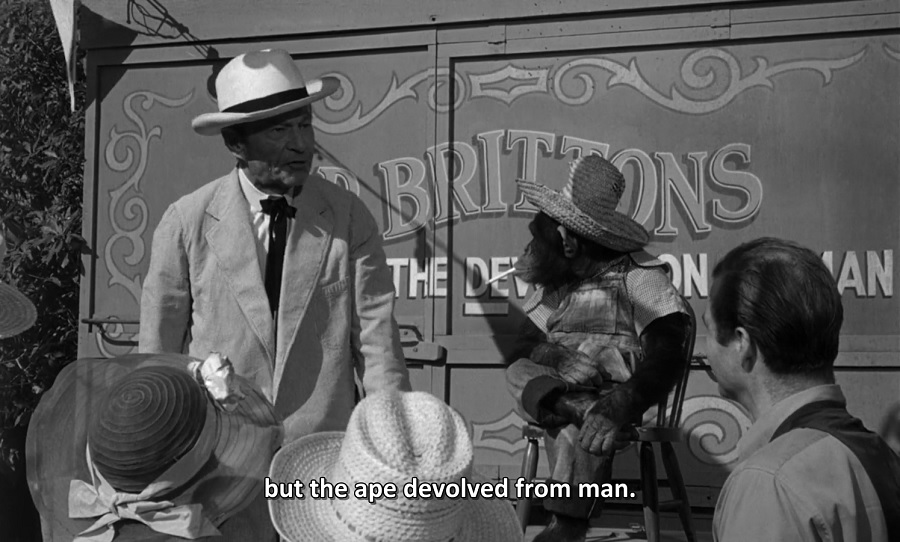
Earle Hodgins and kin talking to distant cousins. Earle, 1893-1964, logged 358 credits.
“Can’t you understand? That if you take a law like evolution and you make it a crime to teach it in the public schools, tomorrow you can make it a crime to teach it in the private schools? And you may make it a crime to read about it. And soon you may ban books and newspapers. And then you may turn Catholic against Protestant, and Protestant against Protestant, and try to foist your own religion upon the mind of man. If you can do one, you can do the other. Because fanaticism and ignorance is forever busy, and needs feeding. And soon, your Honor, with banners flying and with drums beating we’ll be marching backward, BACKWARD, through the glorious ages of that Sixteenth Century when bigots burned the man who dared bring enlightenment and intelligence to the human mind!”