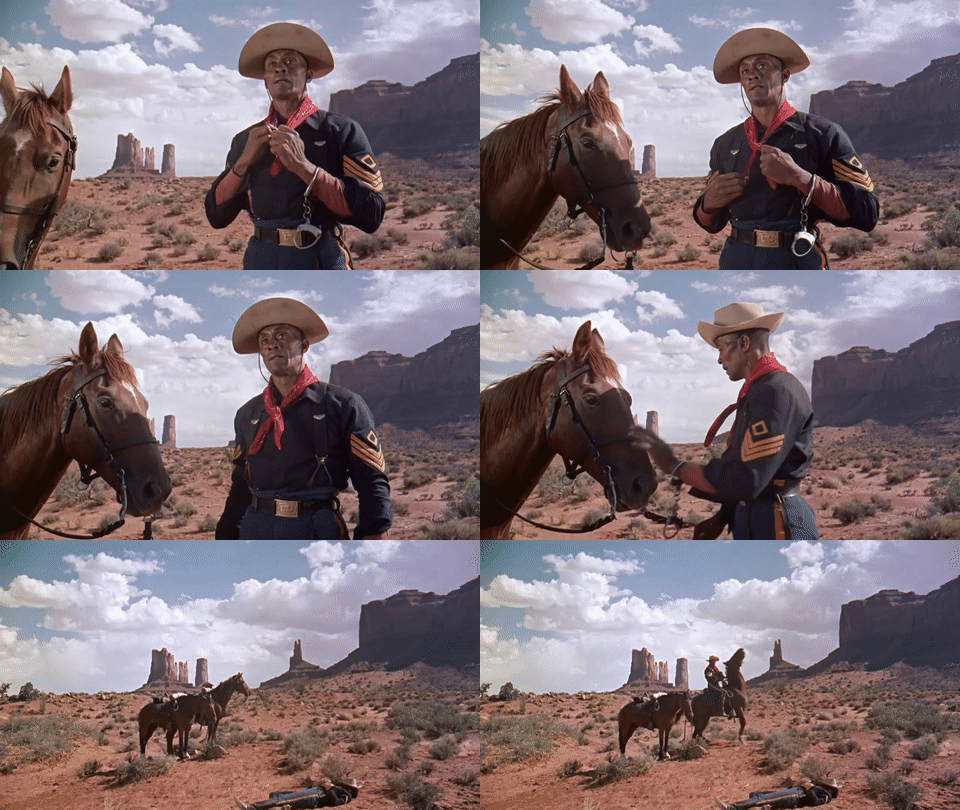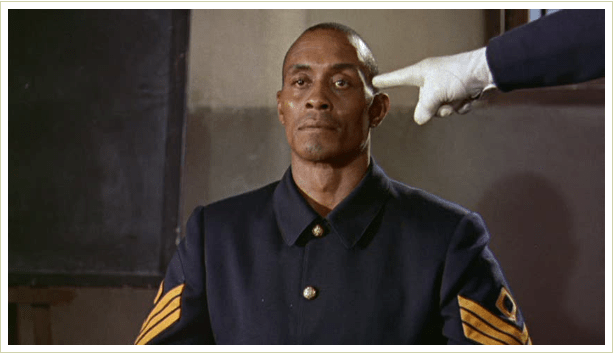
SERGEANT RUTLEDGE didn’t get much more than a half-hearted salute from the public, let alone a promotion to a higher rank, from ‘superior’s (i.e. critics) when it came out in 1960. That was partly because it was an unexciting effort from John Ford, who had noticeably lost steam in his last several films but also because, even with the imprimatur of Ford’s stature, it was lost in the wake of the year’s bigger, more publicized westerns—The Alamo, Cimarron, The Unforgiven, The Magnificent Seven and Flaming Star. Today it’s given more due, not because it’s a great movie—it’s merely okay—but because it did its part in helping to move the country’s racial attitudes out of the bigoted past (into ‘The New Frontier’, as it were), and most noticeably because it gave the commanding presence known as Woody Strode the biggest role of his career, a performance topped by the best single piece of dramatic acting he’d ever deliver. *
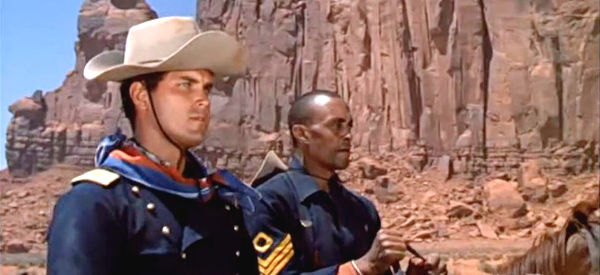
1881, Arizona Territory. A valued 1st Sergeant in the 9th U.S. Cavalry (a “colored” regiment, with white officers), ‘Braxton Rutledge'(Strode, 45) is facing a court martial, accused of the rape & murder of a white girl and the murder of her father, his commanding officer. ‘Lieutenant Tom Cantrell’ (Jeffrey Hunter) is assigned to defend Rutledge, a lopsided task not helped by incriminating circumstantial evidence, the relentless, often vicious efforts of the prosecution and overall ingrained community racism. The heroism displayed by Rutledge in fights against Apache raiders only counts for so much.
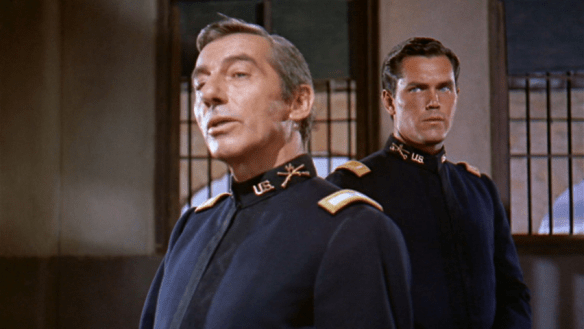
Hunter, also on tap that year in Hell To Eternity and Key Witness, pulls his third and final assignment for Ford, having found the crusty director’s favor with The Searchers and The Last Hurrah. Back from Southern belle duty in The Horse Soldiers, Constance Towers, 26, gets the female lead, with veteran Billie Burke, 66 in her final role, on hand as a scandalized biddy. There’s a good deal of overly broad acting from some of Ford’s stock company stalwarts (Willis Bouchey and Carleton Young) and some pitiful dialogue mangling from several of the younger players.
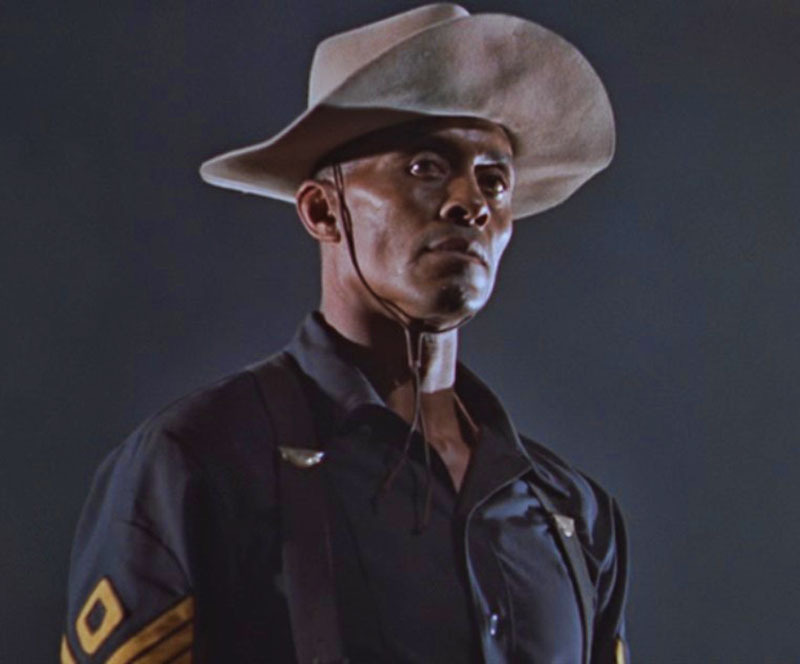
Though 4th-billed, Strode has the de facto lead. His chiseled-from-a-mountain face and physique were key to his visceral appeal; as an actor he was limited, but he brought his A-game to the role and Ford—they became close friends—helped him craft a powerful performance; his defiant declaration of manhood/plea for decency on the witness stand is bracing. Strode called this “the truest moment I ever had on a screen.”
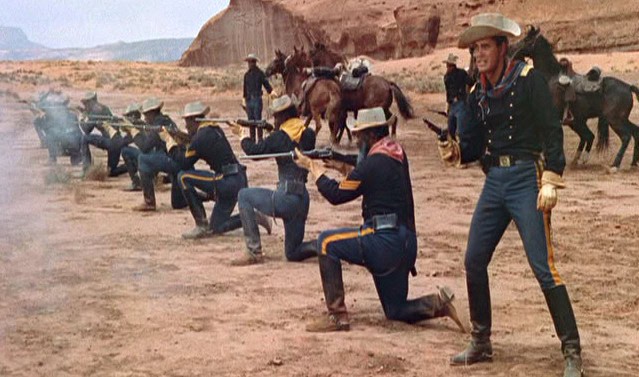
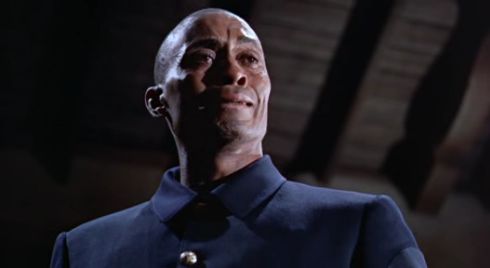 The screenplay from James Warner Bellah and Willis Goldbeck (with definite input from Ford) deserves credit not just for bringing to screen the historical presence of the African-American soldiers who served with distinction in the West (and beyond) but for tangling with the miscegenation fear that permeated the national fabric from way back and still held sway in many parts of the country as it entered the promise of the 1960’s. The framework (courtroom theatrics, flashbacks to factor in some needed action scenes, the romantic angle dross with Hunter & Tower) is unwieldy. Scenery is provided by Monument Valley, naturally, because it’s a Ford western. **
Secondary ‘Buffalo soldiers’ are played by Juano Hernandez (63, excellent as ever) and ex-Olympian Rafer Johnson (25, great athlete, acting…uh, great athlete) and Ford fills the supporting pool with stock company familiars: Judson Pratt, Chuck Hayward, Shug Fisher, Hank Worden, Charles Seel, Jack Pennick, Mae Marsh, Chuck Roberson.
The 111 minutes start out with a boisterous title tune, “Captain Buffalo”, whipped up by Mack David and Jerry Livingstone. Box office in the States was a dreary $784,000, but foreign grosses added another $1,700,000.
* While Strode’s agonized courtroom outburst is powerfully affecting, he drew a lot more attention in another part that year, striking as the impassive yet intimidating gladiator ‘Draba’ in Spartacus, the year’s second most-attended movie (Sergeant Rutledge was 96th). He was also impressive in the disaster opus The Last Voyage. Ford used him three more times (Two Rode Together, The Man Who Shot Liberty Valance and 7 Women). Ironically Strode’s big break came six years later in another western, The Professionals, when in 1966 everybody else seemed to catch on to how cool the guy was. Some of us knew that way back when.
Movie lore always mentions Ford’s “cavalry trilogy” (1948’s Fort Apache, She Wore A Yellow Ribbon in 1949 and Rio Grande in 1950) but you could actually up that to six, with 1959’s The Horse Soldiers, then Sergeant Rutledge and finally Cheyenne Autumn in 1964. “Bugler, sound recall”—he also had the “bluecoats” briefly figure into Stagecoach (Old School saving the day) and The Searchers (not coming off nobly there, wiping out an entire village).