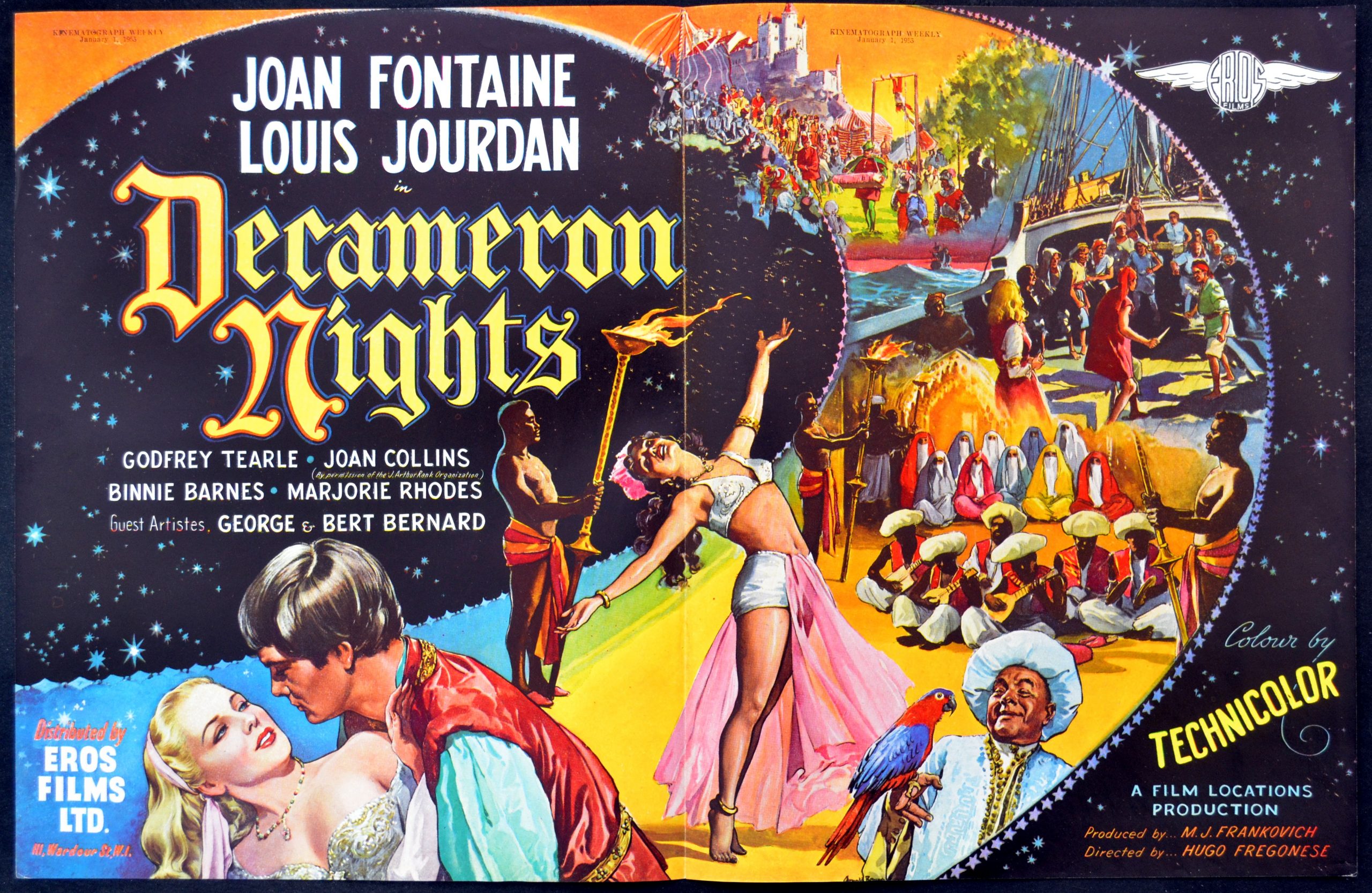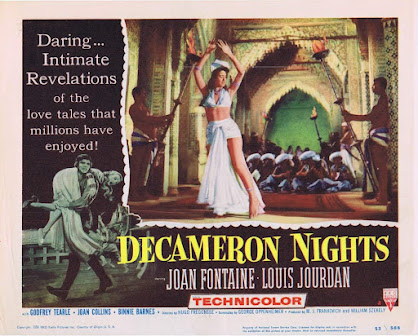
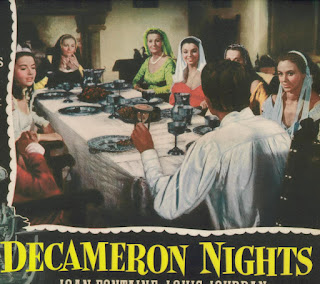
DECAMERON NIGHTS, a British-American co-production from 1953, is a triptych of three humorous tales adapted from Giovanni Boccaccio’s collection of 100 short stories in his medieval opus “The Decameron”. Hugo Fregonese directed on location in Spain and Italy, with the lead roles taken by Joan Fontaine and Louis Jourdan. They’d been paired to acclaim in 1948s classic drama Letter From An Unknown Woman; here their sexual fencing is playful, backed up with a crew of mostly English supporting actors, including 19-year-old beauty Joan Collins. *
“A devil, that’s what he is, a Spanish devil. He’s trying to rob me of my daughter, my poor innocent child. What does he know of love? He’s broken the hearts of half the girls in Florence, and now he’s starting on the second half.”
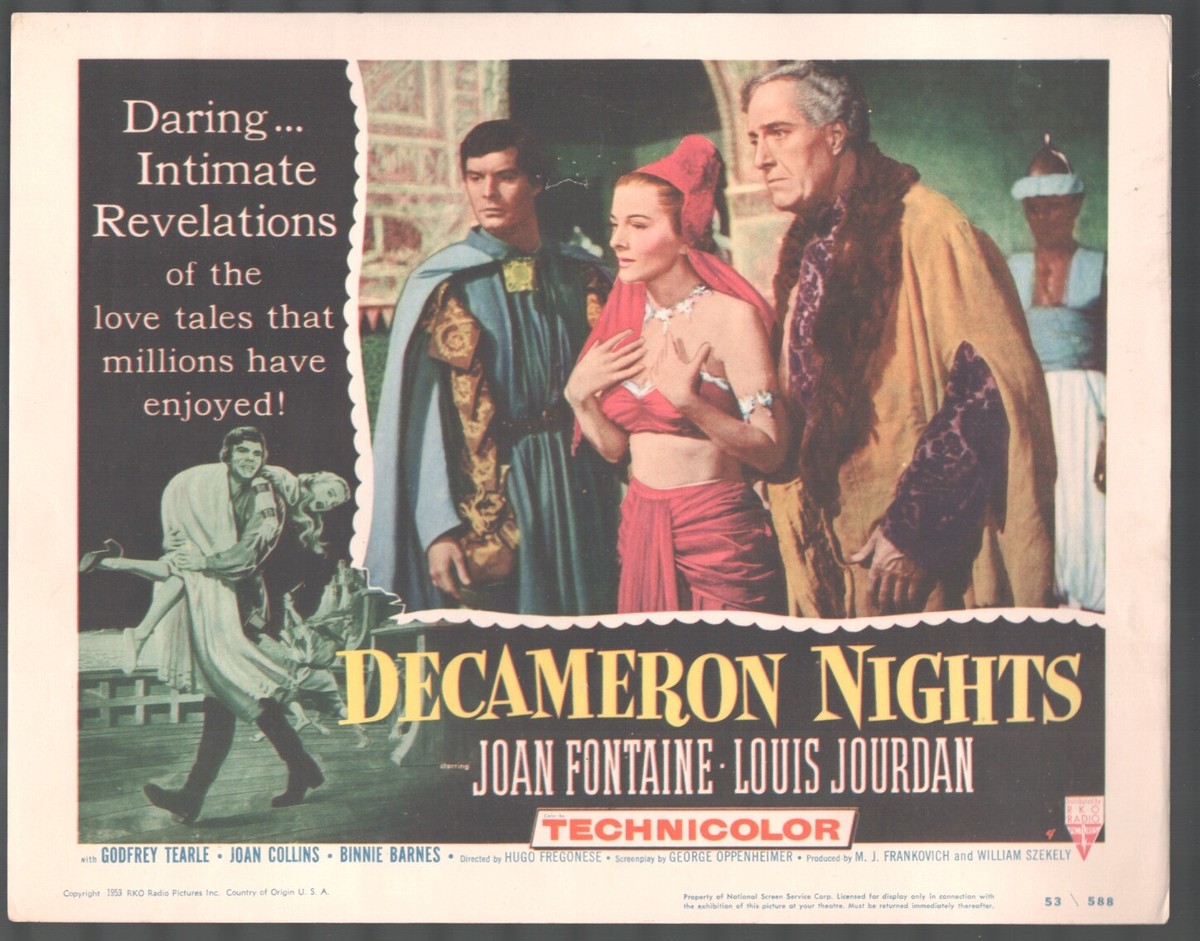
The screenplay by George Oppenheimer has story-spinning rake Boccaccio (Jourdan) ducking out from plague & siege ravaged Florence by taking sanctuary in a rural villa filled with women, overseen by cautious, man-skeptical ‘Fiametta’ (Fontaine) and ‘Contessa de Firenze’ (Binnie Barnes), her more acerbic friend. Marking time while making it, the disarming visitor (who desires Fiametta) and sly host (who has her own ideas about how & when to mate) keep themselves amused by exchanging stories. Fontaine, Jourdan and Barnes play three more and different characters in three saucy morality teasers, with Collins and Godfrey Tearle figuring in two.
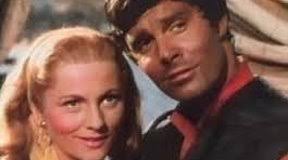
Fontaine, 35, gets to spice it up more than usual—who knew she had such killer gams, was she trying to make sister Olivia de Havilland look frumpy?; Jourdan, 32, is so roguishly handsome it’s essentially unfair; Barnes and Tearle ably serve cattiness and outrage; wide-eyed minxmaid Collins is self-aware & assured at mischief. Antony Hopkins composed a sprightly score, the costumes are colorful, the Technicolor cinematography from Guy Green basks in the Spanish locales (Madrid, Granada, Majorca, Avila, Segovia, Barcelona) and the Italian opener in Florence. The bawdiness of the origin stories is muted due to the restrictions of the 1950’s but enough innuendo still comes thru for the non-uptight to smile over. A pleasant, underrated piece of work.
FIAMETTA: “Must a story be indecent to be entertaining?” CHAMBERMAID: “It often helps.”
Binnie Barnes’ husband Mike Frankovich was the producer. Available figures show a cost of £94,552/$259,145 ($3,118,000 in 2025), which if accurate, is pretty impressive, considering the plush design, shooting in Technicolor at the array of picturesque sites and with the deployment of a horde of period-outfitted extras filling up the background.
The US take of $2,000,000 placed 167th in 1953. It likely did well in Europe; further box office info is lacking. 94 minutes, with Meinhart Maur, Eliot Makeham, Gérard Tichy, Noel Purcell, Hugh Morton and Marjorie Rhodes.
* Fregonese, interviewed at the time of release: “…we take sex and make fun of sex. Everything is done with tongue in cheek and above all, with great charm. The three stories are humorous love stories….Joan Collins, who is in the film and who is under contract to J. Arthur Rank, is a future star in my opinion.” Contrarily, Dame Joan later offered that “Hugo Fregonese was cold and treated us casually”. Que Sera Collins.
“Location, location location!”—Hollywood gone Continental in 1953: Roman Holiday, Paratrooper, Indiscretion Of An American Wife, The Master Of Ballantrae, Beat The Devil, The Sword And The Rose, Rob Roy: The Highland Rogue.
Giovanni Boccaccio, 1313-1375—“The Decameron” has been adapted into theater, novels, poetry, opera, TV and a half-dozen movies.