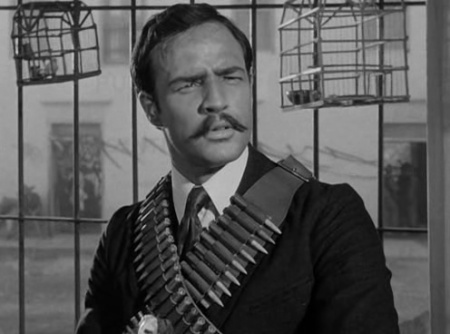
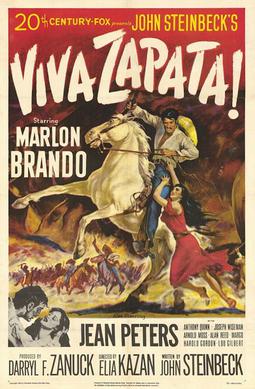
VIVA ZAPATA!—like countless movies based on real people and events, this prestige production from 1952 plays as it wishes with historical facts for the sake of dramatic license and in keeping a complex political-social-military arena and its swirl of conflicting players simple enough to follow in two hours of bio-drama. Huff if you insist over inaccuracies (try telling the truth about your own life) but they don’t spoil the movable feast provided by the passionate acting, literate writing, keenly observant direction and inspired photography, nor do they dampen the opposing yet entwined themes of the dynamics of leadership, the value of myth, how power can corrupt, how corruption draws vultures and why change for the better usually comes from the bottom up. At a cost. *
“Cut off the head of the snake and the body will die.”
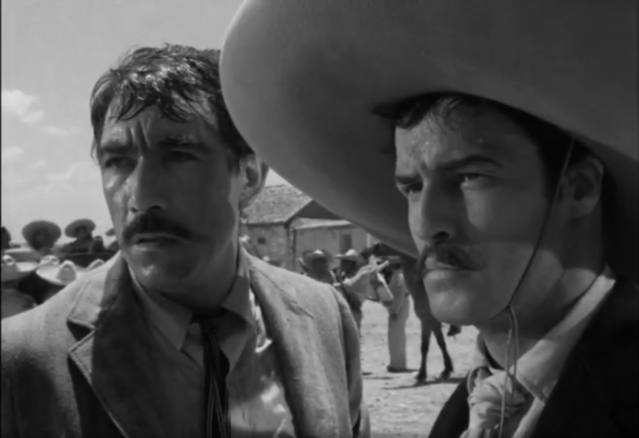
The arena is the Mexican Revolution, a hydra-headed convulsion that took ten years and over two million lives, 15% of the country’s population. Dominated in this telling by farmer-turned-rebel Emiliano Zapata (1879-1919), the power players include dictator Porfirio Diaz, revolutionary politician Francisco Madero, charismatic guerrilla legend Pancho Villa and despotic Federal general Victoriano Huerta. Leadership demands loyalty, corruption attracts vultures, myth inspires allegiance, change risks sacrifice.
“You people want honest politicians. There are none!”
In 1909, outraged by the contempt Presidente Diaz shows peasants whose land has been stolen, Zapata (Marlon Brando) helps lead a revolt that unseats the long-entrenched regime. The replacement government headed by cautious Madero (portrayed as naive) is co-opted by the casually cruel Huerta. Zapata in the south and Villa in the north battle first against Huerta, then his successor Venustiano Carranza. Zapata is aided by his impetuous older brother Eufemio (Anthony Quinn) who eventually proves to be a loose cannon liability. In the midst of the campaigns Emiliano woos and weds Josefa Espejo (Jean Peters), educated daughter of well-off landowners. Their bond is strong as the years pass, but so are the dark and calculating forces who repeatedly seek to undo the Revolution.
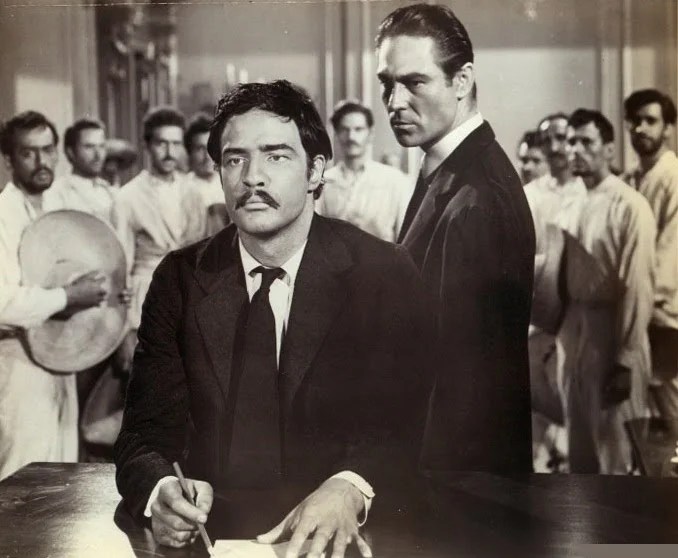
“A monkey in silk is still a monkey.”
Fresh off A Streetcar Named Desire, Elia Kazan directed a screenplay collated by a friend and neighbor—John Steinbeck. Brando, 27 in his third film (following The Men and A Streetcar Named Desire), earned his second Oscar nomination as Best Actor, providing one of his best early career immersions, and also his first as a non-Anglo-American character. He’s honest, instinctive and direct, quietly forceful and other than using subtle makeup, is absent affectation. Quinn, 37, who could give anyone a run for their money insofar as covering nationalities, had appeared in 53 pictures since starting in 1936 (he had three more in ’52, simple actioners The World In His Arms, The Brigand and Against All Flags). His superlative performance as the lusty, ultimately self-destructive brother was the best he’d given to date (with more to come) and gave him an Academy Award as Supporting Actor. Along with Brando’s, nominations went to Steinbeck’s screenplay, Alex North’s score and the Art Direction. One should have gone to the superb black & white cinematography, where per Kazan’s wishes, Joseph MacDonald aimed to replicate the classic still photographs captured by Agustín Casasola. Location shooting was done in Colorado, New Mexico and Texas. **
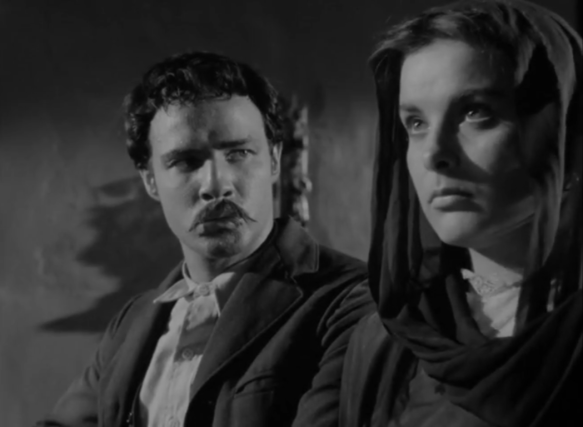
Peters, 25, graced three more pictures that year, Lure Of The Wilderness, O. Henry’s Full House and Wait Till The Sun Shines, Nellie; her warm performance as Josefa is one of her best. The intense Joseph Wiseman, 33, has one of his early–and largest–parts as the fictional ‘Aguirre’, a cold advisor who is dedicated not just to the Revolution, but to revolt itself—the character suggesting a Communist zealot (Russia was ditching the Tsar for Lenin, one overlord for another). Notable figures are exceptionally drawn by Harold Gordon (as Madero), Alan Reed (as Villa, a much tamer version than Wallace Beery’s), Frank Silvera (coolly chilling as Huerta) and Fay Roope (as Diaz).
“This land is yours. You must protect it. It won’t be yours long if you don’t protect it. If necessary with your lives, and your children with their lives. Don’t discount your enemies! They will be back. And if your house is burned, build it again. If your corn is destroyed, replant. If your children die, bear more. If they drive you out of the valley live on the sides of the mountain. But live! You’ve always looked for leaders. Strong men without faults. There aren’t any! They’re only men like yourselves. They change, they desert, they die. There are no leaders but yourselves. A strong people is the only lasting strength!”
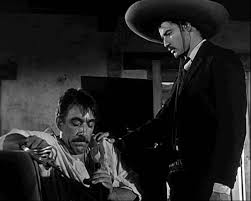
The running time is 113 minutes–adding another ten of fifteen worth of action and/or chronology linking material would have made it even better. Kazan, uncredited, co-wrote the script, and later offered “John thought we should have more narrative in it, but I didn’t like that idea. Its virtue was that it covered a lot of ground in very swift, vivid glimpses. The result was that you sometimes didn’t know where you were or why. We took jumps and left out a lot of intervening history and some people had trouble following the story. Maybe it couldn’t be licked. If I’d solved the problem of historical continuity, the film might’ve been longer and tamer.”
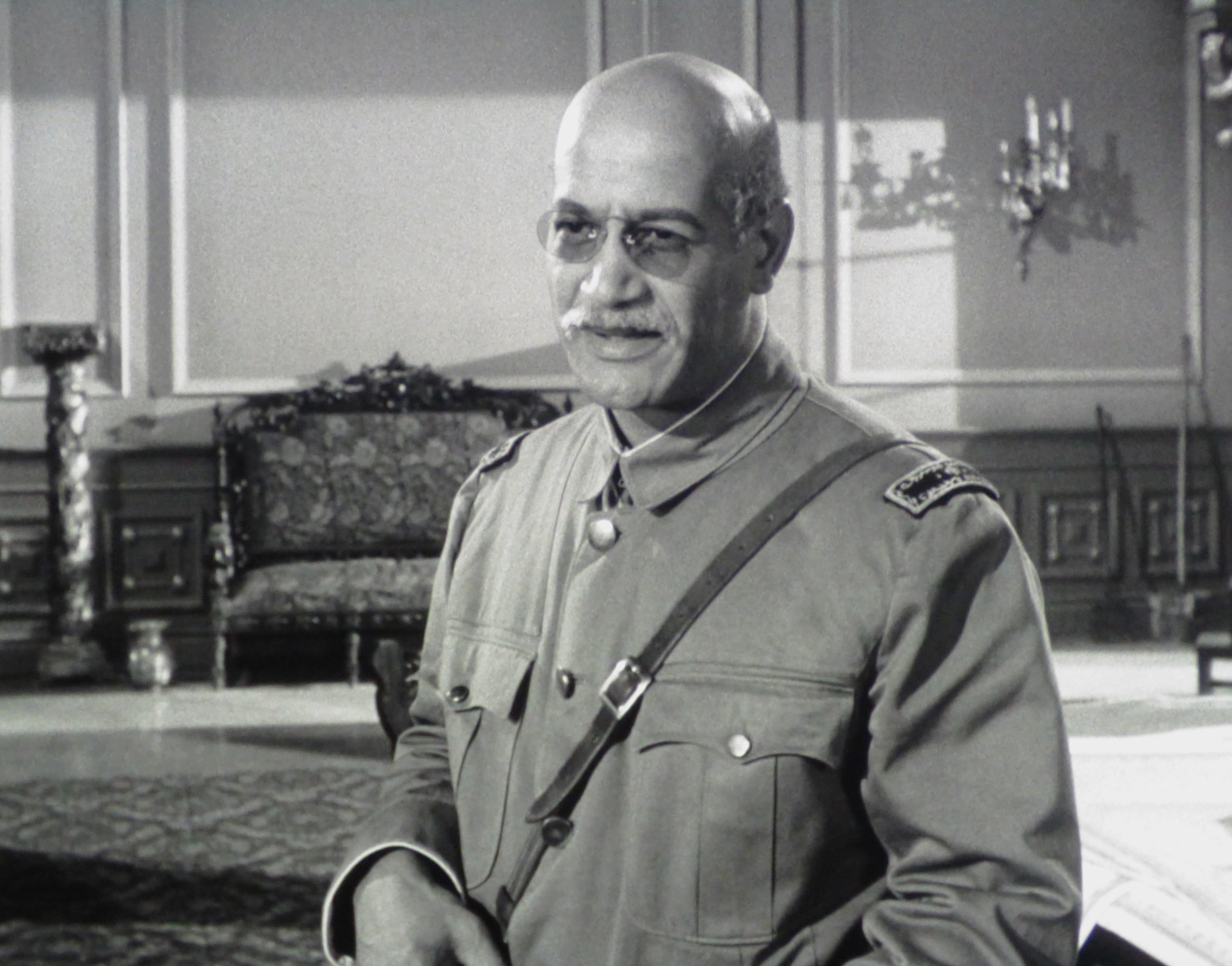
Frank Silvera as the eternally hated Huerta
Though critical praise came, the $1,800,000 production wasn’t big at the boxoffice, the $5,300,000 gross placing 60th. Several of Kazan’s best were not moneymakers—Wild River, America America, A Face In The Crowd, Panic In The Streets.
With Lou Gilbert, Arnold Moss, Margo, Florenz Ames, Mildred Dunnock, Rico Alaniz, Henry Silva (25, first film), Richard Garrick, Nina Varela, Ross Bagdasarian, Abner Biberman, Frank DeKova (the betrayer who calls the final shots), Larry Duran, Will Kuluva, Nestor Paiva, Alex Montoya and Philip Van Zandt.
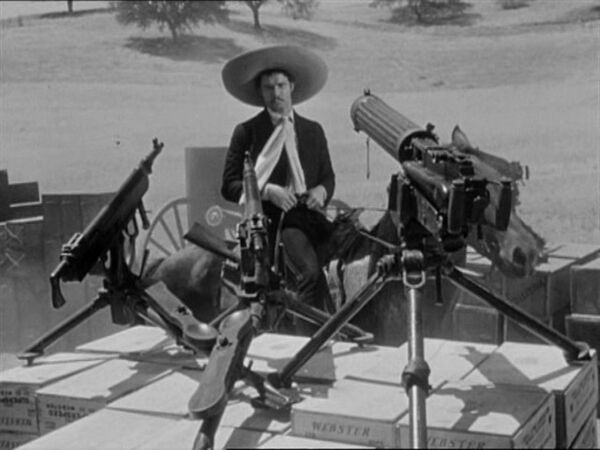
* Slate choices graded on a curve—1952 arrayed fourteen features taken from history flicks, of which eight were biodramas, with John Huston’s superb Toulouse-Lautrec story Moulin Rouge tying Viva Zapata! as the top of the crop. The other six were all Americana-born, uplifters serving to massage misery over the Korean War: Carbine Williams (convict-turned inventor David Williams), The Iron Mistress (frontiersman Jim Bowie), The Pride Of St. Louis (baseball pitcher Dizzy Dean), Stars And Stripes Forever (composer-conductor John Philip Sousa), The Story Of Will Rogers (legendary humorist and actor, played by his son Will Jr.) and The Winning Team (another pitcher, Grover Cleveland Alexander).
**—-What are those guys?— multi-morphing Marlon would do Roman (Julius Caesar), French (Désirée), Okinawan (The Teahouse Of The August Moon), German (The Young Lions and Morituri), English (Mutiny On The Bounty, Burn! and A Dry White Season), Indian (Candy), Irish (The Nightcomers), Sicilian (The Godfather and The Freshman), South African (A Dry White Season) and Spanish (Christopher Columbus: The Discovery). Quinn may have outcounted Brando in the Be-Ethnic Dept., but mention must also go to the great Frank Silvera, a Jamaican/Portuguese-American shape shifter, 37 at the time, who as the evil Huerta had one of his earliest movie roles. Q: did J. Carrol Naish best them all? List people, get crackin’.
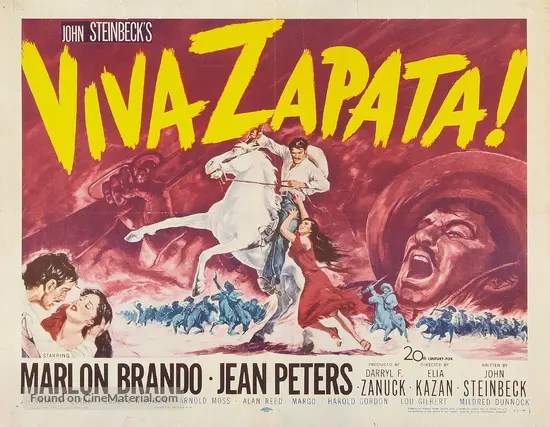 Brando on Kazan: “I have worked with many movie directors—some good, some fair, some terrible. Kazan was the best actors’ director by far of any I’ve worked for … the only one who ever really stimulated me, got into a part with me and virtually acted it with me … he chose good actors, encouraged them to improvise, and then improvised on the improvisation … He gave his cast freedom and … was always emotionally involved in the process and his instincts were perfect. … I’ve never seen a director who became as deeply and emotionally involved in a scene as Gadg … he got so wrought up that he started chewing on his hat.” Kazan’s thoughts on the film can be found in a fascinating book of interviews done by Jeff Young: “Kazan: The Master Director Discusses His Films”.
Master-Pupil-Master—Kazan: “I think I directed him well, but you really didn’t work with Brando. You told him what you wanted and tried to describe it in words that had meaning for him. By the time you finished telling him what a scene was about, he’d be way ahead of you. His talent used to fly.”
Numerous sources say Steinbeck based the script on Edgecomb Pinchon’s 332-page 1941 book “Zapata The Unconquerable”. Edgecomb also wrote the book that the 1934 hit Viva Villa! was based on, for better or worse. However, Steinbeck, fluent in Spanish, had studied Zapata for years and traveled into Morelos to extensively interview people who knew him and had written his own book—“Zapata”— on the man, later published along with his screenplay. He’d wanted Pedro Armendariz to play Emiliano. While nine actors have covered colorful Pancho (Beery the most famous, others include Armendariz, Yul Brynner and Antonio Banderas), Zapata has been done by four others besides Brando: Antonio Aguilar in 1970s Emiliano Zapata, Alejandro Fernández in 2004’s Zapata: el sueño del héroe directed by Alfonso Arau (and terribly reviewed), Demián Bichir in the 2004 mini-series Zapata: Amor en rebeldía and Tenoch Huerta in a 2011 Mexican series El Encanto del Aguila. A Huerta playing a Zapata!?
*** Class act(ress)—Peters: “I like to play roles I understand. As I am a farm girl, born and raised near Canton, Ohio, I like the frank, honest approach. Innuendo, intrigue, the devious slant, are foreign to me and to the sort of character I best understand. I often think our glamorization of Hollywood stars – the perpetual photographing us in ermine and bouffant tulle, in French bathing suits or sleek satin – throws the public off. They don’t recognize us as human beings subject to the same discomforts of climate and working conditions as they are. They expect to see that goddess leading a couple of wolfhounds come striding onto the set. Because I like to get away from all that and down to the heart of things I choose such characters as Josefa, or Anne (Anne Of The Indies), or Louise, the girl in Lure of the Wilderness.”
 Movies ala Mark