
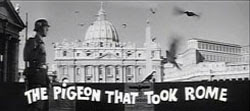
THE PIGEON THAT TOOK ROME flew into 1962 as a World War Two comedy—with Charlton Heston. Placement, theme and star don’t immediately start air raid sirens wailing “laugh attack incoming!” but there are worse examples in the mili-com subgenre. Missing in action today, it did okay at the time, and oddly enough, while you won’t find it on any medal of honor roll it’s not treacherous enough to be shot at sunrise either. Essentially the straight man of the piece, Heston doesn’t dishonor himself, and the other cast members do their assignments proficiently. Not a hit, but the $4,700,000 gross (62’s #52) adequately covered the budget bet. *

Italy, 1944. The Allies have invaded Italy, but are bogged down on the coast at Anzio. Two American officers are pulled from combat and detailed to perform espionage, sent ahead into Rome where, disguised as priests, they will report back using carrier pigeons. ‘Capt. Paul McDougall’ (Heston, who also narrates) and ‘Sgt. Joseph Angelico’ (Harry Guardino) don’t know spying from spaghetti, but like countless GI’s who took forced tours to Italy they find amore in the Eternal City. Liberating Europe is important but so are the ‘Massimo’ sisters: ‘Antonella’ (Elsa Martinelli) and ‘Rosalba’ (Gabriella Pallota), whose papa ‘Ciccio’ (Salvatore Baccaloni) is happy that the Americans have landed, two of them, anyway, and at his house. Meanwhile, the Germans…**

The old act-shy-when-finding-Italian-bombshell-showering situation
Dated but diverting, going for droll instead of slapstick, written, produced & directed by comedy vet Melville Shavelson, based off “The Easter Dinner”, a novel conjured by former spy Donald Downes. Shavelson did something similar just the year before, On The Double, with Danny Kaye impersonating a British officer flown to Berlin to spread false info before D-Day. He’d had luck in Italy with the fun It Started In Naples, so why not mix & match? On the heels (or sandals) of Ben-Hur and El Cid and with 55 Days At Peking on the horizon, Heston was ready for something light. He’d actually done a comedy seven years back, 1955’s The Private War of Major Benson, set not in a war but in a boy’s military academy run by nuns (awful to consider), which was a minor success (Chuck wisely took a percentage rather salary). The effervescent Elsa, 27, drew extra international notice that year with Hatari! and The Trial, and Guardino, 36, was getting a good deal of work: he’d just played Barabbas in King Of Kings and in ’62 he guested in nine TV series and logged another war movie, a serious one, Hell Is For Heroes. Pallota, 23, had appeared in a dozen Italian pictures, while opera star Baccaloni, 61, had done four US films, this fifth his last.
It did manage to snag an Oscar nomination for b&w Art Direction, somewhat of a reach. With old pro Brian Donlevy, Marietto, Arthur Shields, Rudolph Anders, Argentina Brunetti, Gary Collins (23, uncredited debut), Ted Knight and eventual prehistoric cave goddess Victoria Vetri (17, uncredited debut). 103 minutes.
* WW2 comedies that, to one degree or another, actually work: To Be Or Not To Be, Hail The Conquering Hero!, Mister Roberts, Operation Petticoat, The Best Of Enemies, The Americanization Of Emily, Catch-22, Kelly’s Heroes, Hope And Glory, Life Is Beautiful, 1941, The Cuckoo, Jojo Rabbit.
** Occupational Hazards overcome—during the 1943-45 Italian campaign there were over 10,000 marriages between American soldiers and Italian ladies. As many as 18,000 Italian women emigrated to the States after the war.

 Movies ala Mark