
FIVE wasn’t the first movie that dealt with the subject of atomic weapons. That would be 1947’s The Beginning Or The End, a bogus account of the Manhattan Project. But this bare budget 91-minute ponder from 1951 was the first to consider the aftermath of a war with such implements of destruction, and the effect on those who might be ‘lucky’ enough to survive. Apart from fun but ridiculous sci-fi thrillers about radiated insects, serious “then what?” looks at the dire aftermath stayed off screen radar until the end of the decade. *
“He’s dead, they’re all dead! We live in a dead world! And I’m glad it’s dead…cheap, honky-tonk of a world.”

Susan Douglas, 1925-2013
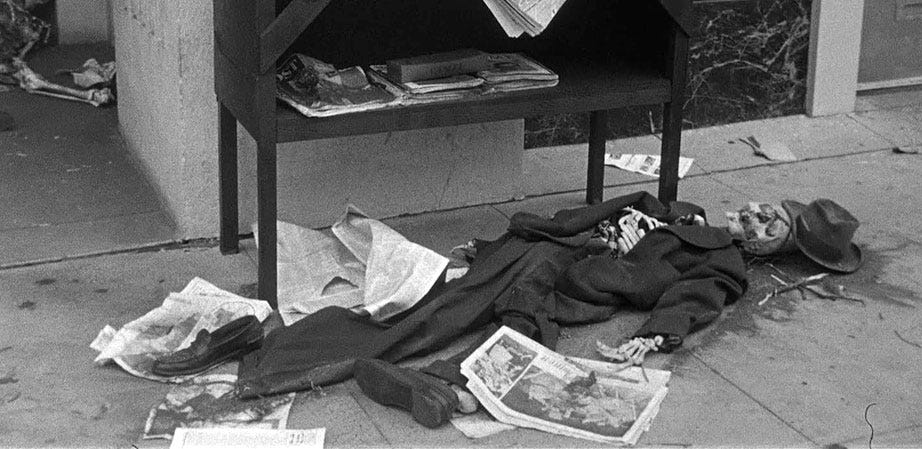
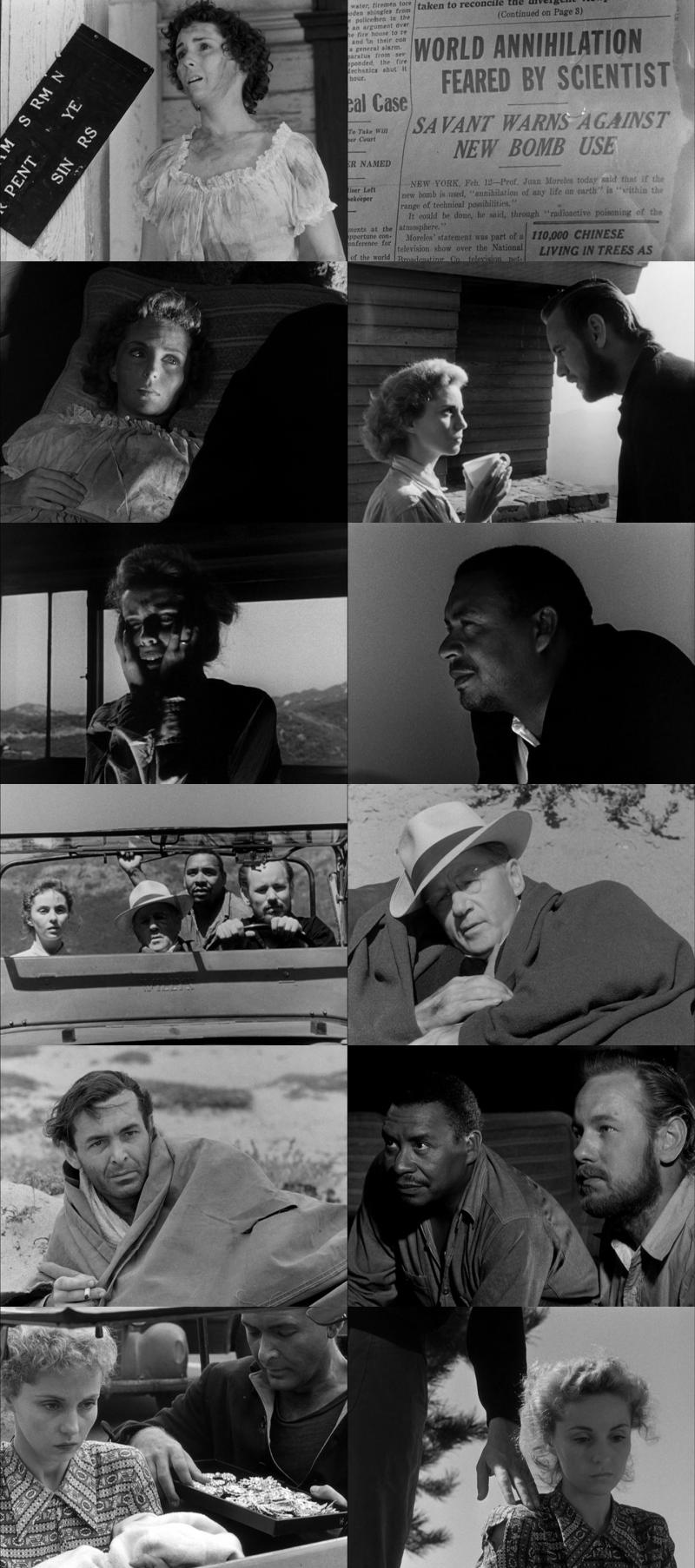
The War—THE war—is over. An ‘improved’ type of everyone-bomb has left structures undamaged, decimating the population, only skeletons left behind. Wandering in shock, a lone woman (Susan Douglas) makes it to a relative’s hillside retreat near the coast (we presume California) to find a stranger living there. He’s ‘Michael Rogin’ (William Phipps) and she is ‘Roseanne Rogers’, married but almost certainly widowed. She’s also pregnant. Presently they encounter ‘Charles’ (Charles Lampkin) and older, somewhat unsteady ‘Oliver’ (Earl Lee), co-workers at a bank who were locked in the vault when “it” happened. Michael had been in an elevator at the Empire State Building; during his cross-country trek he’d seen no one else, alive. Roseanne was in a hospital’s x-ray room, lead-lined. They assume their circumstances and locations had left them untouched by fallout. The amiable quartet make a determined go of it until Earl sickens, radiation having found him. Then they find a fourth man, washed up on the beach. A foreigner (European, unspecified) he’s made it across the Pacific from Asia. ‘Eric’ (James Anderson) had been stranded in a blizzard on Mt. Everest, saved by isolation and altitude. Arrogant and dismissive, Eric is remote in another way, racism: he does not care to associate with Charles, who is African-American. The group, eventually joined by Roseanne’s baby, surmises there must be others alive somewhere: their new arrival makes it painfully clear that age-old human flaws haven’t died out, either.

William Phipps, 1922-2018
Long-time radio writer and host Arch Oboler (famous for the spooky program Lights Out) conceived, wrote, produced and directed this spare, unhistrionic and haunting meditation piece, shooting in the Santa Monica Mountains around Malibu, and at a guesthouse on a ranch he owned: the structures had been designed for him by Frank Lloyd Wright. Editing assist came from John Hoffman, who’d directed two B-pictures; camerawork and other chores were handled by recent USC film school grads. Character actors Phipps 29, (recommended by mentor Charles Laughton) and Anderson, 30, had been around for a while, Czech-import Douglas, 26, had appeared in three little-seen pictures, and musician-lecturer Lampkin, 37, made this his acting debut. Lee, 65, logged a handful of credits. The wallet-sized budget was $75,000 (about $931,000 in 2025), and while visual effects are minimal (garbed skeletal remains, some montage work of smoke obscuring landmarks like the Eiffel Tower and the Taj Mahal) the sense of existential despair is acute. I remember seeing this as kid, alone, late at night. Without any house-sized monsters, WW2 stock footage of explosions, or scenes of rampaging Reds with Slavic accents shooting secretaries and librarians in the back, its quiet fright cut a trace memory that lasted for decades. Finally seeing it again in 2025 showed why it hooked me, back before before I knew fusion from fizzies. **

James Anderson, 1921-1969
The basic dynamics—numbers, sex, age, race, condition, choice—are obvious, but the unadorned matter-of-fact presentation is so well put over by the non-star actors in gradual reveals of behavior and histories that the contrived coincidence holes in the plot don’t scuttle dramatic impact. The setting is essentially a sixth character, isolate enough to seem primeval—nothing around but empty hills, birdless skies and the limitless yet constricting sea—while also fittingly futuristic, thanks to the unusual look of the dwelling. There’s the challenge of providing food, the division of skills, talents and duties, a baby—having one (one of the earliest movie depictions of the ordeal of childbirth, tame today, daring at the time), then taking care of it—and the ugly reminder that everyone may be created equal but not everybody believes it. Through it all there is the likely forlorn but crucially valiant attempt to keep hope flickering in the face of incalculable loss. The acting is naturalistic, Oboler’s dialogue exchanges simple yet weighted, his direction nimble, the black & white cinematography (by Louis Clyde Stoumen) striking, occasionally beautiful, evoking the classic Depression Era photographs from Dorothea Lange.

Charles Lampkin,1913-1989
* Duck, cover and kiss your…— there was the bonkers Cold War paranoia of Invasion U.S.A., a must-see from 1952, and 1954’s The Atomic Kid, a radiation comedy with Mickey Rooney. But they’re so silly, the first trying not to be, the second flailing to be funny, that they can be lumped in with the science-fiction “what have we spawned?” faves like It Came From Beneath The Sea, Them!, Tarantula, Gojira/Godzilla: King Of The Monsters, Day The World Ended and Attack Of The Crab Monsters. Lazy corporals and clumsy ensigns forgot to remove bugs, reptiles and seafood from the test sites. Did anyone notify Ike?
In 1959 we would self-depopulate in the serious A-list dramas The World, The Flesh and The Devil and On The Beach. The accelerated H-bomb tensions of the early 1960’s (the Cuban Missile Crisis cut fuses atom-close) generated Panic In Year Zero!, Ladybug Ladybug, Dr. Strangelove and Fail-Safe. Later in the hairjacked 80’s, the global stockpile topped 70,300—100 are enough for nuclear winter—and Reagonic bellicosity air-dropped The Day After, Testament and Threads. Next time the ultimate light-show won’t come thru a movie.
 ** Arch Oboler, 1909-1987, though a big deal in radio, had a sparse film resume, 11 pictures scattered between 1940 and 1972. Five deserves the recognition it’s now given but only two made much of an impression when they came out. His first, which he co-wrote with Marguerite Roberts, was an early anti-Nazi picture, the well-regarded Escape, with Robert Taylor, directed by Mervyn LeRoy. His big score came in 1952, writing, producing & directing the dorky low-budget Bwana Devil, which became a surprise hit not due to being good but because it kicked off the 3-D craze.
Older buffs recognize and appreciate William Phipps and James Anderson. Phipps 237 credits include doing the voice of ‘Prince Charming’ in Disney’s Cinderella. My favorite Bill Phipps moment is in 1959’s The FBI Story when he does a bit as killer Baby Face Nelson; the way he barks at geezer Burt Mustin “You too, Uncle Fudd!” is priceless. Reliably creepy Anderson topped 156 credits with his incarnation of the vicious ‘Bob Ewell’ in To Kill A Mockingbird, scary enough on-set that he unnerved Gregory Peck for real.
 Phipps in 1991: “Whatever came along, whether it was Cat-Women of the Moon, The War of the Worlds or Five, I would stick my toe in the water. If it felt OK, I would do it. I never thought about what any of these would do for my career, never thought ahead to whether it would be a success or what it would do for me. I never had any kind of plan or blueprint, never tried to capitalize on anything. But I kept busy throughout a 40-year career and I’m still busy today. I know I’ve always been a good actor, I know that I am now, and I know I still get work. And I have the respect of my peers. Hey, what more could you ask for?” Good man.
Renaissance man Charles Lampkin did much TV and film work until the late 80’s but made his most influential mark as musician, lecturer, educator and pioneer orator of Spoken Word recitals. Like fellow multi-faceted African-American composer/arranger/actor Jester Hairston, his acting career had a highlight—Five, Hairston’s was The Alamo—, then he was consigned to thankless roles as a butler, laborer, servant, etc. Posterity takes a while to show appreciation, but it does catch up.
Susan Douglas (Rubeš) logged a good deal of TV (ten years on The Guiding Light) but didn’t make another film appearance until 1968, an unbilled bit in Peter Bogdanovich’s debut sleeper Targets.
Meanwhile, the Damoclean broadsword of thermonuclear Armageddon is in some interesting hands, hearts and minds. Small ones.
Click on pic for extra clarity
 Movies ala Mark