
THE ISLAND OF DR. MOREAU sank beneath waves of ego and disdain in 1996, years of planning scuttled, months of filming and millions of dollars squandered by on-set misbehavior that became legendary, the results demolished by critics and insufficient receipts at the box office. Shame on numerous guilty parties, because this frustrating third version of H.G. Well’s classic novel has a number of excellent elements hybridized with others that run amuck. Catastrophes, viewed from a safe remove, can be fascinating. Too bad more people don’t learn from them. *

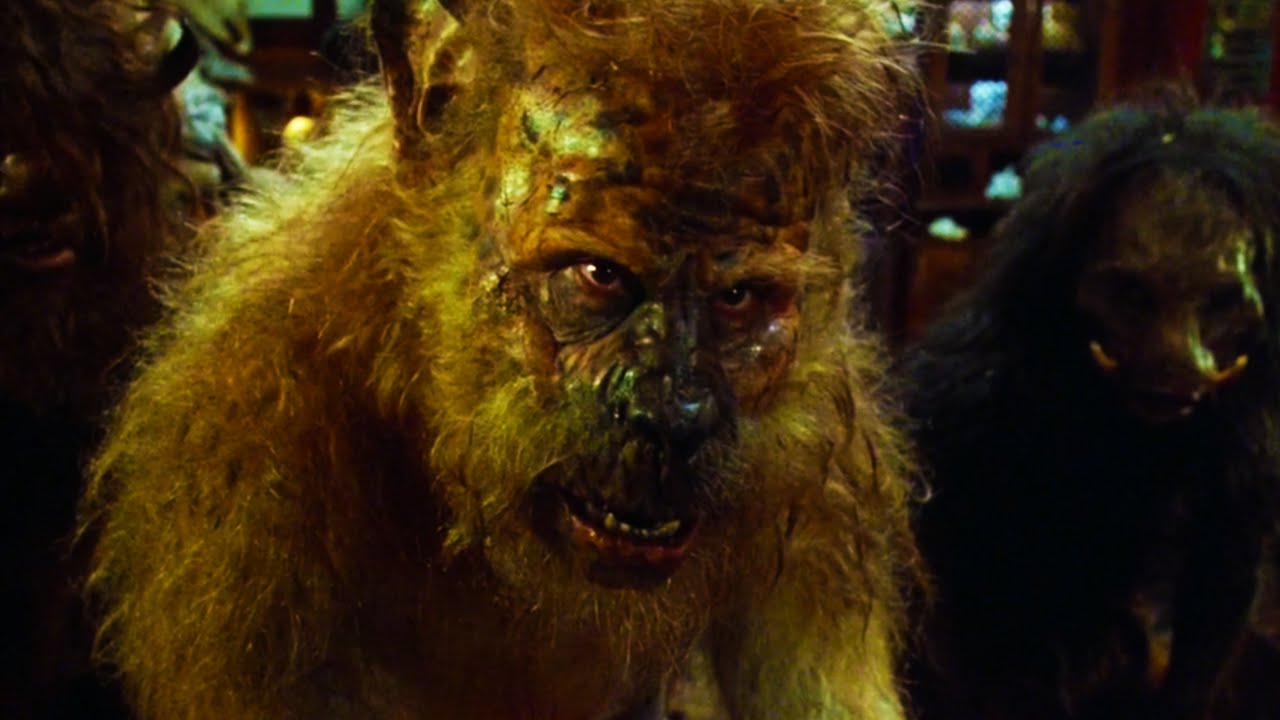
‘Edward Douglas’ (David Thewlis) has managed to live thru a plane crash in the Java Sea. Found by rather suspicious fishermen, he’s introduced to ‘Montgomery’ (Val Kilmer) who brings the dazed survivor to a remote island where airily evasive Montgomery works with & for ‘Dr. Moreau’ (Marlon Brando), an animal research scientist who’s gone 20,000 leagues past eccentric into full metal straight-jacket. Moreau’s experiments have put human DNA into animals, resulting in a menagerie of grotesque and pitiful creatures who Moreau hopes to ‘perfect’ while Montgomery helps keep them in line. Not rescued but hijacked and horrified, Douglas finds an ally in kind and captivating ‘Aissa’ (Fairuza Balk), a ‘daughter’ of Moreau, and one of his experimental subjects who hasn’t yet gone completely ‘back to nature’. Edward and Aissa try to escape, but Montgomery is unstable, Moreau is insane and the much abused ‘natives’ are restless.

Richard Stanley had drawn notice for writing & directing two small-scale pictures, the sci-fi entry Hardware and Dust Devil, a horror indie. The venerable Wells story was his pet project and a shot at the big time; he spent four years developing it. With the cast assembled and sets built in the Australian rain forest region near Cairns, three days into filming he was canned by the production company suits and replaced by veteran John Frankenheimer, who promptly brought in Ron Hutchinson to rewrite the script. Though the devastated Stanley shared screen credit, he said none of his writing remained in the finished product, ‘finished’ the operative word.  Launched by Kilmer’s deliberate sabotaging of Stanley, a civil war erupted with key belligerents and multiple collateral damage casualties. Add the interference of a typhoon and a family tragedy. Brando, 71, took his decades-long penchant for dicking with directors, producers, writers and other actors and reached Apocalypse Nadir, with a complimentary Kilmer kill-shot, Val seemingly hell-bent on hamstringing the whole shebang. Fed up, Balk bolted to quit until informed that if she didn’t kowtow she could kiss her career sayonara. The agonizing shoot stretched out longer than the WW2 campaign for Guadalcanal, the price tag reaching $40,000,000. Everyone involved blamed everyone else. Upon release, critics clobbered it like Victoria’s Secret models reacting to a short mutant with bad breath (and no bankroll) and the stateside gross stopped at $27,700,000, 54th place. Another $15,000,000 emerged abroad, but balanced against the outlay (generally doubled by prints and ads) it was about as successful as one of Moreau’s experiments.

Whatever may be lacking (or salvaging) in how Frankenheimer directed what Hutchinson rewrote, their efforts ran head-on into the willful abandonment of professionalism by Brando and Kilmer, each delivering easily their career-worst performances, Kilmer’s devoid of energy, Brando’s a gluttonous mockery of craft, topped by his utterly ridiculous costuming and make-up choices and foolish, self-bemused fiddling with supporting player Nelson de la Rosa, a 28-year old Dominican actor, proclaimed as “the world’s shortest man”, thanks to Seckel syndrome that left his adult height at 2’4″. Though the bigger stars received top billing, the largest role of trapped visitor Douglas is another wound, thanks to lackluster work from Thewlis, ordinarily excellent but here seemingly as unhappily adrift as his character. In the last act, with nowhere to go, the show falls into the tried & true fallback of just blowing everything and everyone to pieces, ironically fitting, given the self-destruction of the shoot.
 And yet, hold the hybrids! If you persevere and paddle past the wreckage, there’s still a good deal of cool stuff to enjoy. From the jolting title credits (designed by Kyle Cooper) to the smithereens wrap up, William A. Fraker’s lush cinematography rates as prime cut. The unsung Gary Chang does well by his scoring, not succumbing to the lazy route of portentous bombast. The superb creature design from Stan Winston and Shane Mahan brings lavishly updated and refined craftsmanship to the legacy of unease created from the earlier versions, bolstered by outstanding work from the sound effects team. Under their makeup, actors Temuera Morrison, Daniel Rigney and Ron Perlman emerge with honor. And 21-year-old Fairuza Balk acts rings around the big stars, showing up the crash indulgence of Brando and Kilmer and the miscast Thewlis with grace, passion and fire. She not only joins the earlier versions resolve-stiffening panther-women (Kathleen Burke and Barbara Carrera) but bests them in the ‘Girl We’d Most Like To Meet On An Island Even If She has Fangs and Claws’ category. “Dear Fairuza, I like cats, know how to pet and can be reached via this blog…”(sad note found in bottle, or next to one)
For sure, 96 unusual minutes, with Marco Hofschneider, Miguel Lopez, Peter Elliott and Mark Dacascos.

* H.G. Wells not only imagined futures, he seemed to have foreseen this particular piece of it, released a century after the book was published in 1896. A quote from the novel: “I must confess that I lost faith in the sanity of the world when I saw it suffering the painful disorder of this island.”
The 1932 version, Island Of Lost Souls, is a creepy classic. 1977’s underrated The Island Of Dr. Moreau is pretty good.
Frankenheimer: “I don’t like Val Kilmer, I don’t like his work ethic, and I don’t want to be associated with him ever again.” “Will Rogers never met Val Kilmer.” To be fair to Val, who was so good, so often (The Doors, Tombstone, Heat) he had his own take on the Moreauic misadventure, and we’ll vouch that he did fire on target that year in the much undervalued man vs. beast thriller The Ghost And The Darkness.
What happens during the creative stakes in the making of motion pictures can sometimes be as interesting (and/or more fun) than the picture itself. A great 2014 documentary tackled this one: Lost Soul: The Doomed Journey of Richard Stanley’s Island of Dr. Moreau. Stories behind the blessings or woes of other notable films have generated some swell books and documentaries (no, not the extras on discs). Some that have been exhaustively dissected: King Kong, The Wizard Of Oz, Gone With The Wind, Citizen Kane, The Red Badge Of Courage, Giant, The Alamo, Psycho, Cleopatra, 2001: A Space Odyssey, The Wild Bunch, Heaven’s Gate, The Godfather, Apocalypse Now, The Bonfire Of The Vanities, Blade Runner, Titanic...


 Movies ala Mark