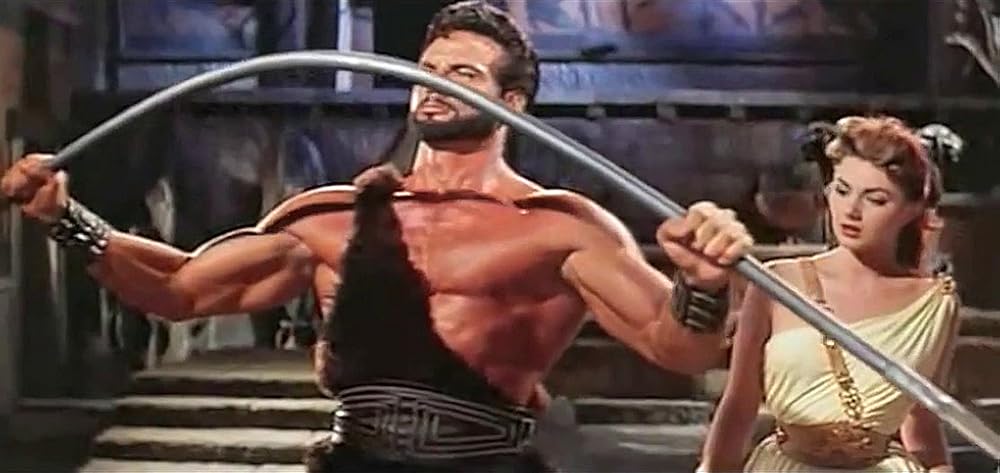
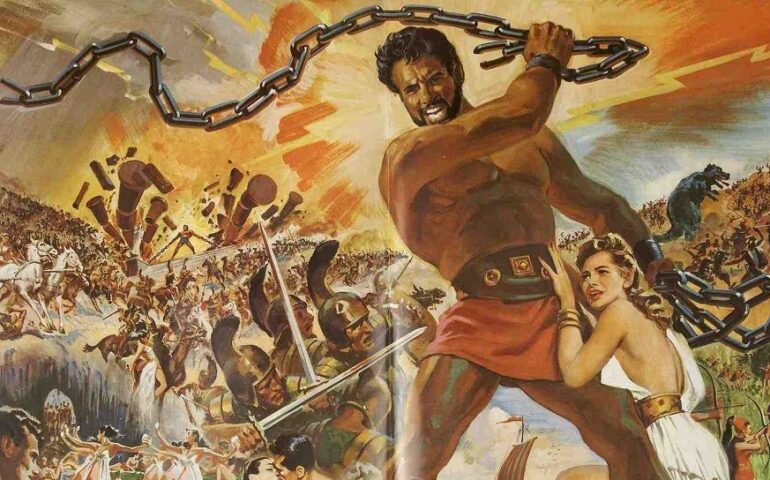
HERCULES muscled his way onto movie screens in 1958 in a surprise attack from Italy that stunned the box office world and opened the floodgates for not merely an immediate sequel (delightfully daft Hercules Unchained) but for 17 more adventures featuring the immortal Greek and a mighty (and mighty silly) host of ‘peplum’ pix showcasing Goliath (5), Maciste (25), Ursus (9), Samson (5) and countless sword-wielders in dozens of similarly themed mini-epics. Herc of ’58 notably cast the attention and eyes (adoring, disbelieving or smirking) onto the handsome face and pretty darn awesome physique of one Steve Reeves, 32, a bronzed spear-bending, boulder-tossing, monster-masher hailing from the distant Greek province of Glasgow, Montana. *
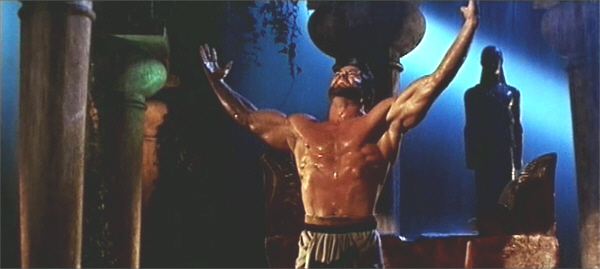
Famed (and friendly unless f’d with) Theban stud x 3 Hercules rescues luscious ‘Iole’, Princess of Iolcus, (Sylva Koscina, 24) from a runaway chariot (he uproots a tree doing so, a surefire way to impress someone with hot legs) and in due course becomes involved with her important and not-so-nice family. Making everything go ‘the way of the Gods’ will see Hercules anger a ruler, humiliate a prince, choke a lion, bonk “the Cretan bull” (a no doubt confused and irritated American bison) and go on a search for the Golden Fleece (take cuts and skip ahead to 1963’s classic Jason And The Argonauts), then return to Iolcus and basically level the thankless place (temple toppling time) before leaving with won-over Iole for the (more entertaining) sequel.
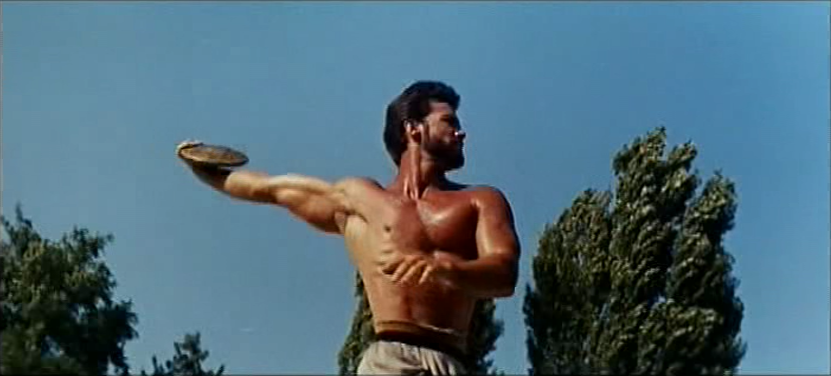
“My heart has reached the crossroads of destiny.” Verily, my pecs have benched 325.
Directed by Pietro Francisco, who co-wrote the windy script with Ennio De Concini (Black Sunday, Divorce Italian Style, The Red Tent) and Gaio Frattini (with onscreen credit also given to Apollonius of Rhodes) essentially hews to the Golden Fleece tale involving the hero with Jason, Argo and oarsmen who are alternately hearty or rebellious. The dialogue (or at least the translation) is goofy, the dubbing laughable, the editing jumpy, the monster fights (lion, bull, dragon) markedly clumsy. There is some nice cinematography from Mario Bava, Reeves is certainly physically impressive, Koscina peach pretty. Stealing interest in a secondary role is Lidia Alfonsi as the haughty Sybyl and it’s pleasing to see future Thunderball villainette Luciana Paluzzi, 20, as one of Iole’s handmaidens.

Sylva Koscina, 1933-1994
The show reportedly cost $2,000,000. Finger on the pulse and nose upon bread to be baked, independent producer Joseph E. Levine snapped up the rights for $120,000 and then pumped $1,250,000 into a publicity blitz of mythological proportions. Kids went ballistic, station wagons swarmed drive-in’s and the gyroic feast was the seventh most popular escape of 1958, grossing $13,400,000 just in the States. Worldwide it sold an Olympian 66,600,000 tickets.

Lidia Alfonsi, 1928-2022
As the modest ad tagline had it “SEE the seductive Amazons lure men to voluptuous revels and violent deaths! SEE the heroic Hercules rip down the Age of Orgy’s lavish palace of lustful pleasure! SEE the Mightiest of Men fight the Mightiest of Beasts, the killer Cretan Bull! SEE Hercules fight off the savage love-starved Amazon women! SEE the seductive Amazons lure men to voluptuous revels and violent deaths! SEE the powerful Hercules crush the savage ape-men who guard the shrine of the Golden Fleece!” SEE what can be summoned with $1,250,000 in strategic advertising. Whoever held the patent for plastic swords made out like a hydra.
Depending on the cut and dubbing you can shake your head in amazement revel in the daffiness at 98, 103, 104 or 107 minutes, with Fabrizio Mioni, Ivo Garrani, Gianna Maria Canale (‘Antea, Queen of the Amazons’) and Mimmo Palmara. Bring your own grapes.

* Bicep-flexing, bosom-heaving actioners featuring basso-voiced mythological heroes and/or ancient historical slaughterers characters were popular in the silent era, especially in Italy. The huge successes of 1949’s endearingly gauche Samson And Delilah and the deluxe spectacle of Quo Vadis in 1951 tapped international audience thirst for the Ways of Way Old Days, and the Italian-made Ulysses from 1954 (with Kirk Douglas and Anthony Quinn shipped over) lit the fuse that eventually blew Hercules back into play. There’s an aged generation who fondly recall the mighty song that accompanied ‘The Sons Of Hercules’ when they showed up on TV for many a Saturday matinee. Though it sprang forth some years after the spearhead of the Reeves opus, to stay in favor with Zeus we thoughtfully include it below. Sing along, mere mortals, and risk some chin-ups. One, even.
 Movies ala Mark