
TWO WOMEN—born in 1934, Sofia Costanza Brigida Villani Scicolone got her first bit parts in Italian movies in 1950. A few years later she scored lead roles, and in 1957 arrived internationally as Sophia Loren, jousting major Hollywood leading men in Boy On A Dolphin, The Pride And The Passion and Legend Of The Lost. Her striking beauty and daunting sex appeal were a given but it took three more years before she found a role that banished any doubts about her depth as a dramatic actress. She portrayed someone a decade older than her 25 years, a refugee in WW2 Italy, mother to a pre-teen daughter, played by 11-year-old Eleanora Brown. Loren’s magnificent performance won universal critical acclaim and a slew of awards, including the Oscar as Best Actress, the first given for a foreign language film. The searing adult drama was a box office hit. *
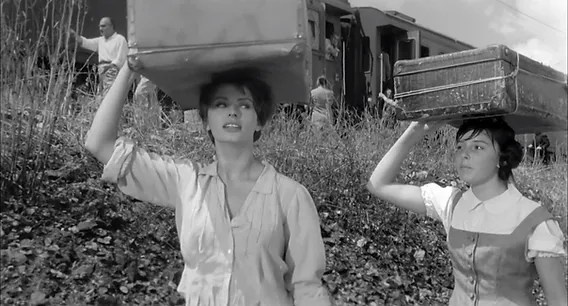
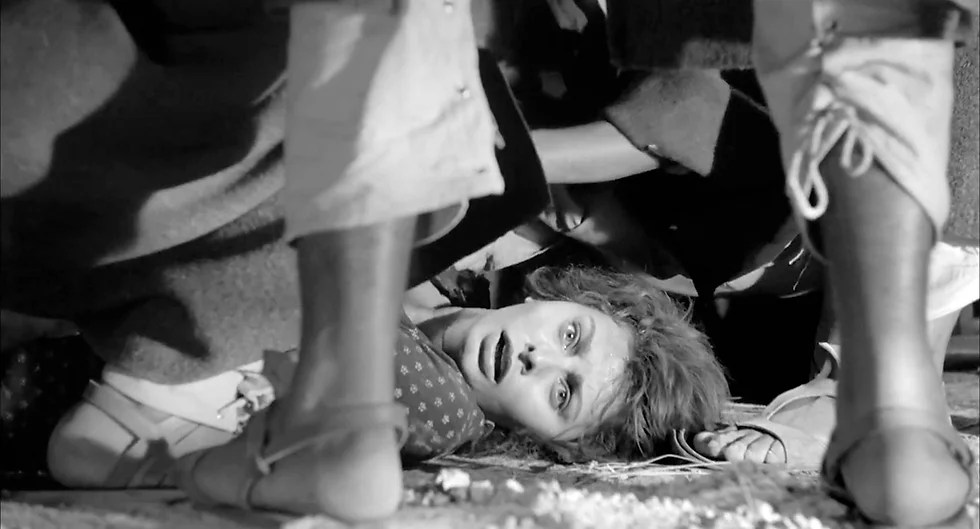
Italy, 1944. The Allies have invaded, Mussolini is out. While fighting continues—Americans, British and French vs. the die-hard German units—the stricken country is awash in desperate civilians hoping to find food & shelter, relatives & friends, something akin to safety. Widowed shop owner ‘Cesira’ (Loren) flees bombarded Rome with daughter ‘Rosetta’ (Brown) to a rural province in the mountains, a region Cesira knows from her youth. Among the variously suspicious or helpful villagers and passing strangers they spark a friendship with ‘Michele’ (Jean-Paul Belmondo), a brainy communist. After the Allies capture Rome, among the outfits roaming the countryside are Goums Marocains, Moroccan colonial irregular troops under French command. Cesira and Rosetta encounter them. **
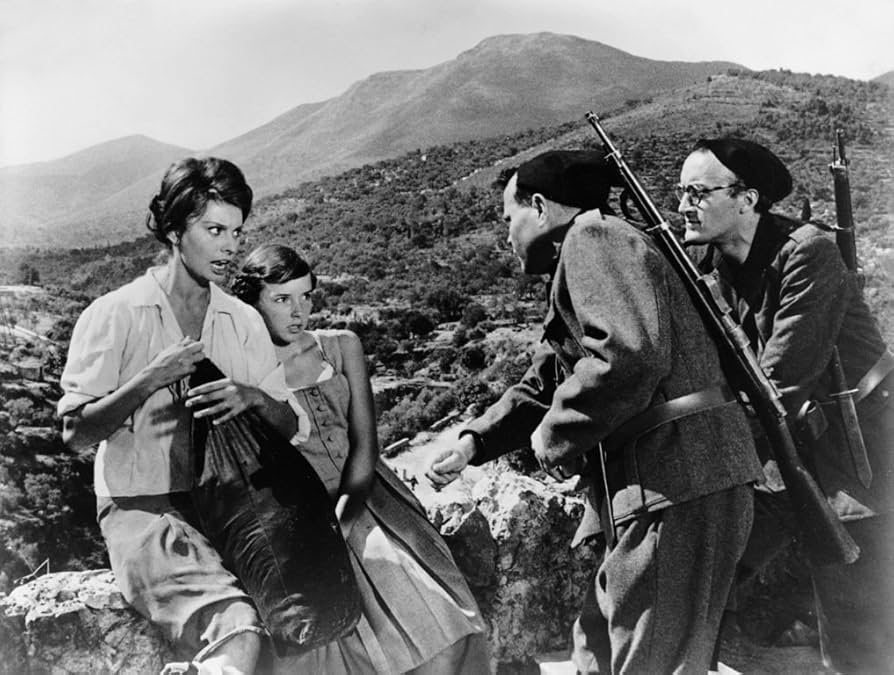
Vittorio De Sica directed and co-wrote the screenplay with Cesare Zavatini, adapted from the novel “La ciociara” (The Woman From Ciociaria) by Alberto Moravia. Besides his triumphs with Bicycle Thieves, Shoeshine and Umberto D., De Sica had directed Loren in 1954’s The Gold Of Naples, which helped establish her as a star in Italy. After Two Women, they’d collaborate on The Condemned Of Altona, Boccaccio ’70, Yesterday Today And Tomorrow, Marriage Italian Style, Sunflower and The Voyage.
“Do you know what they have done, those “heroes” that you command?”
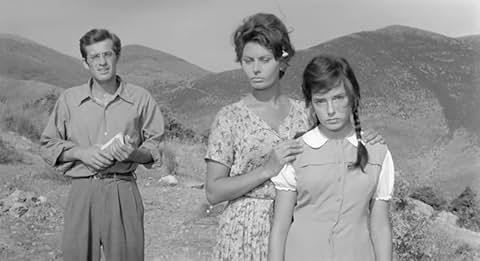
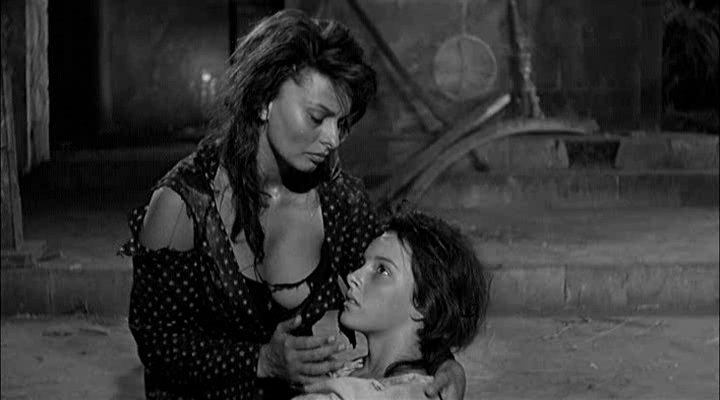
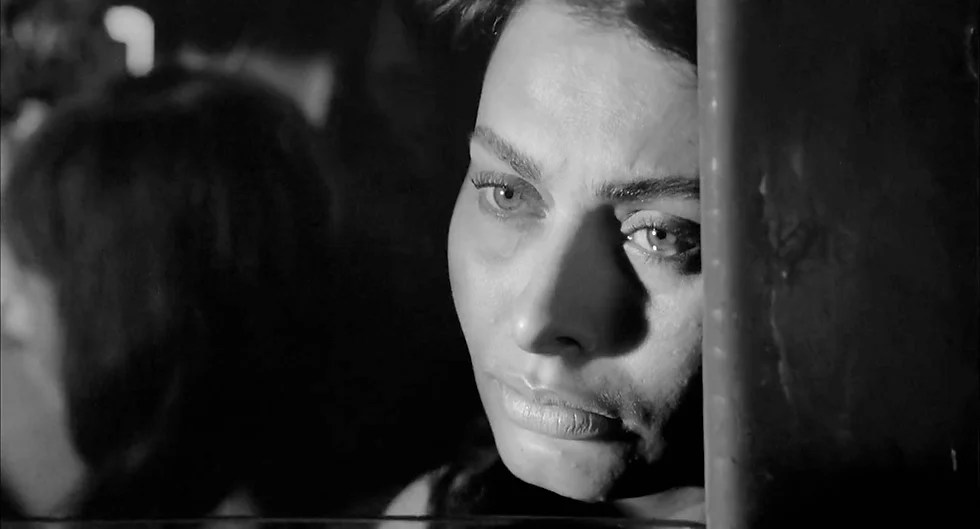
De Sica’s consummately sensitive direction, the sharp writing, stark photography and shrewd casting envelope the actresses and embellish their exacting, impassioned performances. In her debut, Brown is faultless in possibly the era’s most difficult roles for a child actor. Though unadorned in this part with anything like artifice, Loren is ruffled and real yet remains ravishing, her heady mix of elegant earthiness all the more appealing because she exudes honesty and a deep grasp of truth; in the cruelly challenged Cesira, the former war waif Sofia Scicolone emerges as not just a world-class movie star but a force-of-nature dramatic presence, radiating intelligence & wit, passion & pain, hope & despair, defiance & love.
Made for $850,000, in the States a gross of $8,600,000 placed 32nd in 1960’s packed lineup, and there was great success in other markets, notably Italy, where it sold 9,662,000 tickets, and France, with 2,030,033.
“Isn’t there some safe place in the world?” With Raf Vallone, Carlo Ninchi, Curt Lowens and Andrea Checchi. 101 minutes.
* 1960 was not merely lucky for Loren—also starring in four much lighter vehicles, the fun It Started In Naples, the offbeat, underrated western Heller In Pink Tights, The Millionairess and A Breath Of Scandal—it was a boon year to foreign films helping to wake up & shake up the States: La Dolce Vita, Never On Sunday, La Vérité, Rocco and His Brothers, The Virgin Spring, Breathless, Purple Noon and L’Avventura. Plus Sons and Lovers, The Trials Of Oscar Wilde and Tunes of Glory. Though released late in the year in Italy, the US release didn’t come until May of 1961, so it was put on the Oscar roll for that year.
** The Marocchinate or “Moroccan Deeds” entailed the ghastly mass rape in 1944 of thousands of Italian women (and sometimes men) by the Goums Marocains, basically given license by their commanders to do what they wished. The violated ranged in age from eleven to eighty-six.
Sophia: “The facts of life are that a child who has seen war cannot be compared with a child who doesn’t know what war is except from television.” “With my own memories to draw upon, you would think would have an easy time of it. But it was very hard for me to relive my girlhood terror and at the same time to transform the reality of my feelings into the role I was acting.”
 Movies ala Mark