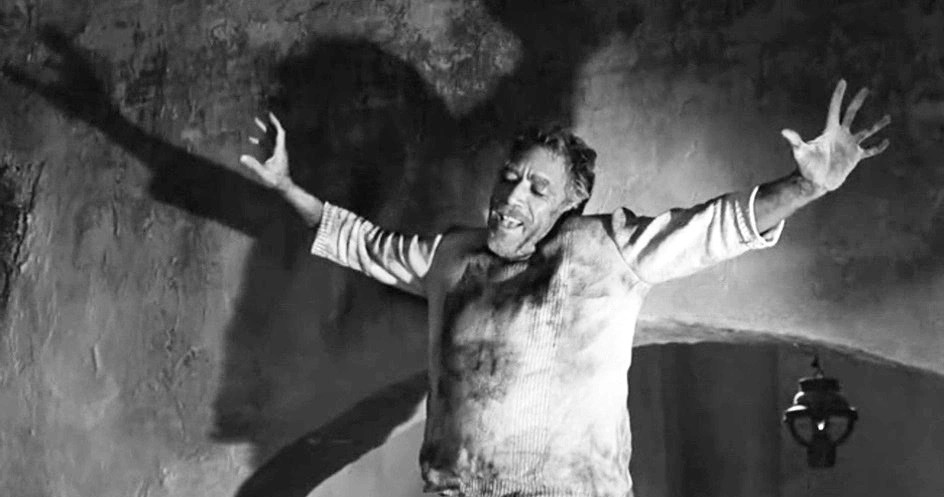
ZORBA THE GREEK—“Am I not a man? And is a man not stupid? I’m a man, so I married. Wife, children, house, everything. The full catastrophe.” It may not qualify as catastrophe but it was certainly a form of larceny that the Academy Award for Best Actor of 1964 didn’t go to nominee Anthony Quinn for his career peak embodiment of the lusty rascal Alexis Zorba. Oscars deservedly went to a supporting actress, the cameraman and the art director, while Quinn’s nomination was joined by vies for Best Picture, Director and Screenplay. Those three were shared by Michael Cacoyannis, who directed, wrote the script and co-produced. He also did the editing of the 142-minute drama, adapting the 368 pages of Nikos Kazantzakis’ 1946 novel “The Life and Times of Alexis Zorba”. *
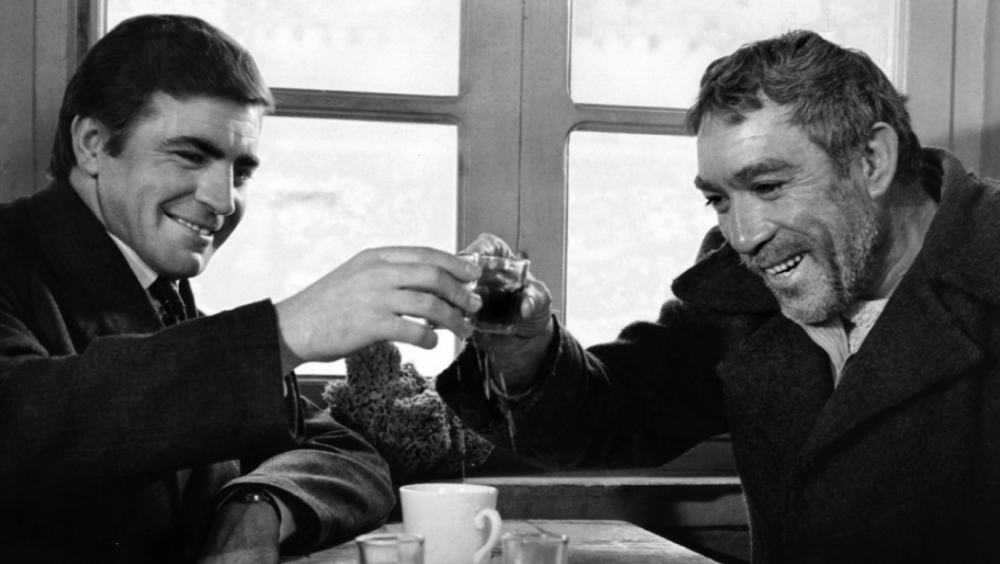
On his way to land he bought in Crete, ‘Basil’ (Alan Bates) is befriended by enthusiastic ‘Alexis Zorba’ (Quinn, 48, makeup making him look 20 years older). The carefree Macedonian peasant, jack-of-all-trades (he says) and the staid Englishman decide to work together to open a mine. During their rollicking and rocky stay, Zorba persuades (cons, really) monks and villagers, including aging and ailing French cabaret dancer (courtesan, really) ‘Madame Hortense’ (Lila Kedrova), while Basil tries to summon spirit from his shyness (or whatever his issue really is) to do something besides sneak glances at an intriguing widow (Irene Papas), who is subject to much speculation from the locals.
BASIL:”I don’t want any trouble.” ZORBA: “Life is trouble. Only death is not. To be alive is to undo your belt and look for trouble.”

Like life, it’s a comedy of errors, an opportunity for growth and understanding and a template for tragedy. Basil’s hard-to-like, locked-down simp is a bit wearying, leaving all the energy, passion, fun and pathos to the others. Without a line of dialog, Papas creates a haunting portrait of nobility, isolation and loss; her luminous visage speaks volumes. Russo-French pixie with moxie Kedrova, 54 in her first English-language film, is pure incandescence as the life & love-worn chanteuse/bawd. Sparkling and sad, proud and pathetic in her hopeless hopefulness, she very nearly steals the movie out from under the star.

Quinn’s powerhouse Zorba is a dreamer and a failure, comrade, clown and conman, fool and hero, a charmer and a louse, selfish and rough, sentimental and serene. His Oscar snub (he already had two for supporting roles) was maybe partially to do with his Zorba-like personal life reaping negative publicity at the time, but in large part the fault was in the Academy. In thrall to the British invasion and always suckered by a Broadway musical, they lavished awards on the mediocre My Fair Lady, including one to Rex Harrison for his agreeable but undemanding ‘Henry Higgins’, a part he’d done a zillion times on stage. No cigar, Rex, the golden goodie belonged to Zorba Quinn.

The flavorful music score by Mikis Theodorakis concludes with the famous sirtaki dance: this became a hugely popular hit as a single (I had a couple of versions, including a 45 from The Tijuana Brass).
Peer praise was echoed by commercial embrace, the US gross of $12,600,000 (#17 in ’64) part of a worldwide reward of $23,500,000, a sleeper smash on a production cost of $783,000, shot on location in Crete. Zorba‘s wide-scale acceptance (critical, audience, awards) also signaled the mid-60s shift meshing art and entertainment. Released thru a Hollywood major (20th Century Fox, and backstopped by Darryl F. Zanuck rescuing its funding), in English language, yet made by a European auteur with the starkly ‘honest’ look and frank adult approach of ‘art-house’ foreign films. Today the bawdiness may seem merely colorful (those ruthless dramatic scenes are undiminished) but in 1964 its overdue handling of ‘lust desserts’ was daring stuff.
With Sotiris Moustakas, Giorgios Foundas, Eleni Anousaki, Takis Emmanuel.

* The Mighty Quinn—always a strong presence from his early days as a villain, Quinn had warmed up for wild & crazy Zorba for a good while. Earthy Tony had been on display in Viva Zapata, The World In His Arms, La Strada, Attila, Lust For Life, Wild Is The Wind, Warlock, The Savage Innocents, The Guns Of Navarone, Barabbas and Lawrence Of Arabia (“because I am a RIVER to my people!“).
The wonderful Lila Kedrova would join him in his next picture, the woefully underrated adventure A High Wind In Jamaica. In 1983 they and Cacoyannis would take Zorba and Madame Hortense to the stage as a musical and knock down 362 performances.
The 1964 Oscars were, Kedrova excepted, a joke. If not winning solo, Quinn could’ve shared with Peter Sellers Dr. Strangelove. Throw in the un-nominated Sean Connery, 007 to perfection in Goldfinger. Must a time machine be invented? Or should we just dance on the beach?
Earth in the blood—Kazantzakis based his novel on his friend, Macedonian miner George Zorbas (1865-1941). His great-grandson Pavlos Sidiropoulos (1948-1990) was a force in Greek rock’n’roll. One of his albums was titled ‘Zorba the Freak’.

 Movies ala Mark