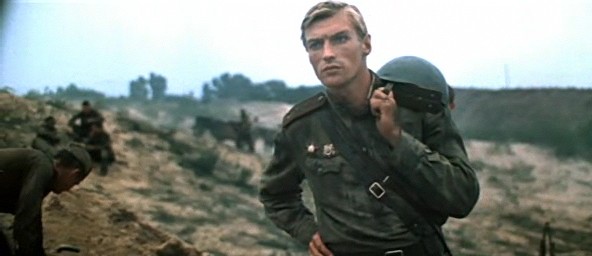
LIBERATION is essentially one long, gigantic monster of a movie, split into five separate segments that were released in 1970-71 in the Soviet Union and its satellite vassals, with prints eventually circulating in 115 countries. The original running time for the quintet was 477 minutes, three shy of eight hours (thirty-two minutes were shorn for the 2002 restoration). By the time Liberation was finished and unveiled, the world had already witnessed the Russian mega-epic masterpiece War And Peace, capturing 1968’s Oscar for Foreign Film. Yet this leviathan (all war, no peace) went missing in action on the figurative Western Front. It wasn’t until 1973 when scant audiences in English-speaking countries received an eviscerated version, trailing in as The Great Battle, chopped from the first two installments, clocking a mere 118 minutes. Ignore that Cub Scout insult and step into the ring of fire with a heavyweight.
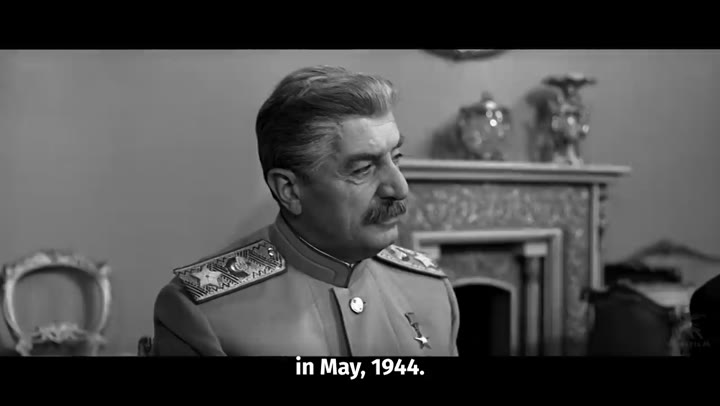
Affronted by Anglo-American WW2 epics that seemed to make victory over Nazi Germany seem either like a foregone conclusion (The Longest Day) or a thrilling adventure (The Guns Of Navarone, The Great Escape), the post-Khrushchev USSR’s slate of hardliners (miss Leonid Brezhnev, anyone?) decided to fire back—Big. With essential cooperation (and da, ‘supervision’) from The State, the production wasn’t just a Soviet muscle flex, but a multi-front effort with studios, crews and actors from servile states Poland, East Germany and Yugoslavia, and ‘we work with everyone’ Italy (courtesy Dino de Laurentiis). Yuri Ozerov directed (Red Army Major and a forward observer during the war) and he helped write the script with Yuri Bondarev (former WW2 artillery officer, noted novelist, Soviet diehard) and Oscar Kurganov. Filming lasted four years, and took place in Lithuania, the central Ukraine, the Crimea, Warsaw, East Berlin, Moscow and Rome. The estimated cost (in US dollars) looks to have been $40,000,000, which in 2026 would be around $344,000,000.
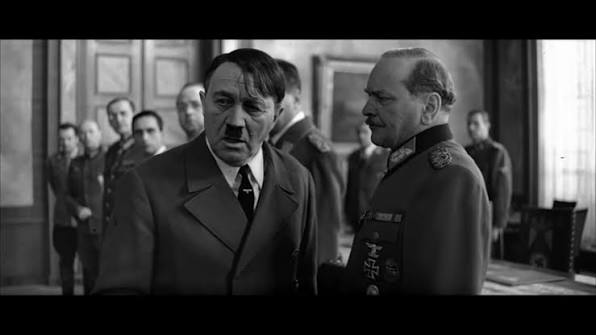
Fritz Deiz does well as the progressively disintegrating Fuhrer.
Film I is The Fire Bulge, which runs 88 minutes and takes on 1943’s titanic battle of Kursk, history’s greatest tank clash, a momentous setback for the 3rd Reich. Film II is Breakthrough, 85 minutes, dealing with the Lower Dnieper Offensive, where the Soviets began to reclaim territory. This segment also contains Mussolini’s daring rescued by German commandos, the Red Army liberating Kiev (never mind the future), and the meeting in Tehran (never mind the future) of Roosevelt, Stalin and Churchill. Film III titled Direction Of The Main Blow goes 122 minutes with the vast Operation Bagration, commencing shortly after the Normandy landings. Film IV is The Battle Of Berlin, self-explanatory, 79 minutes, with the city under siege and a second meeting of ‘The Big Three’ in Yalta. Film V wraps it up with 71 minutes and The Last Assault, the climax of WW2 in Europe and Hitler’s suitably pathetic fate.
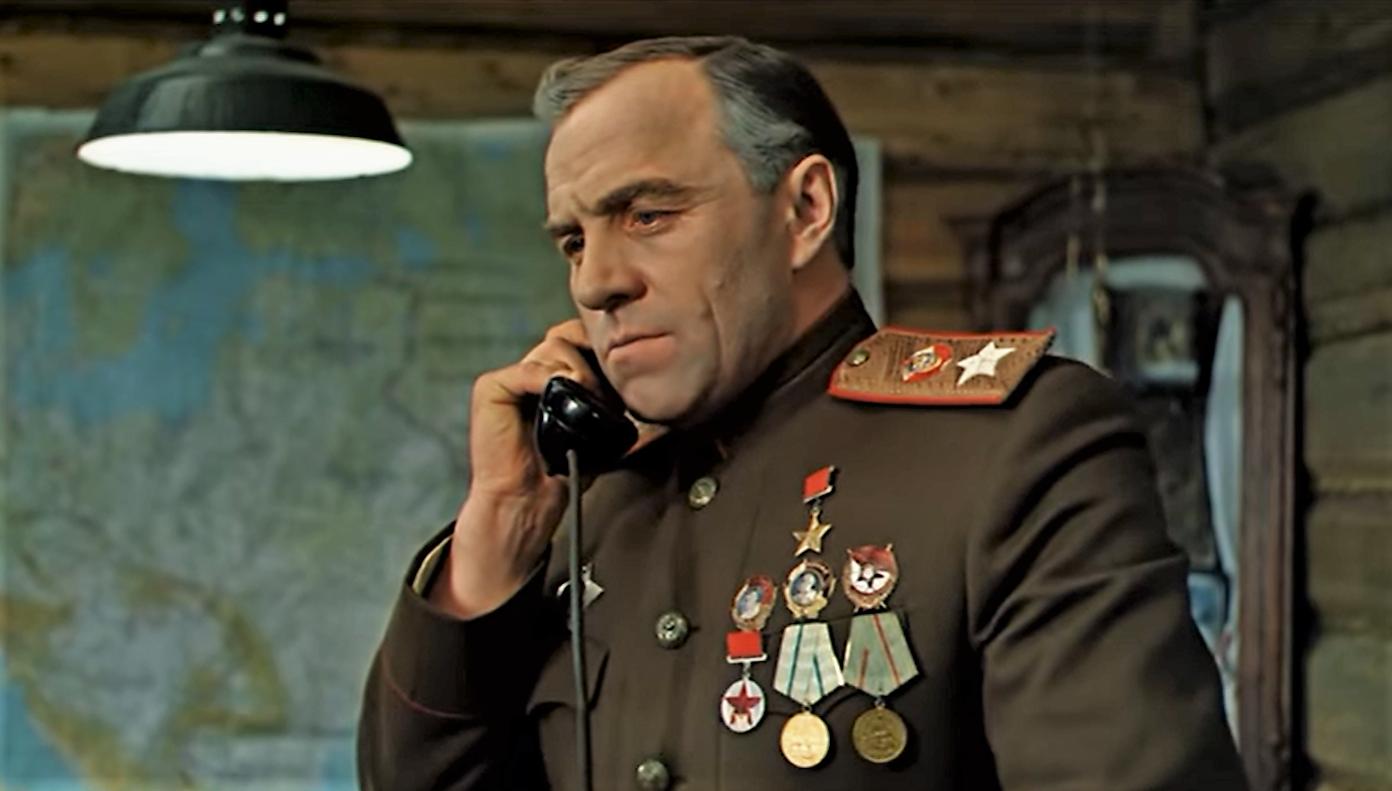
Mikhail Ulyanov, sturdy as victory architect Marshal Zhukov
Representations of 79 historical figures are mixed with dozens of fictional characters; some running thru the entirety of the five, with the leading exemplar of Russian/Soviet martial manhood played by ruggedly handsome Nikolay Olyalin. Often sequences that involve historical personages (talking strategy in the Kremlin or Berlin) are shot in black & white for a documentary ‘look’, switching to color for the action in the field. It’s a triumph for cinematographer Igor Slabnevich, shooting in 70mm. The arise-and-fight music score came from classical composer Yuri Levitin. Like any show about some historical event and the people in it, this one tells the story it wishes to, and leaves out that which doesn’t comport with its message. The dramatics are variable, ranging from compelling to corny, some characterizations are well drawn (Hitler isn’t done as a cartoon, the German generals are credited with skill), others sketchy (Stalin gets a pass, Roosevelt and Churchill are poorly served), and several of the fictional folk land in cliche territory. Lackluster subtitling is an issue. Not only are speakers of their respective languages subtitled in English but that in turn is voiced-over by Russian narration. The later re-dubs have modern slang tossed in: who ever called someone an “airhead” in 1943?
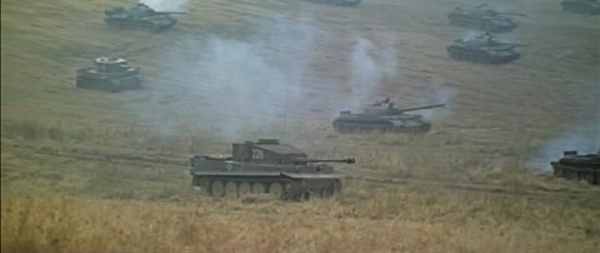
But what’s on view is staggering in scope and detail. The huge battle scenes (on fields, forests, swamps, rivers, villages and cities) are sweeping and incredibly complex jaw-droppers involving 150 tanks, hundreds of artillery pieces, over 5,000 extras and enough full-scale pyrotechnics for twenty movies. It’s hard to believe that a lot of guys (many were actual serving soldiers ‘recruited’ to play their fathers) weren’t hurt in the mayhem. No film, no matter how large, could ever get close to the immense scale of the battles on the Eastern Front, the biggest ever waged on the planet, but this production goes all-out in trying to suggest at least some digestible idea, pieces of pieces. Today of course it would mostly be done with CGI, technically brilliant but with little visceral impact.
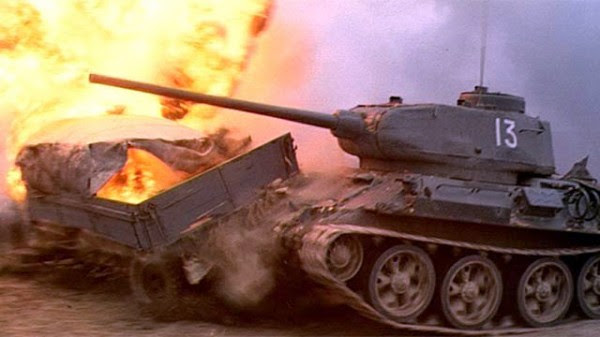
It’s reported that the USSR’s Communist Party instructed all members to buy tickets and that a dutiful 56,100,000 comrades watched the first segment. Official Soviet government statistics (trust us?) said 400,000,000 tickets were sold worldwide. Well, maybe. Then again, maybe I’m young, tall and rich. As for director Yuri Ozerov, he wasn’t thru with The Great Patriotic War. In 1985 he commanded another bruiser, the two-parter Battle Of Moscow and in 1989 came out with his volley on Stalingrad.
What’s conveniently left out? Where to start…uh, 1939 thru 1942, in their dismal entirety. Stalin’s insane 1936-38 decimation of the Red Army’s officer corps was a blessing to Hitler. The USSR’s 1939 pile-on to plunder Poland? Never mind. Stalin refusing the Red Army to aid the Warsaw uprising. Zip mention of American aid (that trifling 400,000 trucks and jeeps, 14,000 planes, 13,000 tanks, 1,900 locomotives and 11,000 railcars, etc, etc). The ghastly mass-rapes, not just in Berlin (hundreds of thousands of victims) but all thru eastern Germany and other countries ‘liberated’? Silence.
Picking at the fault lines in a 1960’s script overseen by a totalitarian government doesn’t discount the incalculable sacrifice made by the Russian people in destroying 80% of the Nazi war machine. They showed, as did our fathers, that fascists only see the light when its rammed down their lying throats.
 Movies ala Mark
Sounds epic. Thanks for the intro to a film I’ve never heard of.
Was wondering if you would be interested in becoming a member of The Classic Movie Blog Association? I’m a member. July is one of the months that we accept new members, and I think you would be a wonderful addition to the group. If you’re interested you can either email me through my contact page, or you can get in touch with the CMBA directly at classic.movie.blog.assoc@gmail.com
Maddy