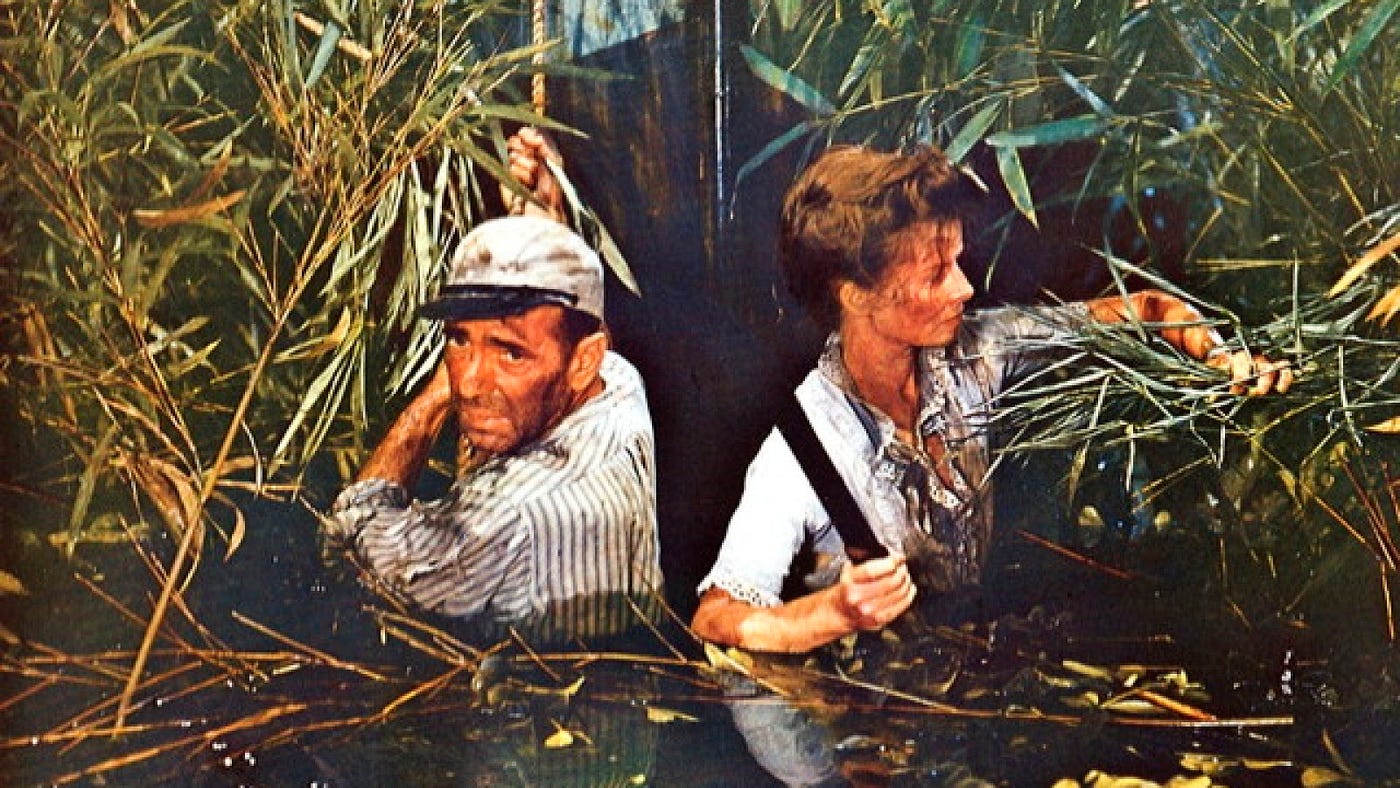
THE AFRICAN QUEEN journeyed into cinemas at the tail end of 1951, premiering in Los Angeles on the day after Christmas. A couple of sweltering, sickness-stricken months of location shooting in East Africa under the drolly indulgent eye of director John Huston spun 257 pages of C.S. Forester’s 1935 novel into 105 minutes of Technicolor glory, winning a gallantly scruffy Humphrey Bogart an Oscar and immortalizing Katharine Hepburn as a heroic and endearing example of a “crazy, psalm-singing, skinny old maid!” *
September, 1914. ‘The Great War’ has begun in Europe. In the far-Southern front of Germany-controlled Tanganyika, ‘Rose Sayer’ (Hepburn, 44) flees when the mission station run by her brother is attacked—the Sayers are English. Her literal vessel of deliverance is the ‘African Queen‘, a battered 30-foot launch skippered by similarly worn river rat ‘Charlie Allnut’ (Bogart, 51), a Canadian (as such, a foe of the Kaiser). As the homely little craft and its odd-couple ply downriver hoping to skirt past enemy forts and patrol boats, Rose convinces Charlie that they outfit the Queen with home-made torpedoes and use it to sink the Königin Luise, a large German gunboat. That wistful hope at striking a blow first entails running rapids, surviving storms and gunfire, sickness and creatures, and desperately hacking their way thru a large swamp. En route, their differences in backgrounds and styles at first clash, then mesh, and ultimately bloom.
“It’s a great thing to have a lady aboard with clean habits. It sets the man a good example. A man alone, he gets to living like a hog.”
Rigged for $1,000,000, delivering $11,800,000 in the US alone, the 8th most popular box office attraction from 1951 endures as a beloved classic. Calling the 106 minutes of fun-thru-peril an Adventure picture is easy—but, hold your 4-inch leeches! It’s also a Drama, a Comedy, a Romance, and a War story. John Collier wrote the first screenplay, then James Agee and Huston refashioned it, followed by Huston’s friend Peter Viertel, who worked it over during the shoot. Collier and Viertel didn’t receive screen credit.
“Nature, Mr. Allnut, is what we are put in this world to rise above.”
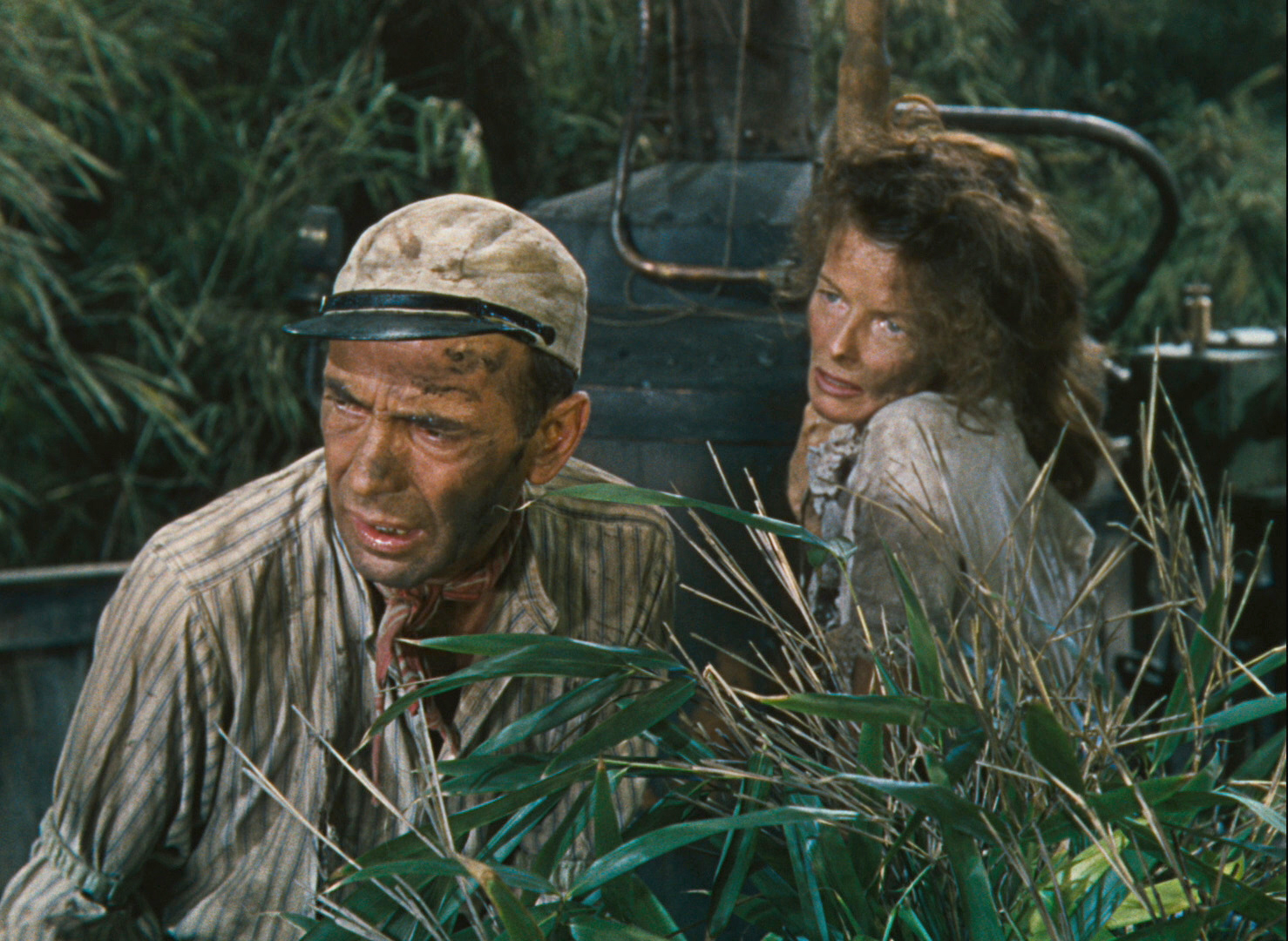
Cast & crew went thru the equatorial ringer in Uganda (on Lake Albert and at Murchison Falls on the Nile) and around Biondo and the Ruki river in the Belgian Congo. Some scenes, too risky to try for real, were done in studio sets back in England: Huston may have relished the idea, but there was no way the actors were going to slip into a real swamp and drag a boat thru choking plants, ferocious bugs and unfriendly reptiles. As it was, the settings and conditions saw nearly everyone fall ill at one point or another. Never mind the hippos, crocodiles, black mambas, hornets and soldier ants.
“I never dreamed that any mere physical experience could be so stimulating!”
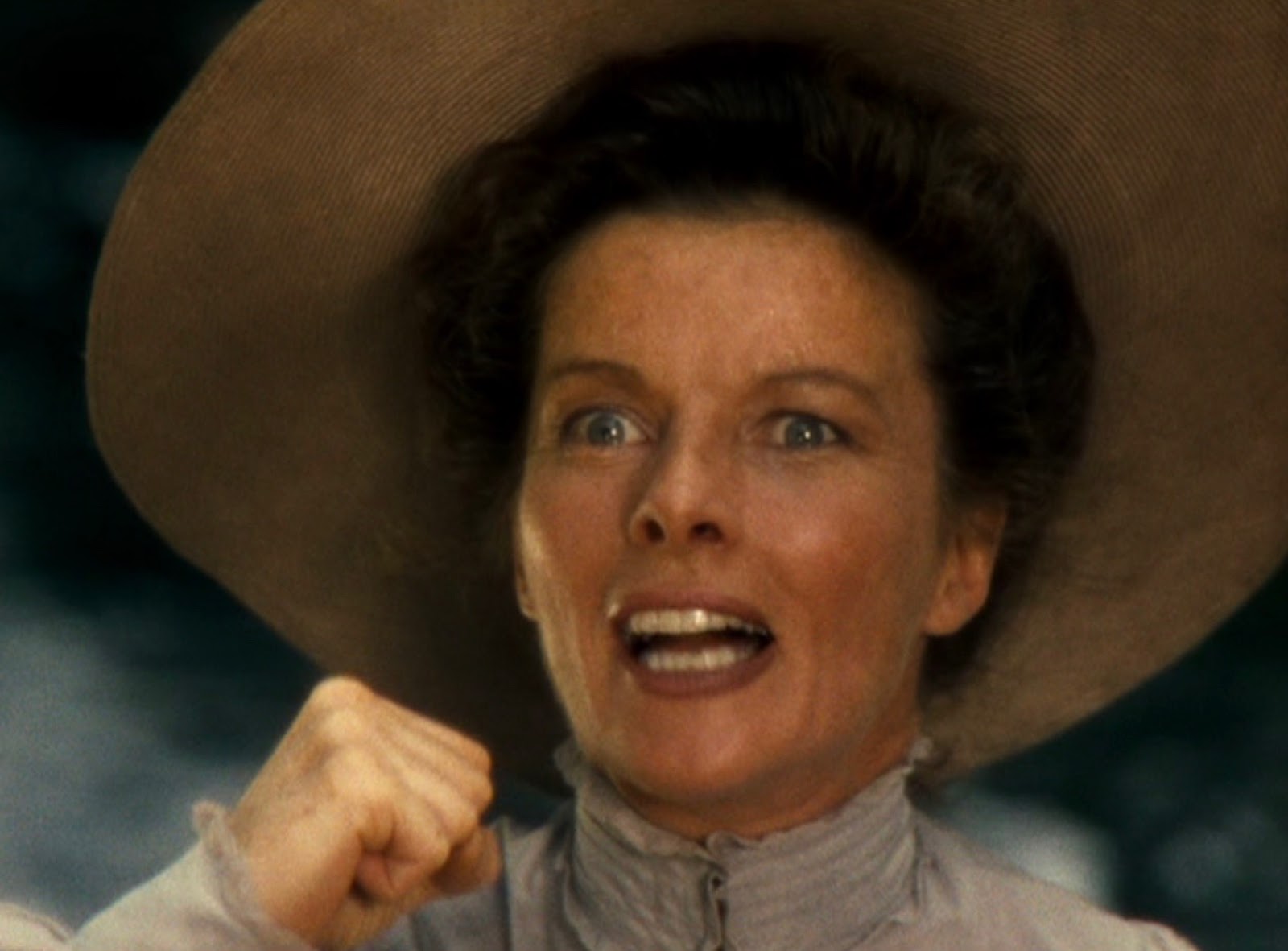
Bogart’s fan-gratifying win was backstopped with nominations for Hepburn for Best Actress, Huston for direction and Huston & Agee for the screenplay. The dissimilar stars take their surface mismatching past rollicking entertainment into deceptively elegant art. Hepburn could command attention as a regal virago (The Lion In Winter), a haughty socialite (The Philadelphia Story) or emotionally wrecked dreamer (Long Days Journey Into Night) but she really won over audiences when playing someone shedding inhibitions to awaken suppressed longings. She offered that “With Lizzie Curry (The Rainmaker]) and Jane Hudson (Summertime) and Rosie Sayer—I was playing me. It wasn’t difficult for me to play those women, because I’m the maiden aunt.” A classy way of accepting credit without taking it.
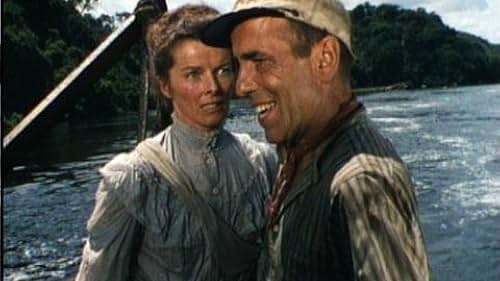
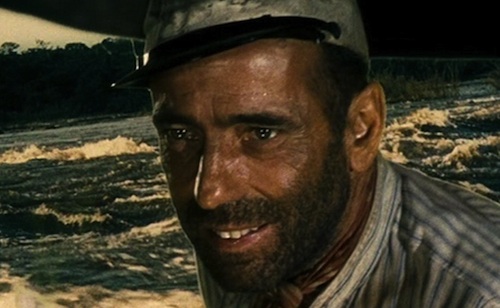
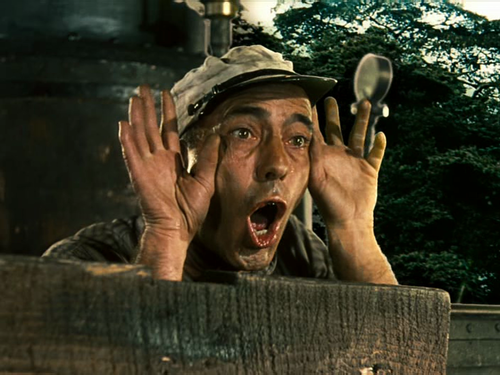
Bogart, with twenty years and 66 feature credits under his probing gaze and signature lisp had only logged a few that were light-hearted (heads up Sabrina and We’re No Angels); the gin-friendly rumpled realist and surprise romantic Charlie Allnut may not be his most iconic incarnation (The Maltese Falcon, Casablanca) or most intense (The Treasure Of The Sierra Madre, The Caine Mutiny) but it’s surely his most disarming and winning, whether in lament of over spilled booze, capering like a kid while doing wacky animal impressions (tickling Katie to no end), shivering in disgust under a flotilla of leeches. Heroes aren’t always handsome, dashing and dressed to impress: for his steady cool under gunfire or under pounding from roiled waters, with his dignity is ruffled by Katie’s demands, his soul touched by her courage, and his f-you when the jig looks to be up Charlie earns our medal of honor.
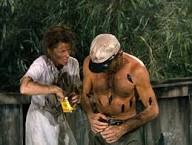
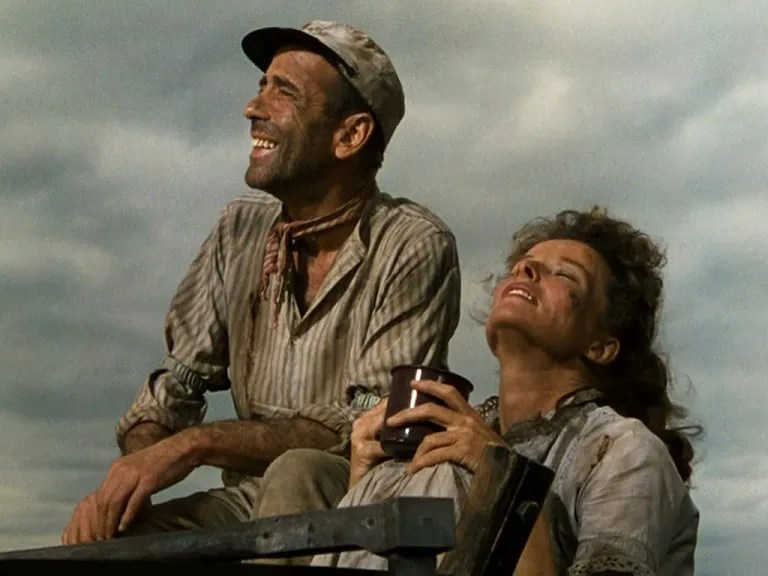
CHARLIE: “Ah, pinch me, Rosie. Here we are going down the river like Antony and Cleopatra on their barge. If it hadn’t been for you, this couldn’t be. Don’t you feel proud of yourself?” ROSE: “Certainly not. Look at the way you kept the engine going. Look at how you mended the propeller. It wasn’t me at all. I don’t think there’s another man alive who could have done it.” CHARLIE: “How right you are, Rosie, ’cause no other man alive’s got you. I’ll never forget the way you looked going over the falls: head up, chin out, hair blowing in the wind. The living picture of the heroine!” ROSE: “Fancy me, a heroine. Oh Charlie, you’ve lost your mind.” CHARLIE: “Lost my heart, too.”
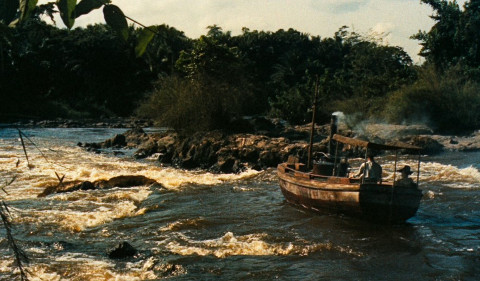
Anyone who ever took the Jungle Cruise in Disneyland owes some of the smiles that ride provided to the craft used in this show: formerly the S/L Livingstone, she was built in 1912. Robert Morley plays Rose’s brother, ‘Reverend Samuel Sayer’. The officious officers of the Luise are represented by Peter Bull, Theodore Bikel (27, first feature credit) and Walter Gotell.
Behind the scenes—Allan Gray’s score gets too obvious in the ‘jolly’ vein, but that debit is moot next to the finesse in very other aspect. That it looks great, thank cinematographer Jack Cardiff, whose mastery of Technicolor had shown up in Black Narcissus and The Red Shoes. The Assistant Director was Guy Hamilton (top dog on Goldfinger and Battle Of Britain); Ted Moore, who’d shoot the first seven Bond films, was the camera operator; Edward Scaife toiled as 2nd unit cameraman (he’d take the lead job on Khartoum, The Dirty Dozen and Dark Of The Sun) and the boom operator was Kevin McClory, 14 years away from producing and co-writing Thunderball).
* Bogart: “All I ate was baked beans, canned asparagus and Scotch whiskey. Whenever a fly bit Huston or me, it dropped dead….While I was griping, Katie was in her glory. She couldn’t pass a fern or berry without wanting to know its pedigree, and insisted on getting the Latin name for everything she saw walking, swimming, flying or crawling. I wanted to cut our ten-week schedule, but the way she was wallowing in the stinking hole, we’d be there for years.” Deploring their copious consumption, Hepburn (who knew serious drinkers when she saw one, learning from Spencer Tracy’s bottle battles) resolved to stick with water, and was stricken with dysentery as a result.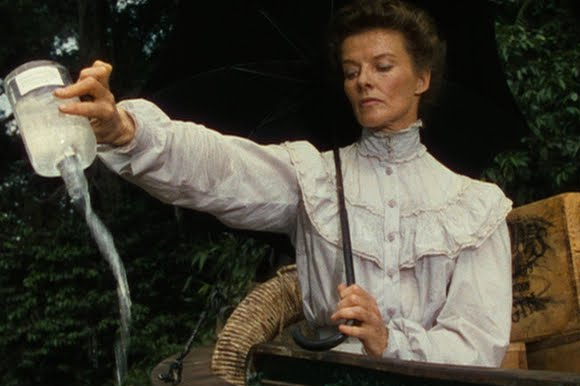
When she was 80, Hepburn published her memories in “The Making of the African Queen: Or How I Went to Africa With Bogart, Bacall and Huston and Almost Lost My Mind.” Kate: “Those two (men) had so much alcohol in their system no germ could possibly survive there”. About Huston: “He told me to base my character of Rosie on Eleanor Roosevelt when she visited the hospitals of the wounded soldiers, always with a smile on her face…It was the best piece of direction I had ever heard.”
Agee, on the danger-defying director: “A natural-born anti-authoritarian individualistic libertarian anarchist, without portfolio.”
Two years after the events, co-writer Viertel published his novel “White Hunter Black Heart“, a thinly disguised take on the experience; it was eventually filmed by Clint Eastwood in 1990 (Clint playing the Hustonish character).
Rosie vs “Stella!!!“—Oscar snobs (think wine noses) twit Bogie’s trophy for unlikely hero Charley over Brando’s decidedly anti-gallant ‘Stanley’ in A Streetcar Named Desire. True that while Allnut is Bogart’s most purely likable character, he may have been given career consideration, considering iconic yet award-absent treasures in Casablanca and The Treasure Of The Sierra Madre. And 26-year-old Marlon was a stage upstart with only one previous film credit, 1950’s The Men. Who’s better? Who says? Who would you rather spend time with?
“By the authority vested in me by Kaiser William the Second I pronounce you man and wife. Proceed with the execution.”
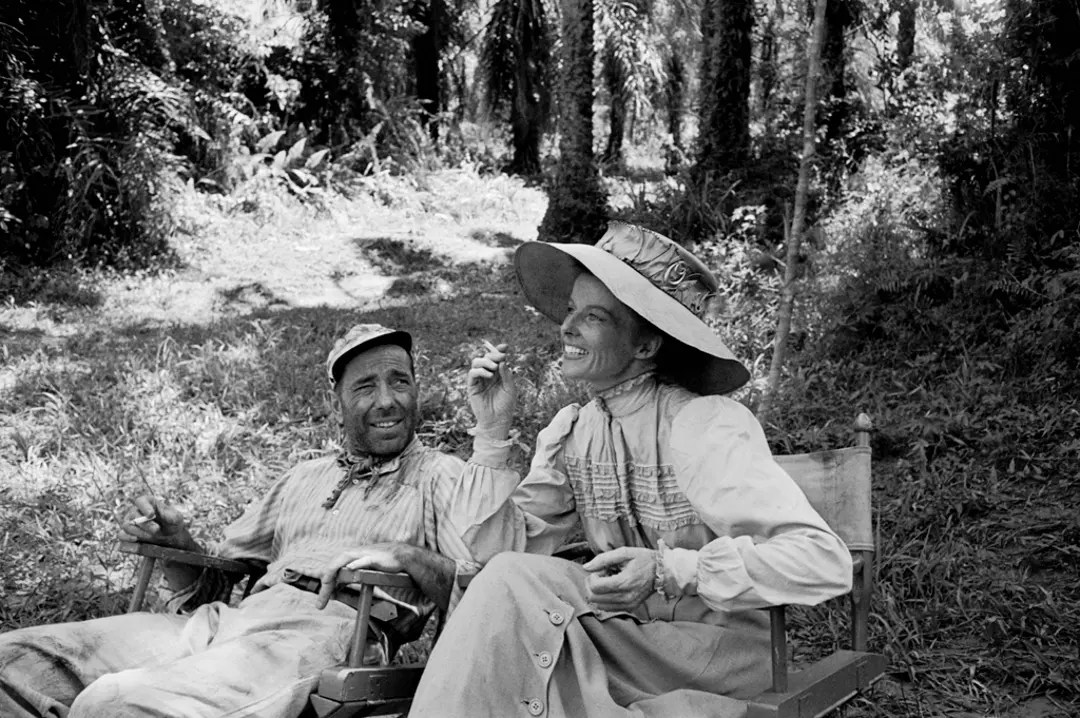
Taking a break

