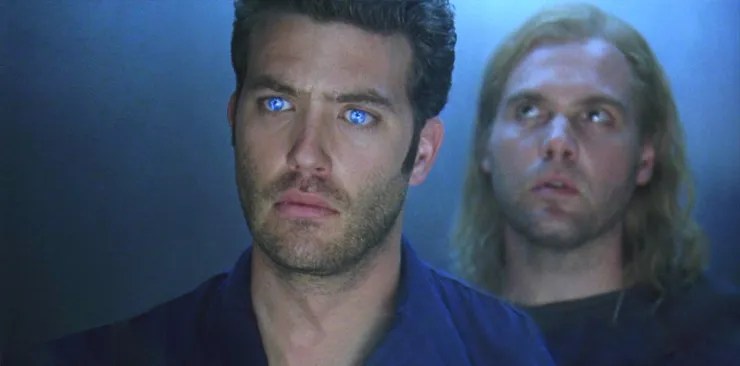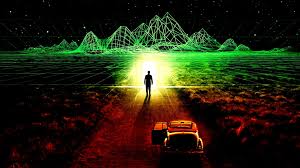
THE THIRTEENTH FLOOR, engaging sci-fi from the ‘simulated reality’ zone, arrived in May of 1999. Critics dinged and the box office was a dud. The key tappers were overly harsh (watching this, entertained, the thought ” bet it got lousy reviews” popped up—I won my bet) and some of the lackluster response had to do with David Cronenberg’s eXistenZ, which came out the month before and was liked by reviewers. But more likely a red pill had dropped with full force the month before that, with The Matrix, outspending, out dazzling, outmaking and managing to convince a lot of sentient humans that we live in a make-believe construct. You’d think that the miscreants who are picked to lead us and the religious fantasies billions swallow would be enough proof without relying on cool special effects. *
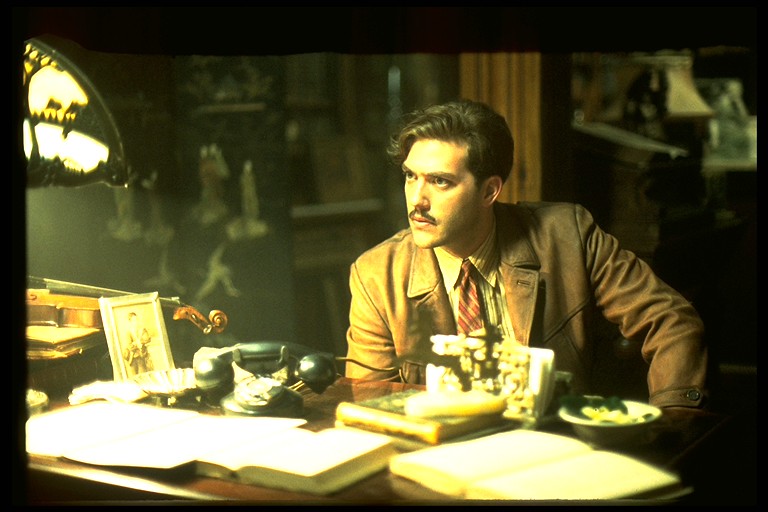
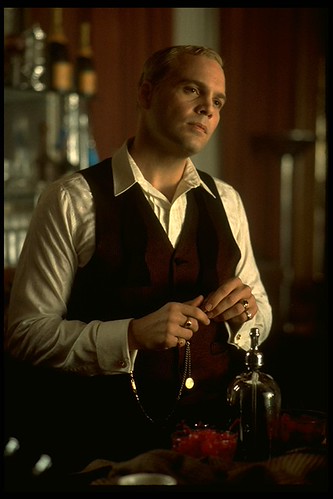
In the modern-day L.A. of 1999, rich gentleman ‘Hannon Fuller’ (Armin Mueller-Stahl) owns a computer company that has invented a virtual reality simulation gizmo that enables users to enter a full-on-lifelike Los Angeles of 1937 and interact as a different self. They look the same, as do others they encounter, familiar faces with flip-flopped attitudes and behaviors. A murder investigation draws in ‘Douglas Hall'(Craig Bierko), Fuller’s protégé, who becomes the chief suspect of an abrasive detective (Dennis Haysbert). Fuller’s mysterious daughter ‘Jane’ (Gretchen Mol) shows up with the intent to shut down the faux-reality system and the entire business. Hall needs to prove his innocence, with help from programmer ‘Jason Whitney’ (Vincent D’Onofrio). In the 1937 mode, Jason is ‘Jerry Ashton, Hall is ‘John Ferguson’ and confusion is the order of the night.
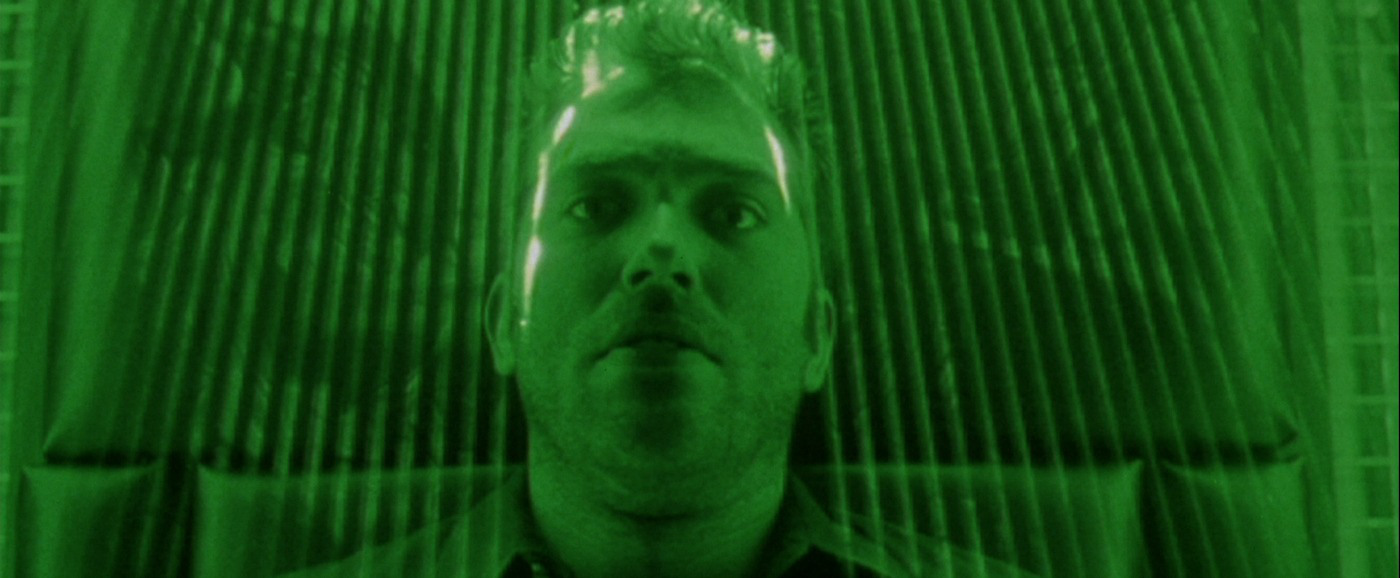
Tension is present from the start and is held for most of the 100 minutes, slipping in the last fifth, with a too easy call-it-quits finale. The recreation of bygone L.A. is done with the now-standard de-saturated visual texturing, effects are decent, the acting varied. Hall is sturdy, Mol not very intriguing, Mueller-Stahl typically reserved, Haysbert rather obvious and D’Onofrio is once again let loose to be weird—how often has he ever played a normal, everyday person? **
Josef Rusnak directed, co-writing the script with Ravel Centeno-Rodriguez. While trumped by The Matrix and trampled by reviewers, the storyline had been around since Daniel F. Galouye’s novel “Simulacron-3”, published in 1964. It was first filmed in 1973 by Rainer Werner Fassbender for a two-part German TV movie called World On A Wire. The 1999 display drew an anemic $11,900,000 in America (112th place) with just $6,000,000 elsewhere, an alternate world away from recovering the $16,000,000 outlay.
With Shiri Appleby, Leon Rippy, Jeremy Roberts and Alison Lohman.
* Pill on. Surreal or too real?—The Butterfly Effect, Open Your Eyes (freaked me TF out), and its remake Vanilla Sky, Slaughterhouse Five, The Truman Show. Donnie Darko, Eternal Sunshine Of The Spotless Mind, Dark City, Cloud Atlas, The Family Man, Everything Everywhere All At Once.
** Musical notes—(1) Harald Kloser’s score holds a definite Jerry Goldsmith vibe. (2) Look quick and spot Johnny Crawford (52, of The Rifleman) as a singer in one of the 30s’segments; he’s with JCO, the swing band that he led. (3) The credits close out with a neat song “Erase/Rewind”, by The Cardigans.