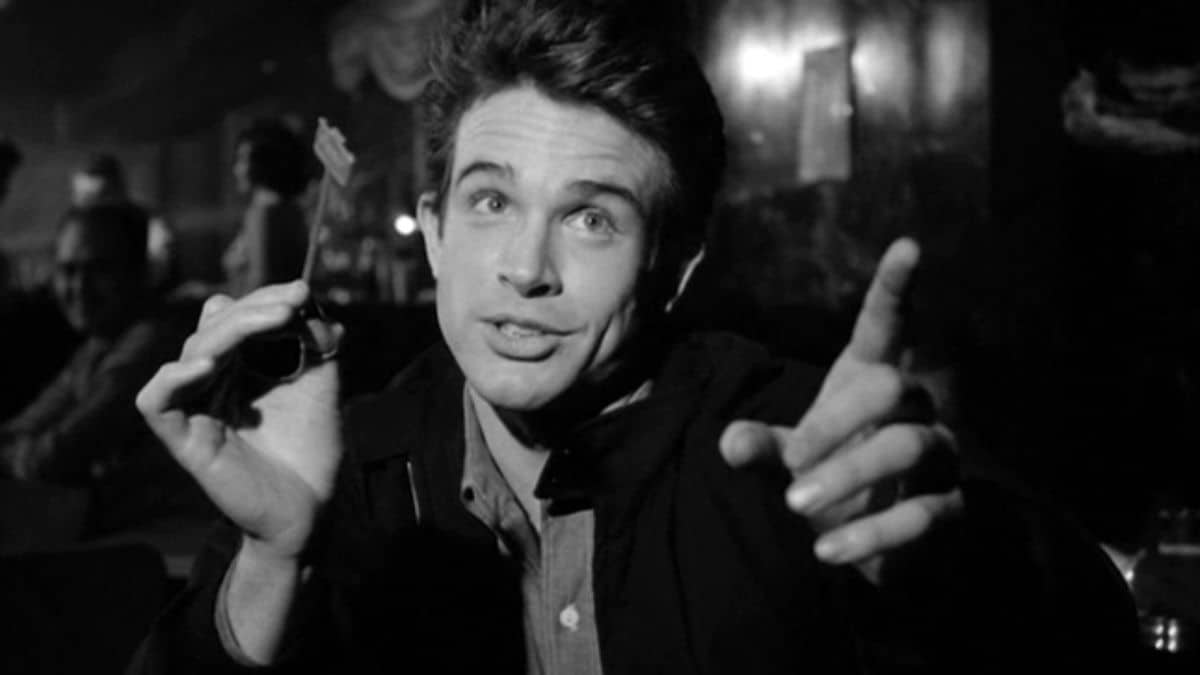
MICKEY ONE is unfortunately not a Mantle, Rooney or Mouse situation, the kind that brings you to your feet with a switch-hit home run, dazzles with innate chutzpah from a pint-sized dynamo or provokes tossing out poisoned cheese after an ethics lesson from a cheerful rodent. Instead,temples are rubbed over the case of a Beatty, Penn & Surgal (no, not a bill-boarded personal injury law firm) aping of French New Wavy angst about corrosive Capitalism, fragmented individualism, the ego-creed complex, and who knows what else?—cue the sum-up from Warren (star) about Arthur’s (director) wrestle with Alan’s (writer) fever-dreamed theme teem: “We had a lot of trouble on that film, because I didn’t know what the hell Arthur was trying to do and I tried to find out. I’m not sure that he knew himself.” Now you tell us. Hang on for S.O.L. on steroids in black & white closeups, a gallery of in-your-face grotesques deliberately designed to be off-putting (thus securing niche appeal with some) in 93 minutes that are just one Mickey from a platoon of joy kills that assaulted 1965. *
“I told you no; I told you my life in your hands, no! What right you got to turn me for some Virgin idea you’re a God with my life? You’re a slut with a snake in your mouth. DIE!!!!”
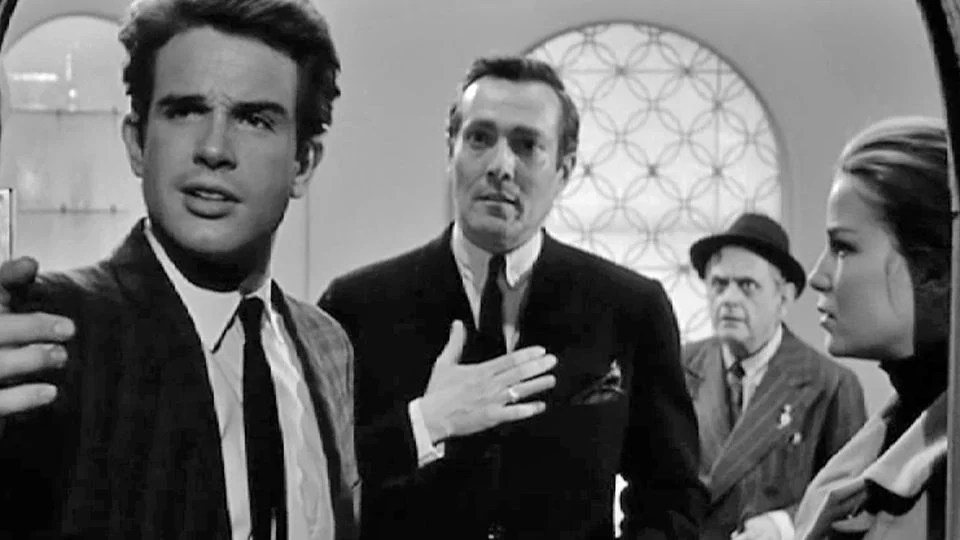
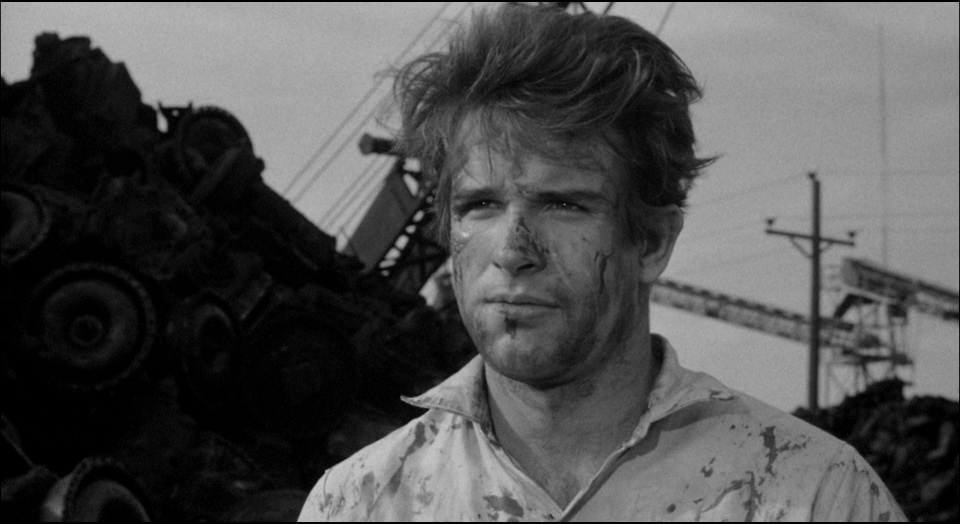
Owing large to The Mob, a brash stand-up comic (Beatty, 27) flees Detroit for Chicago, and rips off a Social Security card from a derelict named ‘Miklos Wunejeva’. As ‘Mickey One’, he crawls up the rancid food chain from hauling garbage at a gross diner, making enough to secure a flop house dive. At length he gets a shot at doing nightclub comedy again (hard to see why considering he’s as funny as a head wound), but finds out that he’s still under the thumb of ‘The Man’–or men, or the machine, etc. Much angry shouting, pained posing, flashy insertions of heavy ‘meaning’ in the visuals, heated conversations that are so oblique they only serve as acting-class exercises/exorcises for the players, and no-one to give a damn about, not least the anti-hero schmuck at the center of the frenetic noise. Beatty gives it what he can, though even when mussed up more than a road kill you never forget you’re watching a disheveled Warren Beatty, playing at being down & out Joe Blow/Mickey One/stand-in for ordinary slobs. Hurd Hatfield looks to be having a fine time being slimy as ‘Castle’, who decides to promote/own Mickey and there are a few bits of watch-me-punks intensity from old pro Franchot Tone (59 looking 80), as a fellow who knew ‘Mickey’ before he was ‘Mickey’.
Plowed under by bad reviews and a $1,900,000 take super-glued to 105th place for the year, Mickey One is better received today. Though struggling with tone and form, we do credit the game actors. Penn’s try was among the era’s caught-in-a-web-of-dissociation scab rippers: notable efforts that were ahead of their time but unappreciated until later include the superb Seconds and striking The Swimmer; others, like Mister Buddwing, may as well be suicide pacts. **
Jazz enthusiasts will note that the soundtrack was arranged by Eddie Sauter and features Stan Getz (albeit the braying here is a far cry from “Desafinado” or “The Girl From Ipanema.”) With Alexandra Stewart (M1’s temporary girlfriend, not remotely believable), Jeff Corey (working furiously), Kamitari Fujiwara (sole US appearance from Japanese comic legend), Teddy Hart (piteously downcast Agent from Gloom) and Donna Michelle (1963’s Playboy Playmate Of The Year, one of the best known of the Heftian harem).
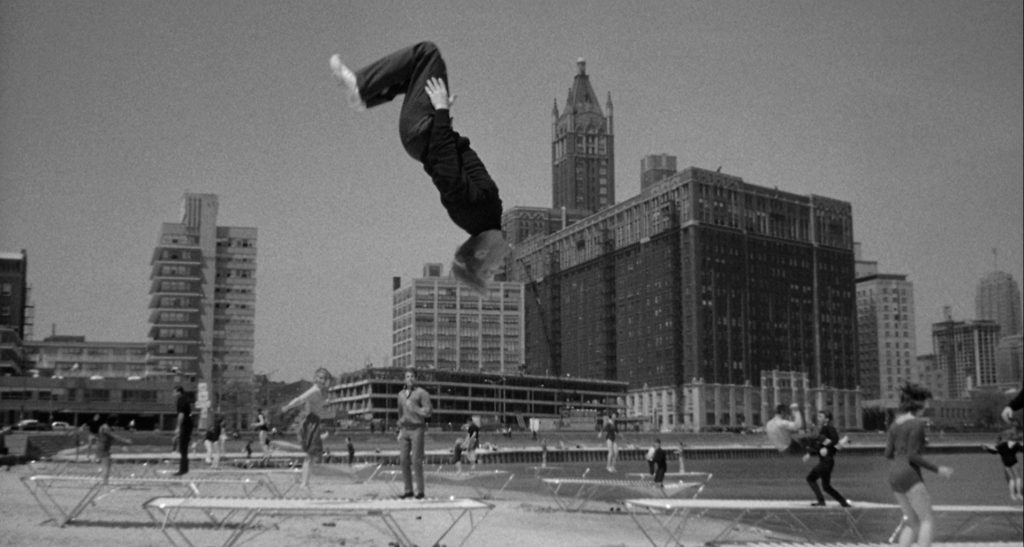
Ah, yes, the pointless ‘We Are All On Trampolines’ passage
* Was this the unhappiest movie of 1965? Some were certainly way better than others. But fun? Yeesh. Tough call, hard knocks: Darling, Baby The Rain Must Fall, Who Killed Teddy Bear?, Love Has Many Faces, Sylvia, The Pawnbroker, Lord Jim, Harlow (two crummy versions), Morituri, The Hill, Bunny Lake Is Missing, King Rat, The Spy Who Came In From The Cold, The Collector, The Slender Thread, Synanon, A Rage To Live.
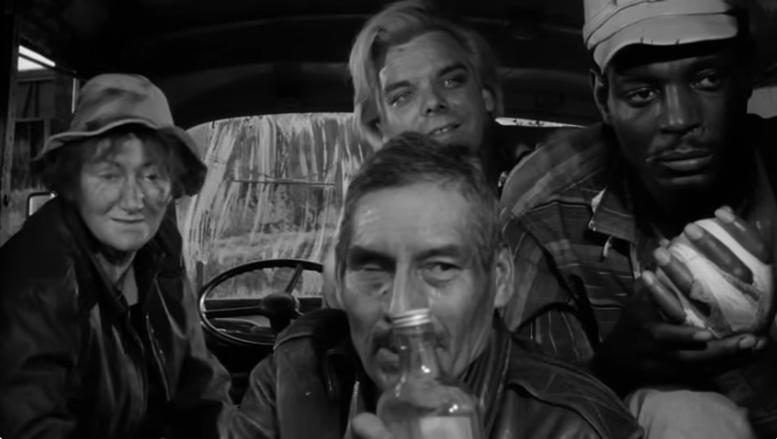
WB: “To me, the stand-up gags that the guy had to do in Mickey One were not funny and that was always my complaint with Arthur.” Outside of incontestably reigning the boudoir realm, for a great-looking guy with charm, smarts and talent it took a while for Warren to transfer personal charisma to professional payoffs. After his feature debut in 1961’s A-grade hit Splendor In The Grass Beatty drew six duds in a row (The Roman Spring Of Mrs. Stone, All Fall Down, Lilith, Promise Her Anything, Mickey One and Kaleidoscope) before batting it out of the park in 1967 with Bonnie And Clyde. In securing Penn to direct that surprise classic, Warren pulled him out of the trench Penn had dug by the dogged opacity of Mickey One and The Chase, more conventional but still a crowd downer and critical target, bigger and costlier.
** Penn: “You know, you could not have gone through the Second World War with all that nonsense with Russia being an ally and then being the big black monster. It was an absurd time. The McCarthy period was ridiculous and humiliating, deeply humiliating. When I finally did Mickey One, it was in repudiation of the kind of fear that overtook free people to the point where they were telling on each other and afraid to speak out. It just astonished me, really astonished me. I mean, I was a vet, so it was nothing like what we thought we were fighting for.” “I was trying to wed a social phenomenon to a liberalization of form.”
Fair enough, but cerebral cooked into confusion is a recipe for migraine-induced nausea.
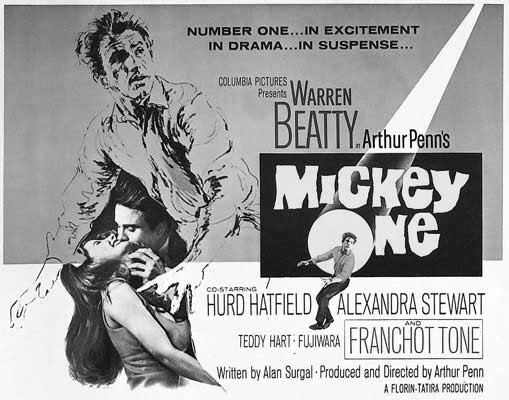
Was there ever “truth in advertising?”
 Movies ala Mark