
BURN, WITCH, BURN is the US title for this much-lauded 1962 horror piece; in Britain, where it was made, it went out as Night Of The Eagle. Whichever you’re spelled into enjoying, the genesis was Fritz Leiber’s 1943 novel “Conjure Wife”, first done as a movie the following year. *
” ‘I do NOT believe’. I do not believe. So, to recap: four words necessary to destroy the forces of the supernatural, witchcraft, superstition, psychic, etc, etc. And these, quote, are a morbid desire to escape from reality, unquote, and can only exist in an atmosphere of belief. Belief is vital. Deprived of that acceptance, it reveals itself as another futile attempt to control one’s environment and the forces of nature.” The teacher needs to be taught…
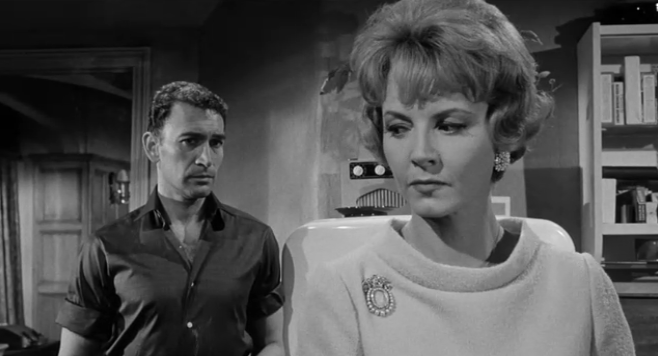
England, the stratified academia demographic. College psychology professor ‘Norman Taylor’ (Peter Wyngarde) scoffs at belief systems tied to superstition and folklore. He’s dismayed to find his wife ‘Tansy’ (Janet Blair) not only believes in but secretly practices obeah, a form of conjuring. When they argue he burns her collection of talismans and charms, horrifying her when his scorching includes an item she insists protects him. Sure enough, bad things begin to happen to Peter and others who know him, and he finds out that Tansy isn’t alone in her ties to an alternate universe; other faculty members are into serious wishing, with malicious intent.
Smartly witchcrafted conversations mark the dialogue; the camera work, art direction and special effects are imaginative, creepy, even startling, and the acting is strong. The offbeat and intense Wyngarde struts and poses with enough flamboyance he might as well be Peter En Garde! but it works well with his character’s intellectual arrogance. Blair’s concern turned to fright and frenzy is excellently interpreted, and among the fine supporting cast and motive-loaded teachers and students Australian actress Margaret Johnston takes top honors for her deliciously nasty immersion into the diabolical. Repeat viewings are recommended: there’s a lot going on in this intelligent chill fest.
American International Pictures shoveled a lot of schlock, but occasionally they planted a winner. Buying a treatment of Leiber’s novel from vaunted macabre masters Charles Beaumont and Richard Matheson, A.I.P. arranged production with an affiliate outfit in England (Anglo-Amalgamated), adding American actress Blair for home base insurance. British writer George Baxt (Circus of Horrors) did some tweaking, Sidney Hayers directed, with Reginald Wyer as cinematographer.
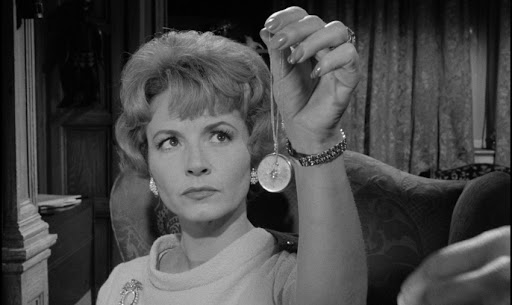
Janet Blair, 1921-2007
TANSY: “I’m sure you’re convinced I’m quite insane.” NORMAN: “I’m not convinced about anything. If we were to investigate all the strange rituals performed by women based on their so-called intuition, half the female population would be in asylums. I don’t know what to think!” If your wife was as smart, talented and hot as Janet Blair would it matter if she went from room to room on a broom? Even if her name was Tansy. Seriously, Tansy? Okay, Bellatrix, hold your wand: it’s shorthand for ‘Tanith’, which is pretty cool—in an ancient fertility goddess/serpent lady sort of way.
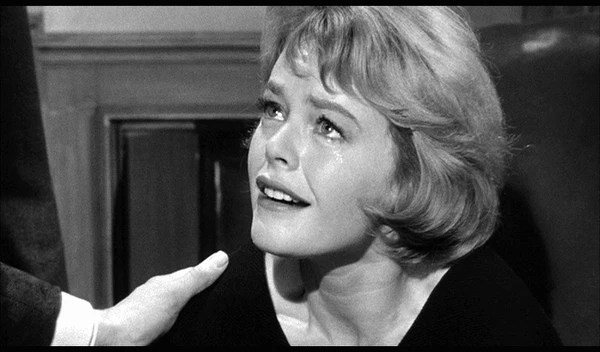
Nice work from Judith Stott, 1929-2010
The progressively weird atmosphere is aided & abetted by exiting scoring from the remarkably prodigious William Alwyn; those familiar with his ‘sound’ might notice his motifs here recall his tension-accenting work on the classic A Night To Remember. The British release clocked 87 minutes, the US version runs 90, led off by a narrated prologue intro from Paul Frees, giving an Orson Welles flourish to “Ladies and gentlemen, the motion picture you are about to see contains an evil spell, as used by practitioners of witchcraft for centuries. Even today, in many parts of the world, people practiced black magic and witchcraft. Charms, amulets, voodoo candles, grave dirt, and locks of hair are believed to ward off evil spirits and spells. You may doubt the effectiveness of these spells, but through every civilization, people have believed in witches. Could they all be wrong? I don’t think so. For I have see its power, proved too many times. I am now about to dispel all evil spirits that may radiate from the screen during this performance!” He recites a chant of some sort, then finishes “And now, with a free mind and a protected soul, we ask you to enjoy, “Burn Witch, Burn.”

Done up for around $200,000 (best we can figure the pound to dollar dif), it did quite well in the States, earning as much as $3,000,000. Effective turns in the supporting lineup come from Judith Stott (pretty and panicking), Colin Gordon (dryly speculating), Reginald Beckwith (ineffectually puffing) and Kathleen Byron (quietly seething).

* Leiber’s 224-page “Conjure Wife” first flick foray was 1944’s Weird Woman, a daft but entertaining Universal cheapie with Lon Chaney Jr. and Evelyn Ankers. A 1980 version was misconjured as a comedy, Witches’ Brew, which featured Lana Turner, 69, in her final film role, supporting Richard Benjamin and Teri Garr. Poorly reviewed, it expired at 132nd place.
Night Of The Eagle fits proudly with Britain’s late 50’s-early 60’s slate of superior films dealing in one way or another with the fantastic—The Quatermass Xperiment, The Curse Of Frankenstein, Horror of Dracula, The Day The Earth Caught Fire, The Innocents, Quatermass 2, Night Of The Demon, Village Of The Damned, The Brides Of Dracula, Gorgo, Mysterious Island, Jason And The Argonauts, The Day Of The Triffids, The Haunting...
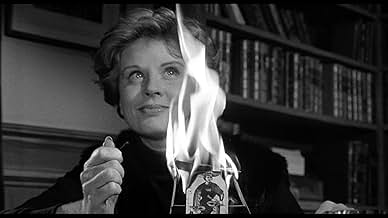
Margaret Johnston, 1918-2002
 Movies ala Mark