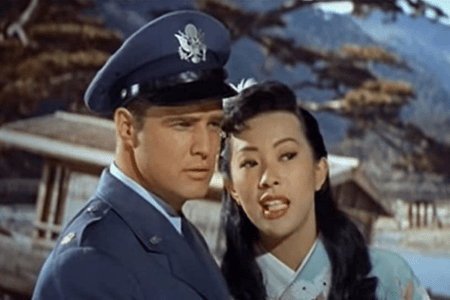
SAYONARA was a huge hit from 1957, third in line after The Bridge On The River Kwai and Peyton Place. Like Peyton it dealt with romance vexed by circumstance, and similar to Kwai it involved with the military, a war and the Japanese. Set in Occupied Japan of 1951, the war this time was in Korea, combat was mentioned only in passing and the Japanese were civilians, women who had the fortune/misfortune to fall in love with equally besotted American servicemen: the personal choices and hopes of all of them face off against cruel official edicts and ingrained cultural prejudices. Sensitively directed by Joshua Logan, the script by Paul Osborn (The Yearling, East Of Eden, South Pacific,Wild River) adapted James A. Michener’s quasi-autobiographical 1953 novel. Made on location in Japan for $1,400,000, the domestic gross of $24,600,000 was internationally reinforced with perhaps $10,000,000 more. Acclaimed in reviews, embraced by the public, it went up for 10 Academy Awards, winning four. *

‘Lloyd Gruver’ (Marlon Brando) is a Major in the US Air Force, nicknamed ‘Ace’ for his combat victories as a fighter pilot in the skies over Korea. He’s bound for promotion and a career in the service, and gets a push in that direction when the General father of his fiancée ‘Eileen Webster’ (Patricia Owens) has him reassigned to a base in Kobe, Japan, where Eileen shows up for a visit. Lloyd’s crew chief , enlisted airman ‘Joe Kelly’ (Red Buttons) is also ready for marriage, in his case to ‘Katsumi’ (Miyoshi Umeki), a local Japanese. The military frowns on fraternization, but despite the guarantee of enforced separation, Kelly is adamant and asks Lloyd to be his best man. Skeptical, Gruver agrees, but when he meets traditional dancer ‘Hana-ogi’ (Miiko Taka) he becomes enamored with her, which not only brings his planned marriage to Eileen to a halt, but jeopardizes his shoo-in career. Pressure from the Air Force is relentless, and there is also resentment from many Japanese toward the Americans dating from the previous war and their own prejudices. Gruver’s buddy Marine Captain ‘Mike Bailey’ (James Garner), also involved with a Japanese woman, is sympathetic, and an added twist comes when the dejected Eileen meets lauded Kabuki performer ‘Nakamura’ (Ricardo Montalban) and the two develop feelings for one another.

The location work is striking and Franz Waxman composed a lovely score to accentuate the moving drama, which runs a measured, unhurried 147 minutes. The property was originally planned by Logan as a musical and Irving Berlin wrote the song “Sayonara” for it. Similar to Casablanca, where Max Steiner wove Herman Hupfeld’s “As Time Goes By” into his score, Waxman smoothly blended Berlin’s plaintive tune into the soundtrack.

“Then permit me to reassure you. I think Major Gruver is brave, but, uh, not so brave enough to face the censure that would result from such a marriage. As for our famous, honored Hana-ogi, there are many Japanese – most of them, in fact – who look upon marriage to an Occidental with as much distaste as your people do to one of us. I do not feel that way, but then I have had the privilege of traveling in your country and knowing some great people there. And I am especially conscious at this moment that beauty is not confined to any one race.”

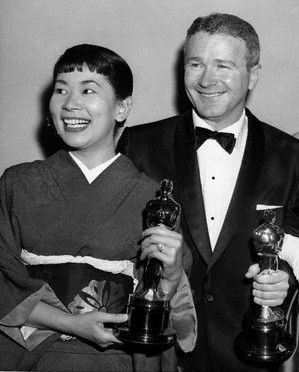
Stage & TV comedian Buttons, 38, was billed as “presented” in this role. Later in his career, he’d tend to irritatingly mug (Hatari!, Stagecoach, The Poseidon Adventure) but he’s good here, and Japanese singer Umeki, 28, is winning; they came away with Oscars for their supporting performances. Canadian-born Owens, is very good. 32, she’d been acting in England for 14 years; 1957 gave her an American introduction with this, Island In The Sun, also a big hit and the well-done No Down Payment. Interned in the States during WW2, Miiko Taka, 31, debuted in her role, and does very well.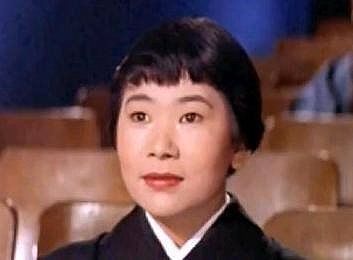 It was a strong showing from Garner, 28, his second year in the business also marked by starting TVs Maverick: one year later he drew his first lead in a feature with Darby’s Rangers. He comes across with easy, unforced naturalism. The casting of Montalban always gets pasted, simply because “he’s Ricardo Montalban and not Japanese”, but the makeup is subtle and there’s nothing lacking in his sincere performance. Kent Smith does all right as the string-pulling ‘Gen. Webster’, but it’s rather a stretch to accept a general be so spineless. With the commendable work from all the above it’s odd that the weak link comes from the star. Some praise Brando’s work in this (and he drew his 5th Oscar nomination) but we’re in the minority: the corn pone Southern accent he chose feels purely arbitrary, he’s so mannered it’s practically a Brando imitation; he does everything but pick his nose. To play fair, one example of a Brando performance that was unfairly pilloried was in the 1962 remake of Mutiny On The Bounty. We thought he was excellent in that epic, and steadfastly defend him there, but we can’t buy him for a minute in Sayonara. The character went to West Point yet Marlon mumbles him like a refugee from Dogpatch. The story is so viable and the rest of the production is solid enough to make up for it.

Besides sympathy wins for Buttons and Umeki, Oscars went to the Art Direction and Sound, with nominations for Best Picture, Director, Actor (Brando), Screenplay, Cinematography and Film Editing. That Waxman’s score was overlooked had Logan was furious: “What a shock, ridiculous”, considering its contribution “to the emotion and authenticity of the picture.”
With Martha Scott (Eileen’s disapproving mother), Douglass Watson (bigoted ‘Col. Crawford’), Reiko Kuba (Garner’s girlfriend ‘Fumiko’), the Shochiku Kagekidan Girls Revue, James Stacy.
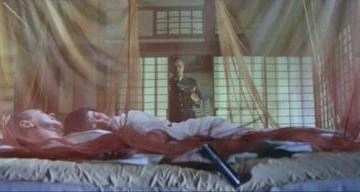
* James A. Michener knew the background first-hand. WW2 naval service in the Pacific generated his Pulitzer-winning debut “Tales Of The South Pacific”. Set during the Korean War, his fourth, 1953’s “The Bridges At Toko-Ri” became a fine film the following year. In 1955 he married Mari Yoriko Sabusawa, a Japanese-American who’d been interned in the States during WW2. Joshua Logan directed the Broadway adaptation of ‘Tales’ which, after Sayonara, was filmed as South Pacific, Logan directing and Paul Osborn adapting the script. For Michener, not only was “Sayonara” close to his heart, it was also, for him, relatively brief at 243 pages. His massive-length, epic bestsellers commenced in 1959 with “Hawaii“.
Though bobbing forgotten in its wake, proceeding much admired Sayonara into 1957 were two more Japan-set items, the woeful comedy Joe Butterfly, placing 66th, scarred by a cringeworthy performance from the normally adept Burgess Meredith, and Escapade In Japan, with Cameron Mitchell and Teresa Wright, a well-reviewed, little-seen (#112) family drama that offers an unaccredited spot from a rangy 27-year-old dude named Eastwood.

 Movies ala Mark