
BAREFOOT IN THE PARK was the 12th most popular movie of 1967, adapted into a screenplay by Neil Simon from his play that ran for four years on Broadway, cruising thru 1,530 performances. Three cast members from the play (Robert Redford, Mildred Natwick and Herb Edelman) came along, with Jane Fonda replacing the play’s Elizabeth Ashley as the female lead. Gene Saks directed (his feature debut) the $2,000,000 comedy, which won audience approval of $22,500,000 and got Natwick an Oscar nomination in the Supporting Actress category. *
“Make him feel important. If you do that, you’ll have a happy and wonderful marriage – like two out of every ten couples.”

After a six-day come-up-for-air honeymoon marathon newlyweds ‘Paul’ (Redford) and ‘Corie’ (Fonda) move into a Greenwich Village apartment. The place is cramped and in dire need of repairs, the other residents are either eccentric ot weird. New not just to marriage but to his job as a fledgling lawyer, Paul is conservative to the point of being a drag, while adventurous and amorous Corie is a bundle of nervous excitement. When her mother ‘Ethel’ (Natwick), now single and lonely, visits, Corie sets up a dinner-date foursome with upstairs neighbor ‘Victor Velasco’ (Charles Boyer), worldly bon vivant and genial Lothario. Things get wild and wacky, and by the time the night out ends, Corie is so despairing of Paul’s sourball attitude that she launches ballistic and demands a divorce.
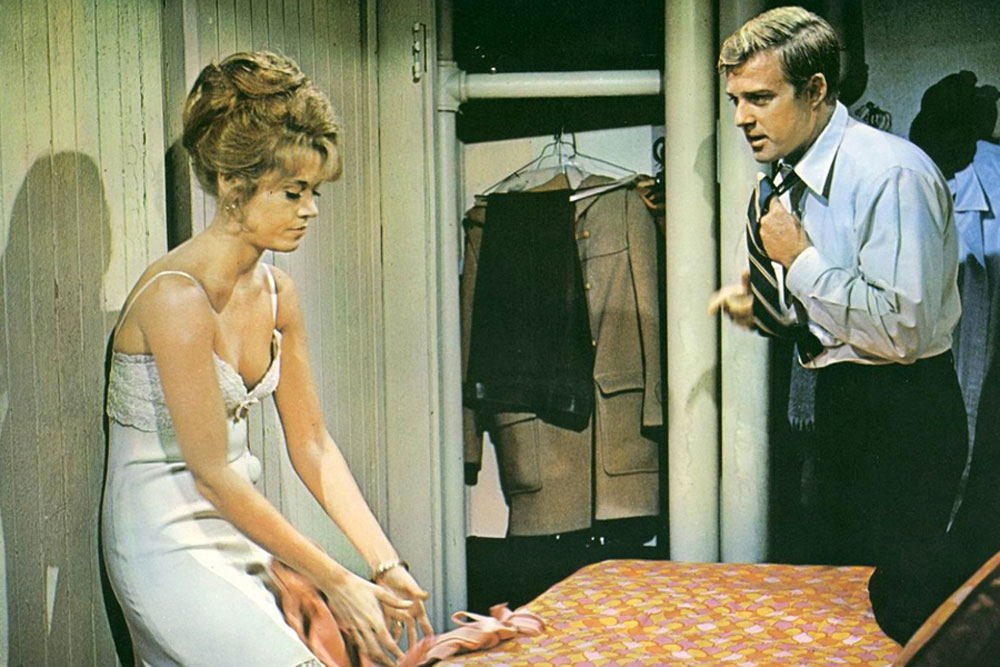
Surefire as a play, it comes off stagy and artificial on screen, the jokes that got crowds lined up for a live show are on film too obvious, too often. Despite the hard-working cast, this shows its age, dated where the year’s #1 comedy, The Graduate, while also a relic of the era, holds its charm. Natwick, 60, who hadn’t appeared on screen for ten years (Tammy And The Bachelor) is fine as the reluctantly revived mom, and Boyer, 66, in his best turn since Fanny in 1961, shows he’d lost none of the skill he’d honed over the 47 years since his French debut in 1920’s L’ Homme du large /Man of the Sea. Redford, 30, as versed as you could get from three years of the play, is excellent; the success of the project was a crucial win since, thru no fault of his own, his three previous pictures—This Property Is Condemned, The Chase and Inside Daisy Clover —drooped with both critics and public. His sharpness contrasts with Fonda, going as shrill as Shirley MacLaine. At 29, she’d done comedy in five (Tall Story, Period Of Adjustment, Sunday In New York, Cat Ballou, Any Wednesday) of her first thirteen roles but, as her later work would reveal, drama is more her forte. She’s got the dangerously sexy deal down, for sure, but warmth is a different kind of heat. The sassiness gelled well in Cat Ballou, but when Jane plays an “ordinary” person mostly what comes across isn’t characterization but impersonation. Working against her as well is that Corie is just too unhinged to care about. Most of us can relate to someone we knew or know who is emotionally challenging (even batshit nutty) but liking said fruitcake is a horse of a different neurosis. The combo of high strung Corie & high decibel Jane has you hoping Redford and Paul will keep walking, barefoot in necessary, to get away from her.

With Herb Edelman (the argument-cornered phone man), Mabel Albertson, Fritz Feld, Ted Hartley, Doris Roberts. 106 minutes.

* 1967 is usually cited as a year where screen violence accelerated (Bonnie And Clyde, The Dirty Dozen, The St. Valentine’s Day Massacre) but it was actually rife with relationship comedies, led by The Graduate. Putting love & marriage thru the mixmaster were Guess Who’s Coming To Dinner, A Guide For The Married Man, Divorce American Style, The Taming Of The Shrew, Two For The Road and Bedazzled. For good measure and extra laughs throw in The President’s Analyst, How To Succeed In Business Without Really Trying, The Producers, The Flim Flam Man and Don’t Make Waves.


 Movies ala Mark