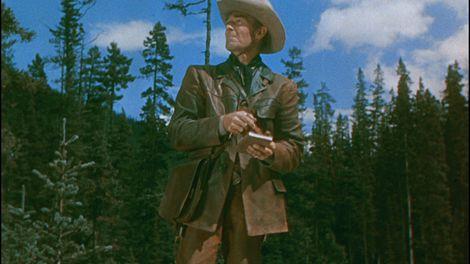
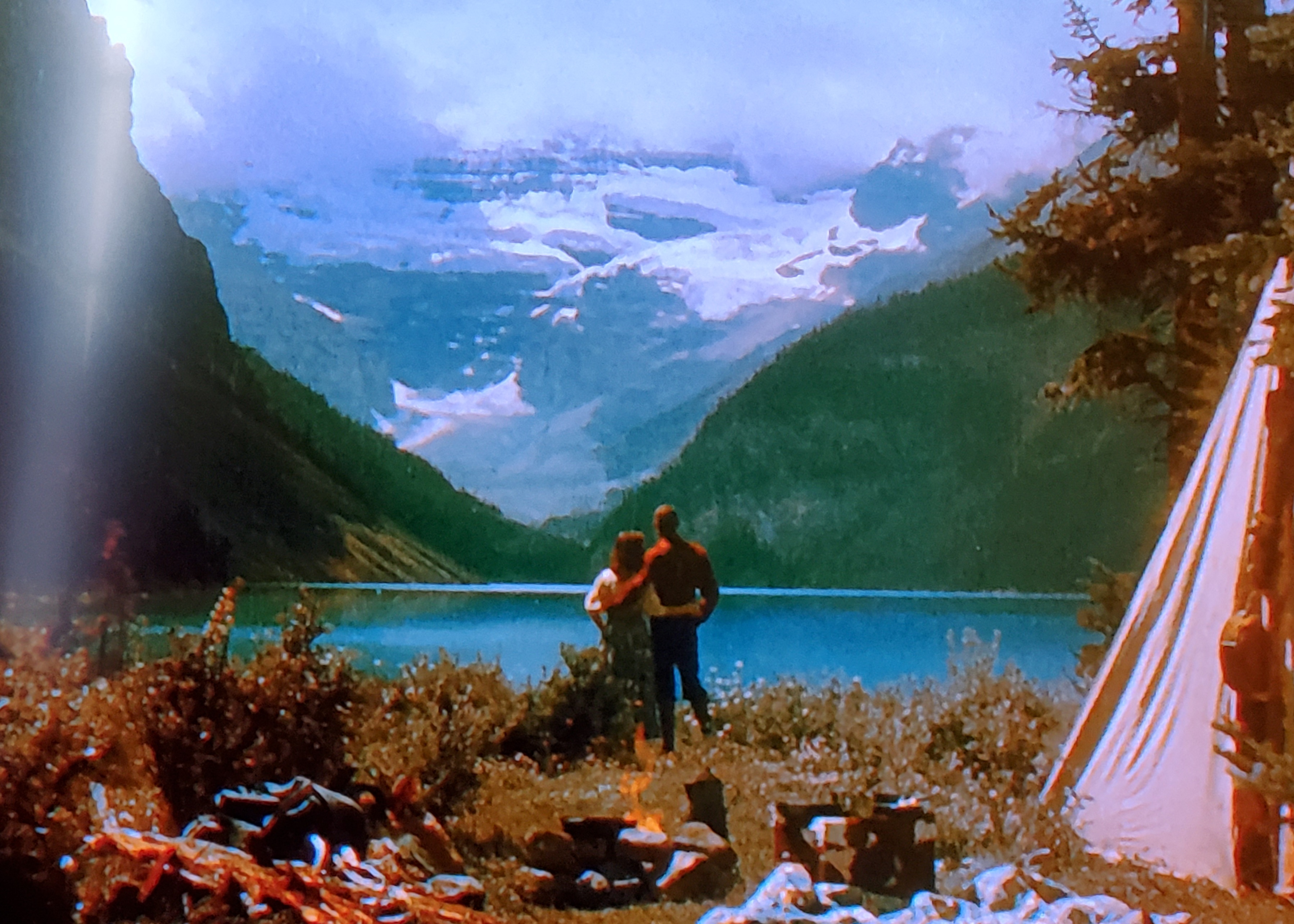
CANADIAN PACIFIC ensured that America’s neighbor to the north wasn’t left out of the railroad & empire expansion subcategory of westerns, with Randolph Scott surveying and shootin’ a way thru the Rockies so that ‘civilization’ could come to the endless sticks of British Columbia. The 1949 matinee item is greatly assisted by having a good deal of its 95 minutes shot in color and on location in the scenery around two national parks ((Banff and Yoho), with a look at Lake Louise added for good measure. Using the Cinecolor format, cameraman Fred Jackman Jr. delivers a look reminiscent of slides you’d see in those neato Viewmaster stereoscopes. *
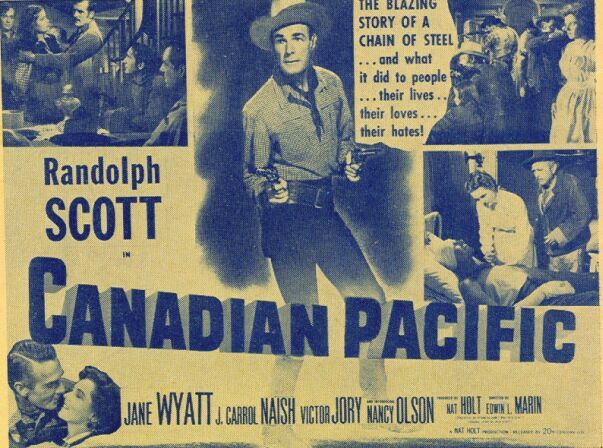
Sure-shot surveyor ‘Tom Andrews’ (Scott, 51 & fit) has his work cut out for him trying to guide the construction route of the title trailblazer. Regional rascals steal explosives and stir up hotheaded settlers, independent-minded trappers and disgruntled Indians. He has two ladies on line: high-minded physician ‘Dr. Edith Cabot’ (Jane Wyatt, 38), whose pacifist philosophy clashes with Tom’s pistol-packing, haymaker-throwing practicality, and earthy country sweetheart ‘Cecile Gautier’ (Nancy Olson, 20, debut) who has helpful info about ‘Dirk Rourke’ (Victor Jory), villain at large. Tod’s best pal ‘Dynamite Dawson’ (J. Carrol Naish) provides bragging solos.
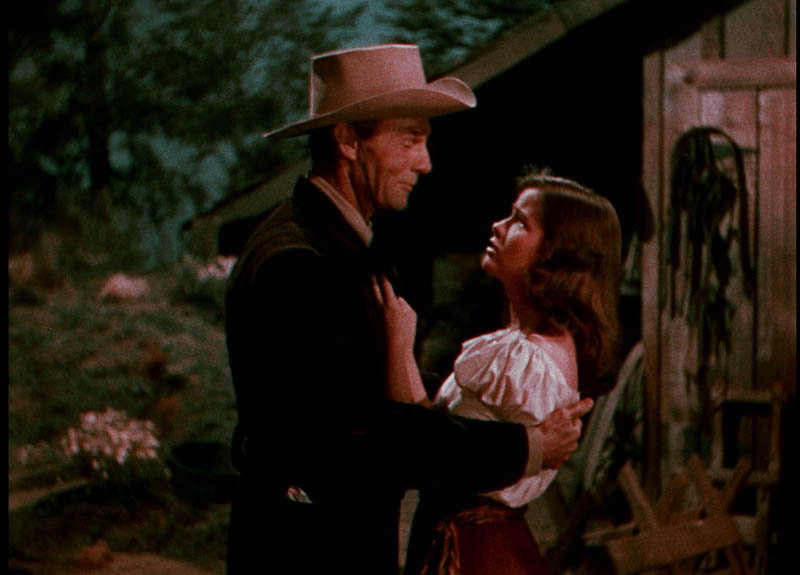
One of seven westerns director Edwin L. Marin steered for Scott, this one works thanks to the capable cast and the glorious settings, even if being overambitious for its limited budget (the ‘hundreds’ of warriors are represented by about 25 extras) and marred by handy simplicities in the script whipped by Jack DeWitt (Sitting Bull, A Man Called Horse) and Kenneth Gamet (Pittsburgh, Wake Of The Red Witch). The Randy & Jane angle does one of those ‘instantly blossoming love’ numbers that pop from one scene to the next, which follows not long after he somehow survives the explosion of a half dozen dynamite cases at close range (physics? more likely a ker-boom too far) and Naish has to handle a really awful ‘gag’ when he outwits Indians, portrayed like dull-witted children, by giving them lit sticks of dynamite that they think are cigars: pretty bad.

Fresh-faced Olson shows oomph in her debut and as always it’s a pleasure just to watch Scott’s effortless grace on horseback. It’s scored by Dimitri Tiomkin; those familiar with the composer’s styling will recognize some signature Dimitri flourishes. Box office placement was 97th in 1949, the gross $3,600,000.
With Robert Barrat, Walter Sande, Don Haggerty, Grandon Rhodes and Dick Wessel.

* Edwin L. Marin’s other Scott westerns: Abilene Town, Fighting Man Of The Plains, Colt .45, The Cariboo Trail, Sugarfoot, Fort Worth. Like other old flicks about the railroads, this one fell in line with the then-accepted gospel that the full-throttle, nation-spanning corporate exploits weren’t exploitation but essentially benevolent progress (with a lot of shooting involved), witness Union Pacific, Rails Into Laramie, Denver & Rio Grande, Carson City, Night Passage, Whispering Smith, A Ticket To Tomahawk, Dakota…It wasn’t until 1963’s How The West Was Won that the brutal behemoths of ‘the iron horse’ were portrayed in less-flattering terms. Come to think of it, Jesse James made a good case for the fair-is-fair of robbing them…
 Movies ala Mark