
ABOVE US THE WAVES, another of the many well-made, stiff-upper-lip WW2 movies Britain rolled out during the 50’s, and one of those based on some derring-do that was actually daring & done. In 1955 it joined with fellow fact-based Brit salutes The Dam Busters, The Cockleshell Heroes and The Colditz Story, this one detailing the perilous, sacrificial attempts to put one of the Third Reich’s mightiest battleships out of action. *
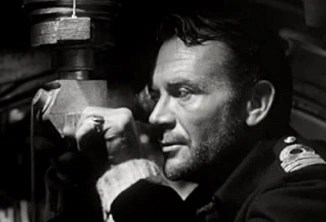
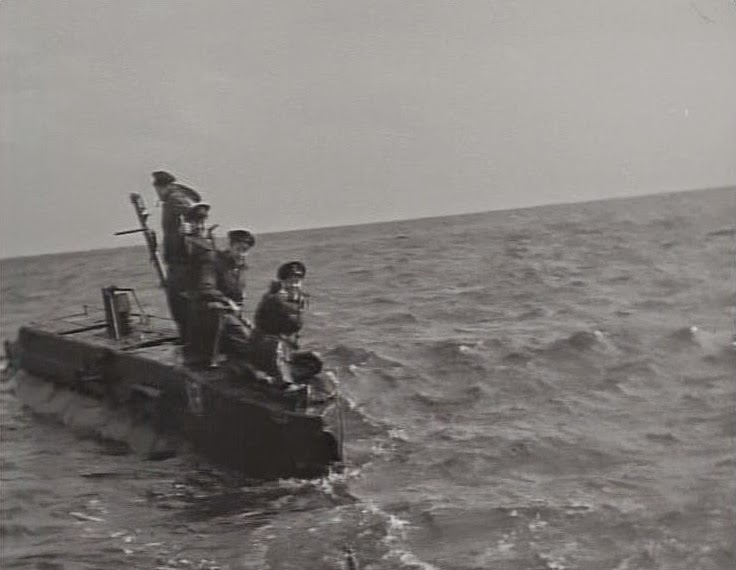
1942. After the Nazi nightmare Bismarck was dealt with, the Royal Navy still faced the prospect of the equally lethal Tirpitz, positioned in a Norwegian fjord and a critical threat to vital convoys coming in from the United States. Though initially skeptical, ‘Admiral Ryder’ (James Robertson Justice) is convinced by ‘Commander Fraser’ (John Mills) that the ship can be neutralized by using ‘human torpedoes’ and miniature submarines. First attempts fail, but ‘never say die’ holds until you’re dead, so the mission moves forward. Three subs and their 5-man crews brave weather, sea mines, and protective nets to sneak in and get their explosive charges placed.
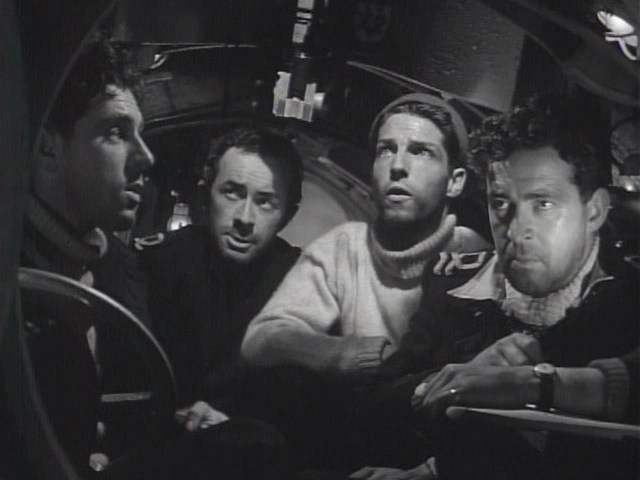
Mills is in his usual top form, and his secondary officers are covered by John Gregson (very good) and Donald Sinden. The crews include Michael Medwin, Lee Patterson, William Russell, Harry Towb, Anthony Wager, Anthony Newley and John Horsley. In small bits as select German officers spot Theodore Bikel, O.E. Hasse and Walter Gotell.
The script by Robin Estridge (Simba, Campbell’s Kingdom, Flame Over India) was based on the book written by C.E.T. Warren, who served on the ‘Chariots’ (the human torpedoes) during the war. Technical advice was provided by Donald Cameron (1916-1961), the real-life counterpart to Sinden’s character. Ralph Thomas directed, and besides being blessed with a can’t lose story and a solid cast he had a grade-A cameraman in Ernest Steward, doing an excellent job conveying the claustrophobic conditions of the mini-subs. A good score from Arthur Benjamin abetts the tension which ratchets up accordingly during the climactic raid. Some key sequences include a bit where the character played by Sinden resorts to using his arms and legs to push a floating sea mine away from his sub, something that actually was done by his counterpart Cameron. Another is get-out!-inducing when tidal movements shift and the Tirpitz begins to settle on top of one of the mini subs. Yikes!

With a good deal of cooperation from the Admiralty (duly thanked at the start of the pic, SOP for military movies of the day), the shoot was accomplished for £158,772 (£5,556,000 in 2025) and did quite well in England (1955’s 6th most popular film); there are no figures from the States. 99 minutes.

Rank strikes again
* Bound for the sea floor: The Battle Of The River Plate/Pursuit Of The Graf Spee, Sink The Bismarck! When the Reich built battleships they intended them to stay afloat. The Graf Spee, though damaged, was scuttled in order to sink and avoid needless loss of life: its commander committed suicide. The Bismarck, despite being pounded mercilessly by big guns and hit with multiple torpedoes, finally went to the bottom from scuttling. As pertains to Above Us The Waves, note that the movie ends abruptly. That’s because valor and serious damage from the mini-subs didn’t fully do the job. That was finally accomplished by British bombers and only after numerous attempts. That takes nothing away from the incredible courage displayed by the crews of those mini-subs.

Their prey, the Tirpitz, 1939-1944

 Movies ala Mark