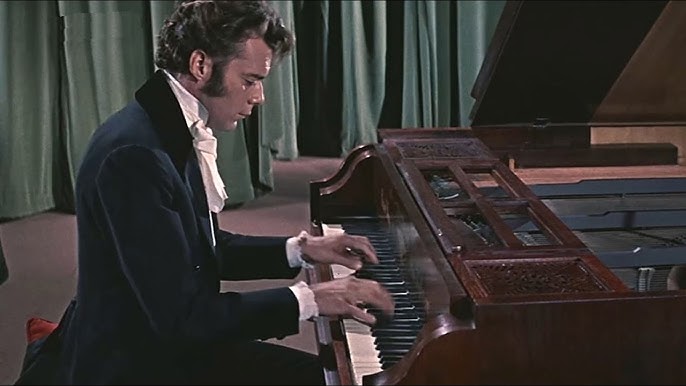
SONG WITHOUT END, a sumptuous-looking, grand-sounding bio of pianist/composer Franz Liszt, offers plush locations, lush costumes and acres of splendidly orchestrated music. It’s undone by a woolly script, ill-considered casting, florid melodramatics and over-length. Director Charles Vidor had a success 15 years earlier with the Chopin biopic A Song To Remember, which made a new star of Cornel Wilde, but a lot had changed between 1945 and 1960, not least tolerance levels for acting excesses and patience reserves for story padding in the editing department. Fans of classical music won’t go hungry, as there are a good forty interludes over the 131 minutes of running time; you just have to barter rarefied sophistication with snorts over the posing, declaring and rushing about that pile up between pianist pieces.
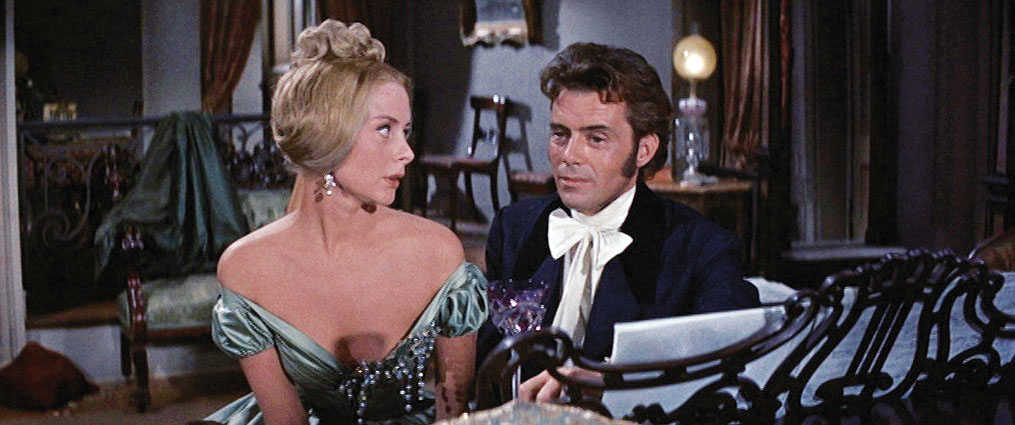
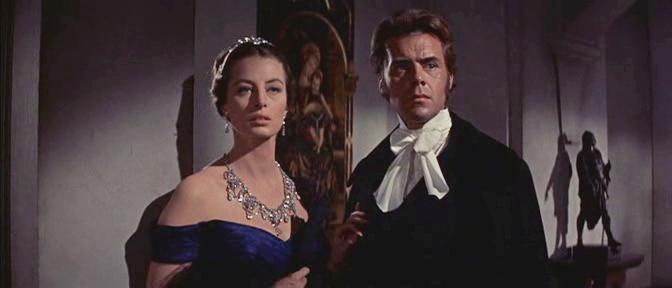
In the late 1830’s Hungarian prodigy-turned-piano virtuoso Franz Liszt (Dirk Bogarde, 38) is convinced by friends Frederic Chopin and George Sand to return to public performing. His ego inflamed by the lure of the stage, and his relationship with partner Marie d’Agoult (Geneviève Page, 31) frayed to breaking, Liszt goes on tour. He becomes a sensation and soon is romantically involved with Princess Carolyne Wittgenstein (Capucine, 31), who is married (Liszt meanwhile has children with the dissed d’Agoult) and whose husband is less-than-pleased. When marriage and divorce are contested and confounded by the Church (thanks for your concern, fellas) impulsive Franz faces a monumental choice between career, commitment and conscience. Are there any stories about famous musicians—classical, jazz, country, rock—that ever work out happily?
COUNTESS MARIE: “ I remember he said, “May I escort you somewhere, madame?” And I said, “Yes.” And he said, “Where?” And I said, “Paradise.” He didn’t smile – he said, “I’ll call a carriage.” PRINCESS CAROLYNE: “Did he?” COUNTESS MARIE: “What?” PRINCESS CAROLYNE: “Drive you there–to paradise?” COUNTESS MARIE: “He doesn’t know the road, madame.” Mee-oww…
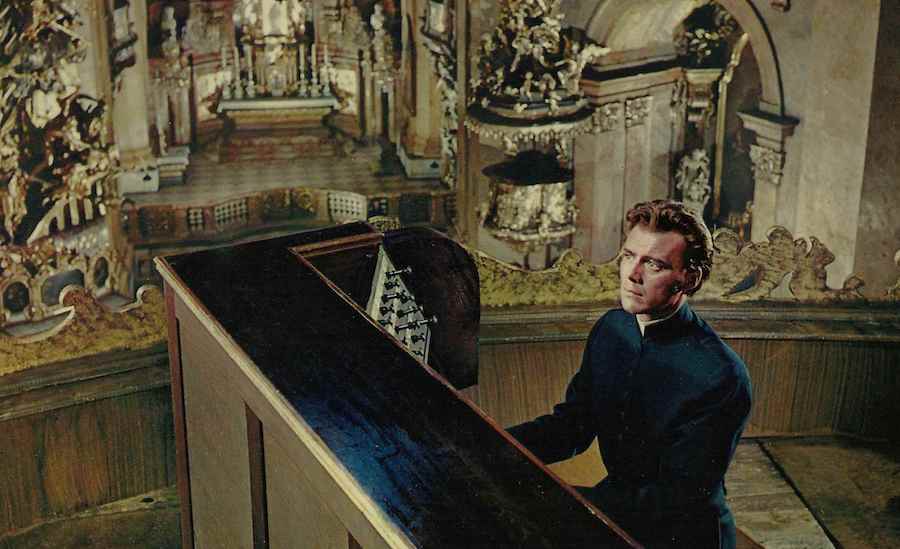
Charles Vidor’s resume was speckled by hits (Gilda, Love Me Or Leave Me) and misses (The Swan, A Farewell To Arms), with this unwieldy costumer not a cap feather. Hardly all was Vidor’s fault: 58, he died of a heart attack after shooting perhaps 15% of the total, and George Cukor stepped in. Vidor had been hell on the actors, Cukor much calmer. Not liking the script done by Oscar Millard (The Conqueror), he brought in blacklisted Walter Bernstein for rewrites, who told him “My best advice to you is to get rid of Dirk Bogarde and get Sid Caesar. Then just film it.” Shooting in Austria, Cukor also replaced cameraman James Wong Howe with Charles Lang; Howe stayed on the credits.
Bogarde had been popular in England; this was his first (last it turned out) foray into a Hollywood-designed vehicle. Imperiousness comes across (the character, not the actor) but as a Romantic Swain type, Dirk’s a dishrag. While he didn’t convince in clutches with either Page (who is excellent, warming up for her marvelously mean Princess Urraca in El Cid) or Capucine (with whom he developed a friendship that lasted until her 1990 suicide) Bogarde did—starting from scratch—try mightily to mimic playing the piano. Visually it’s iffy, but the actual playing from Jorge Bolet is flawless. Bogarde’s 34 costume changes alone took up £150,000, the equivalent to £4,374,000 in 2025.
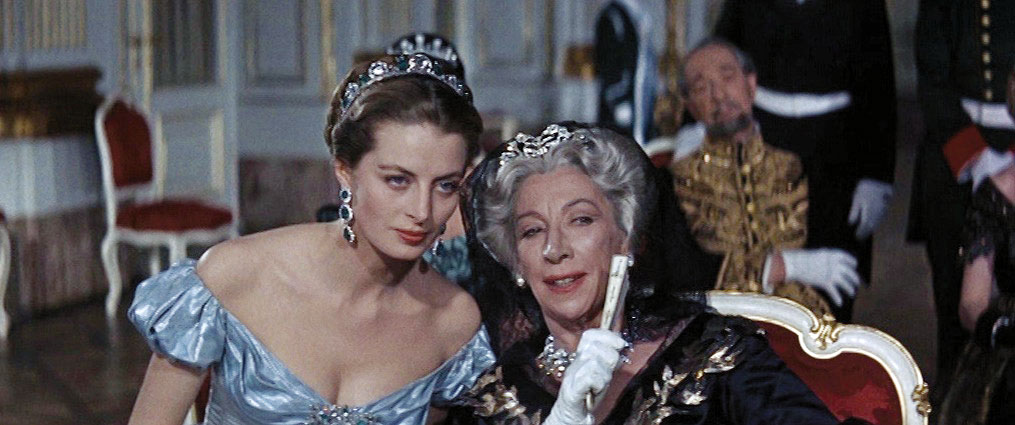
While Page scores, Capucine in her English-speaking debut is almost a dead loss; she drew scathing reviews. Whoever—Vidor or Cukor— gave her that orgasmic seduction scene, swooning off her Royal chemises while Franz atomizes the ivory—was either clueless or vindictive. Other than that quick ascent of Mont Blanc she’s so inexpressive she may as well be wax. We fault the directors, since her next role, the decidedly unpretentious North To Alaska, showed her animate and charming.
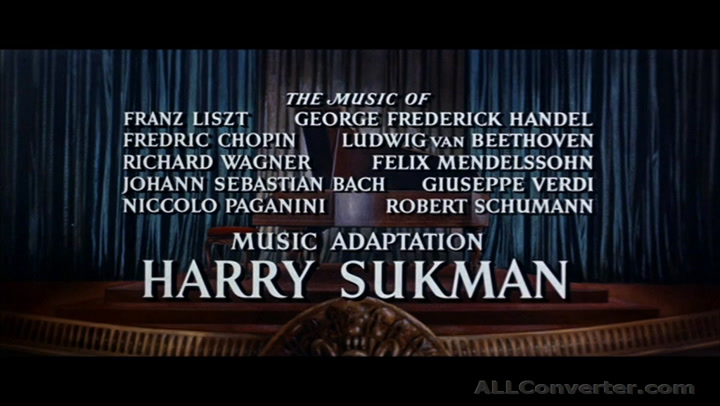
The production won a deserved Oscar for its music (Scoring of a Musical Picture) arranged by Morris Stoloff and Harry Sukman but was cheated of nominations for Art Direction and Costume Design (Spartacus won, but somehow the absurd Pepe was on the list). Since the price tag reached $3,500,000, a gross of just $4,300,000 (62nd place) registered as a flop.
With Lou Jacobi (an impossible pick as Liszt’s manager; he’s straight from a 20th-century farce), Martita Hunt (amusing as a Grand Duchess of Russia), Ivan Desny (the irked cuckold Prince Nicholas), Lyndon Brook (not bad as Richard Wagner), Katherine Squire, Patricia Morison (too bland as George Sand), Alexander Davion (as Chopin), Abraham Sofaer, Marcel Dalio.
* Capucine, 1928-1990—along with North To Alaska, she was fun in The Pink Panther, and fine with lover William Holden in The Lion and The 7th Dawn. So, we’ll allow a rocky launch in Song Without End. And for Bogarde fans who think we’re too harsh on the gentleman, we salute his work in Quartet, So Long At The Fair, Doctor In The House, Victim, Damn The Defiant!, King And Country, The High Bright Sun, The Damned and A Bridge Too Far. And you thought we’d struck him off our Liszt…

 Movies ala Mark