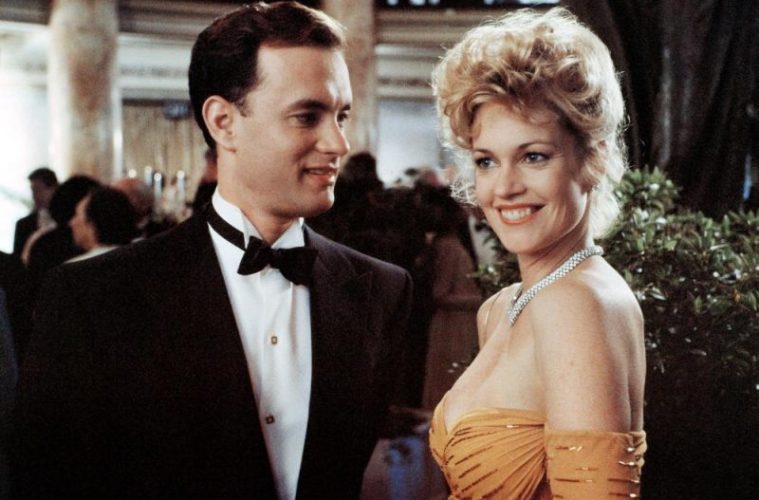
THE BONFIRE OF THE VANITIES was roasted by critics and torched by audiences back in 1990, incinerating its cost cord of $47,000,000 (not counting ads & prints) with a not even lukewarm gross of $15,700,000, 77th place for the year. The firebomb of scorn was fueled not just by some on-its-face flaws (casting and tone) but from how it charred its dragon source, a blistering book that flamed an all-consuming era of selfishness in a 700-page towering inferno of literary brilliance. Okay, enough with the word arson, already: we’re a net firefly, not Tom Wolfe (he didn’t like blogs). But we did devour his super-duper 1987 novel, and like those acidulous reviewers and incredulous ticket-buyers, were frustrated when beholding the results on screen. It was such a loss, immediately legendary, that a book about the production rumble-fumble followed a year later, Julie Salamon’s “The Devil’s Candy: The Bonfire of the Vanities Goes to Hollywood”. A re-peek 35 years on brings not the massacre of yore but a more reasoned split decision. The faults are still obvious, some glaringly so, but there are gleaming embers (here we go again) in the ashes. Perhaps the igniting spark is that it likely put off many people who hadn’t read the book from doing so, missing out on something really hot. *
A “Master of the Universe“, smug, highly successful Wall Street bond trader ‘Sherman McCoy’ (Tom Hanks, 33, looking 20) is caught in the snares of the real world during a night out cheating on his wife with ‘Maria Ruskin’ (Melanie Griffith, 32, looking to thrill–if you can put up with the voice), married airhead sexbomb. A wrong turn down the wrong street in the wrong part of town (for them, at least) results in her running over a robbery-threatening black teenager. Flee the scene, in the clear: time for a post-scare boink. But evidence crumbs lead to what soon becomes a city-wide uproar mixing race relations, political posturing, legal eagles/vultures, phony pastors, affronted spouses and Maria’s decency issues. Sherman’s lifestyle—and life, period—are poised to go down the john. Like the ones at Riker’s Island and Sing Sing. Dryly chronicling McCoy’s Last Stand is ‘Peter Fallow’ (Bruce Willis, 34, smug redux), a boozy, story-desperate journalist, who, like nearly everyone involved, is a self-server, hustling crisped marshfellows from the bonfire.

Directed—with his typical visual flair and usual blunt force lack of sensitivity—by Brian De Palma, the script was taken on by playwright Michael Cristofer. The book’s scathing, quite funny satire is mostly reduced to coarse jokes, the incisive characterizations simplified, provocative situations bowdlerized, with much excised in favor of re-arrangement tack-on’s to please studio demands and star egos. When in doubt, go shrill. The three leads were all considered miscast. Hanks does his best (he seems too young and likable); Griffith comes off as a one-trick trick; flat & pat Willis (and his horribly delivered narration, as and as Harrison Ford’s in Blade Runner) is all wrong. Dave Grusin’s “pay attention!”score is annoying. These debits rightly nettle fans of the book, but won’t be as much—any?—irk if you haven’t. Our guess: those not wedded to the novel may see an okay movie and wonder why it has such a lousy rep. Those who once damned it to the Bronx & gone for straying from & flaying at the novel, making Wolfe’s feast into gulped fast food, might take another look, one that that could tamper the bile reflex and concede elements worth applause. **

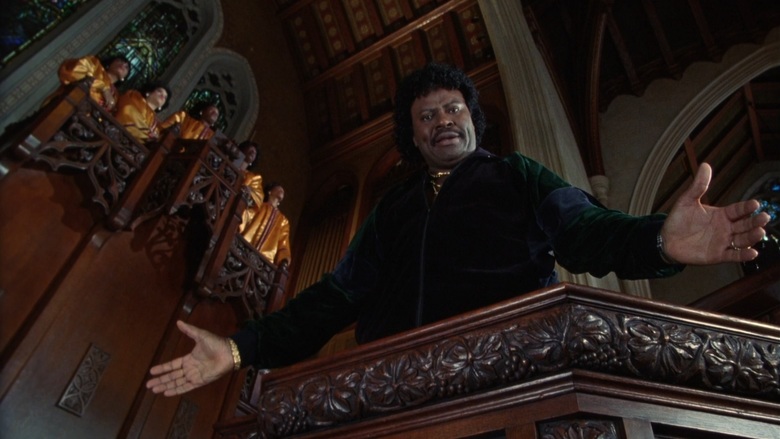
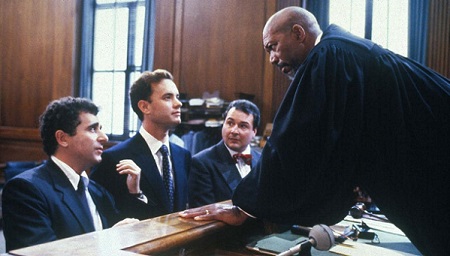
The second-tier players emerge much better. They include an impassioned Morgan Freeman as a fed-up-with-bull judge, Kim Cattrall as Sherman’s indestructibly shallow wife, Saul Rubinek as a blood-smelling prosecutor, John Hancock as a charlatan preacher/rabble rouser, Kevin Dunn as Sherman’s bemused attorney and best of all, F. Murray Abraham, who rips into his District Attorney’s key speech with mainlined enthusiasm and the sort of anarchist’s glee the material begs for.

There are walk thru’s from Clifton James, Donald Moffat (telling as Sherman’s WASP old man), Alan King, Robert Stephens, Rita Wilson, Geraldo Rivera (how many lives does this mouth get?), Andre Gregory and George Plimpton (just go away) .7-year-old Kirsten Dunst appears as McCoy’s daughter.
Also in the swirl: Louis Giambalvo, Barton Heyman, Norman Parker, Troy Winbush, Adam LeFevre, Mary Alice, Richard Libertini, Camryn Manheim, Richard Belzer. 126 minutes.
* Fire at will—Tom Wolfe, 1930-2018. Previously lauded for his non-fiction (“The Electric Kool-Aid Acid Test”, “The Right Stuff”) Wolfe’s first novel was/is a stunner. Won us over: we suggest “A Man In Full” and “I Am Charlotte Simmons”. No, we don’t subscribe to all of his outlooks, but anyone who can piss off John Updike and Norman Mailer gets a pass, any page of the week.
** The old book v. movie argument is past tiresome; obviousness & obtuseness posturing as erudition & expertise. But, as long as we’re at it, revisiting this adaptation brought back bummer memories of being let way-down by the TV-movie versions of “Once An Eagle”, “The Last Convertible” and “The Far Pavilions”. Tai-Pan. Rising Sun. The Shining. The list would be a long one.
Corruption then, societal or personal, figured in a lot of 1990’s output, witness Presumed Innocent, The Godfather: Part III, Goodfellas, Internal Affairs, Reversal Of Fortune, Wild At Heart, The Grifters, Bad Influence, Q & A, The Two Jakes, Miller’s Crossing, King Of New York and The Last Of The Finest. Jeez, you’d think the Reagan-Bush greed stampede left a price tag with small print.

 Movies ala Mark