
GREEN DOLPHIN STREET, as one of its ad-lines had it, was the story of “A Fiery Girl Who Dares The Dangers Of The Sea And A Savage Land…Fighting For The Love Of A Bold Adventurer!” Yowza! It was also the 8th most popular movie of 1947. Like three other lavishly expensive productions that year (Forever Amber, Captain From Castile, The Foxes Of Harrow) this one was taken from a bestseller melodrama set in the distant past. MGM expended $4,391,000 to ream the 584 pages of Elizabeth Goudge’s novel down to a fairly hefty running time of 141 minutes. Period adventure and romantic travail span years in the Channel Islands of England, the coast of China and both islands of New Zealand, finding room for drunkenness and salvation, wealth and despair, an earthquake and flood, a native uprising and Donna Reed becoming a nun because she lost a man to Lana Turner! The only way it could be sillier would be if their roles were reversed, but even tear-duct wringer Louis B. Mayer must’ve realized Lana in a habit and a winkle was a sis too far.

At this site we keep synopses brief because (a) less revealed = more fun for the viewer when they see the film and (b) we think it can be a bit of a cheat to pad a review with six paragraphs describing ¾ of the plot. The trouble with a blue whale like Green Dolphin is that trying to sum up the labyrinthine outline risks running half as long as the show itself. The chase being cut, in a nutshell (or coconut husk)—in 1840, the ‘Patourel’ sisters—‘Marguerite’ (Lana Turner, 25) and ‘Marianne’ (Donna Reed, 25)—are both keen for recently met ‘William Ozanne’ (Richard Hart, 31, debut). William’s time as an officer in the Royal Navy ends in disaster, shame and self-exile to New Zealand, where he goes to work for ‘Timothy Haslam’ (Van Heflin, 38), who, go figure, came from the same Channel Island as the ladies. A name switch mistake in a letter William drunkenly writes sends the wrong maiden (willful and cagey Marguerite) to New Zealand, while back home the sensitive and stunned Marianne turns—climbs in fact—to the Church for solace. Times are tumultuous in New Zealand: relationship revelations sink in, nature goes haywire on a grand scale and the resident Maoris decide to fight the colonizing Brits.
“I’m bold and scheming and sometimes I think I’m not quite nice.”

Admired screenwriter Samson Raphaelson (The Shop Around The Corner, Heaven Can Wait) did what he could but his gift for comedies and musicals ran aground on over-ripe situations presented by a tangled story, hard-to-admire characters and tough-to-accept twists of fate, let alone the ‘letter flub’ whopper catalyst that chokes off the vital suspension of disbelief. What passed melodrama muster back when Harry Truman was President comes off like good-looking camp today. The acting is fine. Heflin, given the most shaded character, is easily the best. The lovely Reed gets thankless duty, though she scores a truly zany sequence where she does a frankly impossible desperate climb up a near-vertical chasm to escape the sea and find fulfillment— as a nun (?) Newcomer Richard Hart is all right, but in his first role (of only four; he died suddenly in 1951) he’s handicapped by being stuck as a weakling. Turner displays movie star oomph, but the writing (and the basic character) sabotages audience identification or sympathy.
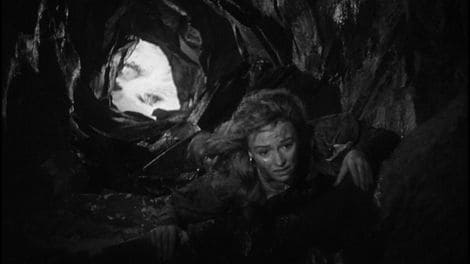
Far and away the highlight is the earthquake and flood sequence that rumbles in at around the 1:38 mark, several wowing minutes of special effects that topple massive trees, collapse a cliff, crack the earth open, swallow and/or smash natives, wreck buildings, a ship and a business and provoke Lana’s…er Marguerite’s…giving birth at the worst possible time. Alas, the right guy (Van) is on hand. The combo of live action, miniatures and process shots joins the classic catastrophes from San Francisco and The Rains Came.

Victor Saville was the director; his resume contains winners (The Green Years), also-rans (Kim) and an immortal woof (The Silver Chalice).The impressive scenes of tectonic destruction ensured this won the Oscar for Special Effects and nominations were nabbed for Cinematography, Film Editing and Sound. Audiences lined up to the tune of $11,600,000.
With pro work from Frank Morgan, Gladys Cooper, Edmund Gwenn, May Whitty, Reginald Owen, Linda Christian (the requisite slinky native girl beauty), Gigi Perreau, Lila Leeds and Ramsay Ames. Bronislau Kaper’s main theme music later became a jazz standard.
 Movies ala Mark