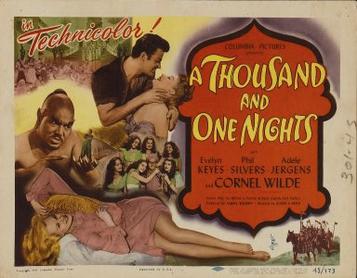
A THOUSAND AND ONE NIGHTS sports affronted-9th-century-princess talk such as “You care not how much you shame me, do you? It was not enough that you raided my lips when I unveiled to you, not enough that I suffered you to steal a kiss like any thief, now you must come into my garden, cheapening it with the talk you would give to the maid in a wine shop!”
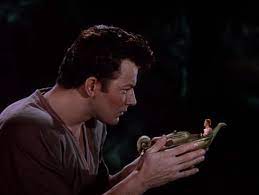
This screen version’s patented silliness arrived in 1945, a year when more serious issues besides magic lamp ownership were on the table, but audiences were a tad weary of not just the war, but war movies, and while some of the best of those (made during the fight) came out in that climactic year, they were mostly superseded by either lightweight entertainments or dramas that didn’t involve tanks, ships and fighter planes. Directed by Alfred E. Greene (The Jolson Story), this fantasy-adventure-comedy upped the tongue-in-cheek angle by inserting contemporary slang and references and insured that the bright Technicolor complimented not just the sets and costumes but the pictorial charms of its bevy of desirable damsels. Soldiers and sailors, though wondering why the guys in the cast weren’t in uniform, heartily approved of the tease-clad actresses and Home Front patrons plunked down $4,200,000, the 82nd biggest donation to Hollywood that year. Academy Award nominations went to the Art Direction and Special Effects. *
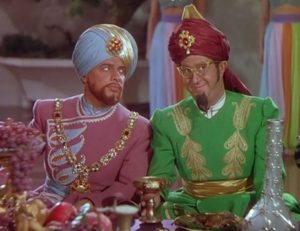
To woo or not to woo—ALADDIN: “First hear me and then summon your guards if you will, and let them dry my torn limbs in the sun. PRINCESS ARMINA: “Have no fear for your limbs. They will not be harmed.” ALADDIN: “My lady is gracious.” PRINCESS: “Because my guards will strike off your impudent head.” ALADDIN: “You do not think it a sad thing that one so young should lose his life? Oh, I do not plead for my head, princess.” PRINCESS: “Then for what?” ALADDIN: “For that for which I placed it in jeopardy – the sight of your face!” PRINCESS: “You are mad.”
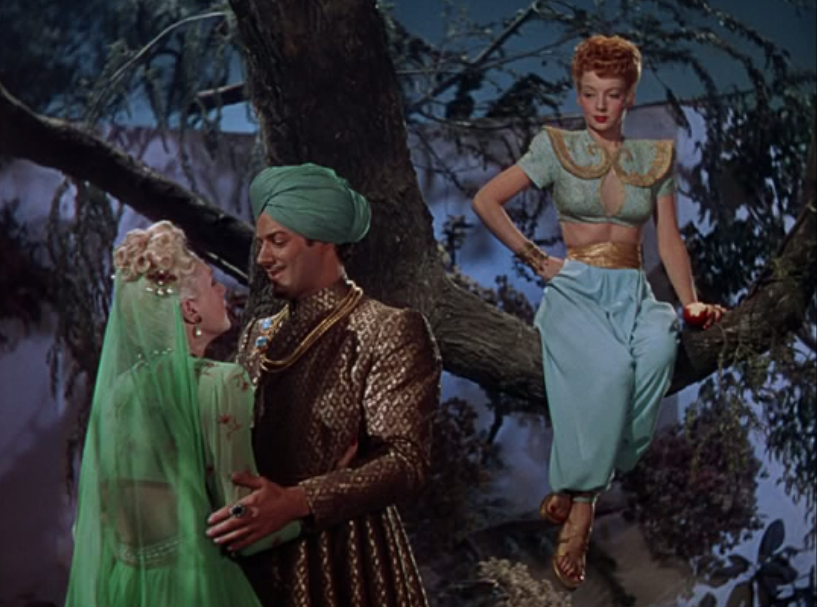
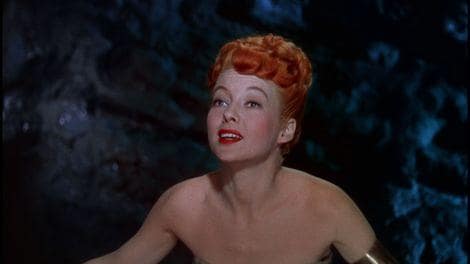
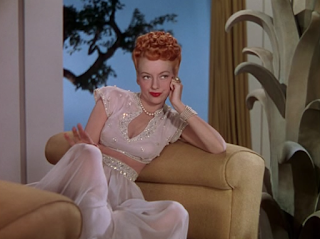
“In old Baghdad” vagabond adventurer (and occasional dubbed singer) Aladdin makes a foolish but gallant play for ‘Princess Armina’ (Adele Jurgens) only to be dungeon’d with his pickpocket pal ‘Abdullah’ (Phil Silvers—so you can already see how serious it is). They escape, evade one genie (Rex Ingram, briefly reprising his role from The Thief Of Bagdad) before stumbling upon a lamp which contains another. That’s their luck and ours, as it contains lady wish-giver ‘Babs’, played to perfection by the delightful Evelyn Keyes. Babs/Keyes is bright, sexy and funny, and more than makes up for Silvers shtick. Phil’s modern patter (including lip-syncing to new crooner sensation Frank Sinatra) may have rolled ’em in the aisles back when, but today welcome wears after a few minutes. Wilde is fine, but Jurgens lacks the ‘princessy’ spark (she worked better as a tough-talking dame in B-flix). More interesting is Dusty Anderson as the princess’s chief chick and harem-minder. But Keyes steals the show.
There’s a plush, rousing ‘Arabic’ score from the prodigious, unsung Marlin Skiles. Wilfrid H. Pettit, Richard English and Jack Henley wrote the material, but we wonder if Silvers didn’t inject his own. Delivering olden-dayz threats with aplomb: Dennis Hoey, Philip Van Zandt, Richard Hale, John Abbott, Nestor Paiva, Gus Schilling and Trevor Bardette. Among the cluster of harem girls see if you can detect Shelley Winters, 24, and Nina Foch, 20.
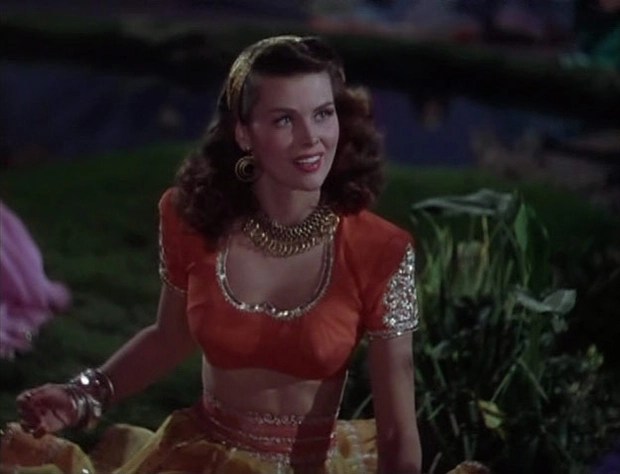
Well, hell-o Dusty Anderson, 1918-2007
* Besides more-pressing news, 1945 marked the arrival of Cornel Wilde. At 33, he’d been in films for five years but zoomed to stardom in the Victory Year. Besides leaping and loving as Aladdin he won fans with Leave Her To Heaven (the year’s 3rd biggest hit), The Bandit Of Sherwood Forest (28th) and A Song To Remember (#45) which netted him an Oscar nomination as Best Actor. Likable and athletic, Wilde had a few big hits up his sleeve (The Greatest Show On Earth, Forever Amber) as well as a number of solids (Road House, Two Flags West, The Big Combo, Lancelot and Guinevere, The Naked Prey). Independent-minded, with acting not enough, he added writing, producing and directing to his talents.
Footnotion, genie slipper variety—this lark may have inspired the minor 1964 foof The Brass Bottle, with Tony Randall, Burl Ives and Barbara Eden. That one;s been given as the germ behind I Dream Of Jeannie. To which your humbled servant adds that back in the 70s I once saw Barbara Eden in a restaurant, with her husband, the cool Michael Ansara. She was very pretty.