
THE BLACK ROOM opened its door of gothic darkness in 1935 and allowed Boris Karloff a chance to shine in one of his best roles—make that two, since he plays twin brothers, one gentle and cultivated, the other brutal and depraved. Boris was on a roll, nailing a triumph with Bride Of Frankenstein and also headlining The Raven with a fiendish Bela Lugosi. In this 70-minute gem R. William Neill (Frankenstein Meets The Wolf Man, 11 Sherlock Holmes entries) directed a script written by Arthur Strawn and Henry Myers.

‘Somewhere in Europe’ (let’s say Austria), 1834. A family curse laid on them at birth comes to fruition for twin brothers and hereditary barons ‘Gregor and Anton de Berghmann’. Kindly, well-mannered Anton returns to the (not-very cheery) family castle after a long absence to find sib Gregor crude and cruel, despised by the locals as a ravager of their women, who regularly disappear after Gregor takes a fancy to them. Bad to worse under that accursed curse. *
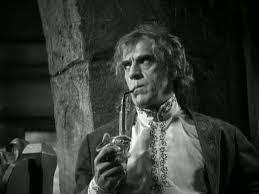
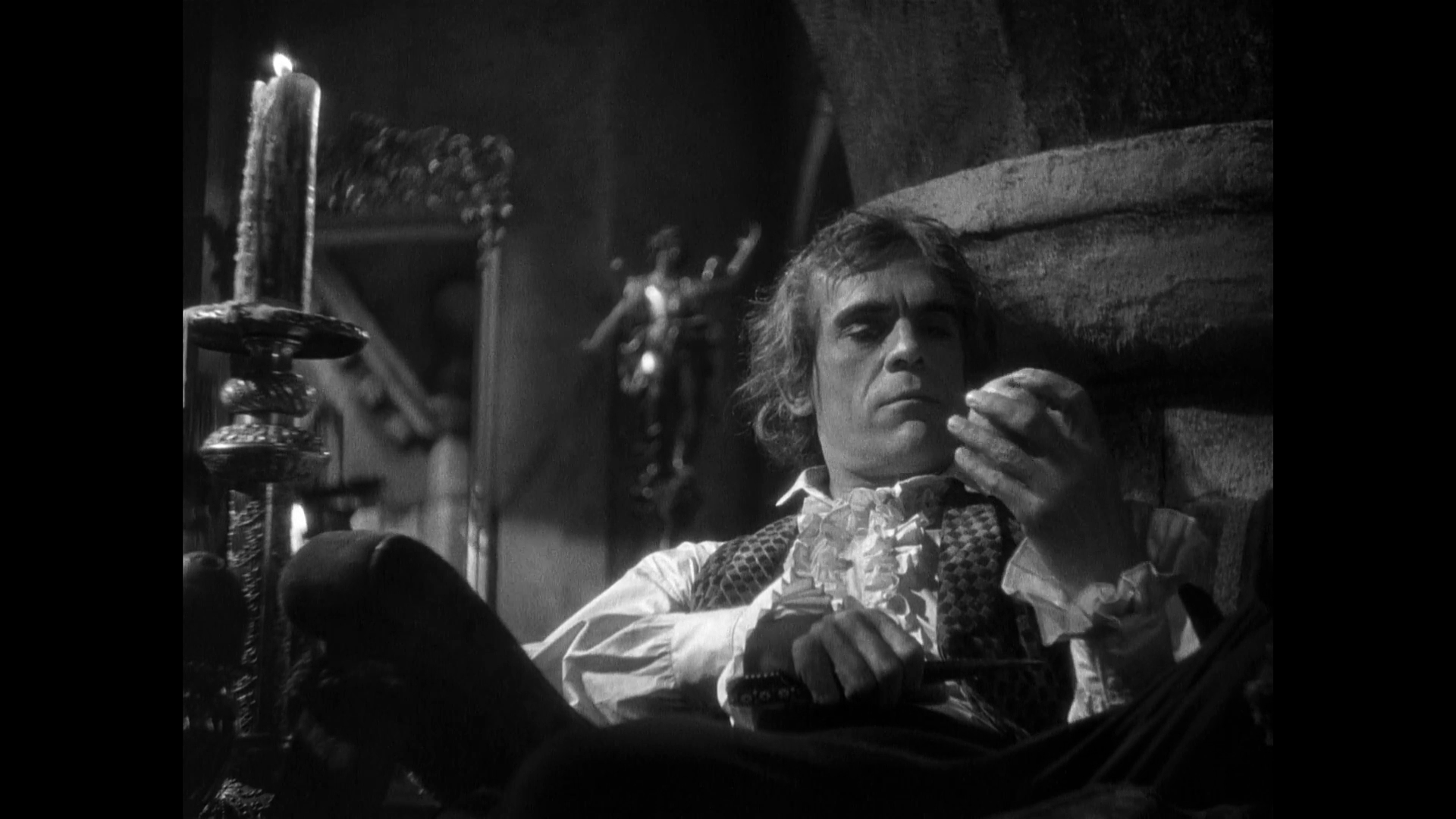
Though the finale is on the rushed side, this compact and satisfying Gothic immorality tale has a lot going for it. Neill’s direction is fluid, the set design appropriately ominous, the background music symphonic without being overbearing and there is superior cinematography from Allen G. Siegler. Front and center is Karloff, relishing the task of inhabiting physical lookalikes with polar opposite moral compasses. His ‘bad’ brother is rotten to the core, and all the more effective because Boris wisely resisted going too ‘big’; as a result his subtlety makes Gregor’s sadism even creepier. How the Hays Code spoilsports let the script get away with his suggestive ‘pear’ whimsy is a mystery. Slicing one with his knife and slurping it while he muses to one of his conquests—MASHKA: “Don’t you want to kiss me?” GREGOR: “A pear is the best fruit! MASHKA: “Every time you see her, you want to be rid of me.” GREGOR: “Lots of juice in a pear!” MASHKA: “Well, you’ll find out I’ll not be got rid of so easily! Do you hear what I say?” GREGOR: “Adam should’ve chosen a pear.” MASHKA: “You’ve got it all planned, haven’t you? You’re gonna marry her. You’re gonna make her your wife, your baroness!” GREGOR: “I like the feel of a pear! And when you’re through with it…” (idly flinging it away)
Three composers worked uncredited on the dramatic score: R.H. Bassett, Milan Roder and Louis Silvers. That nifty art direction was overseen by Stephen Goosson (Lost Horizon, Meet John Doe, A Thousand and One Nights, The Lady From Shanghai). Attendance clocked 102nd place for the year, grossing $1,300,000.
With Marian Marsh, Robert Allen, Thurston Hall (impressive as ever, 17 parts in ’35), Katherine DeMille and Torben Meyer.

* In the 1930s & 40s Mitteleuropa was the favored setting for Ze Baron Knows How Many period-set horror pictures and the odd adventure like The Prisoner Of Zenda. Customs-bound and costumes-bedecked, the haughty nobility and alternately cheerful or fearful peasantry commanded carriages or broke out pitchforks in a never-forever castleland that ranged over fanciful facsimiles of Germany, Austria, Czechia, Slovakia, Slovenia, Romania, Croatia and a goulash of Balkans. Englishmen (often with American accents) visited at their peril.

 Movies ala Mark