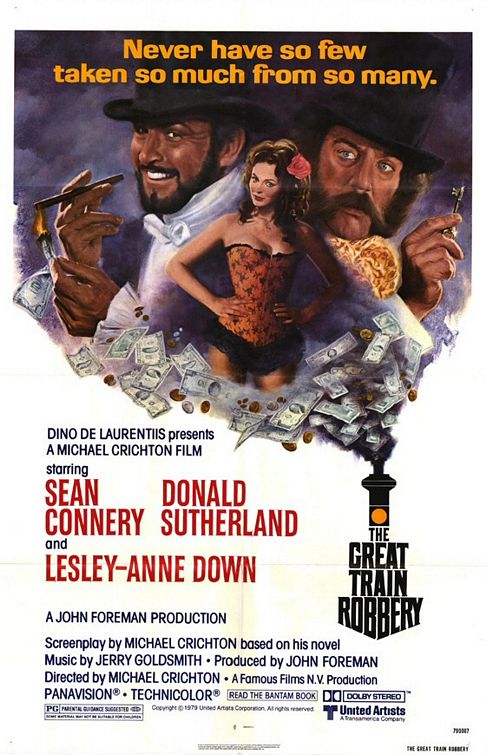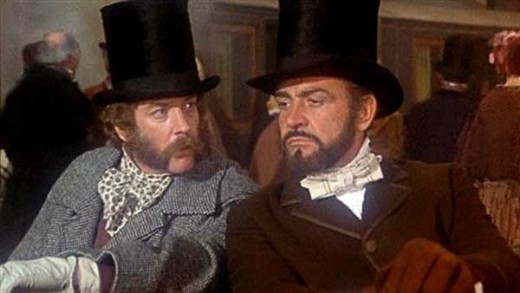
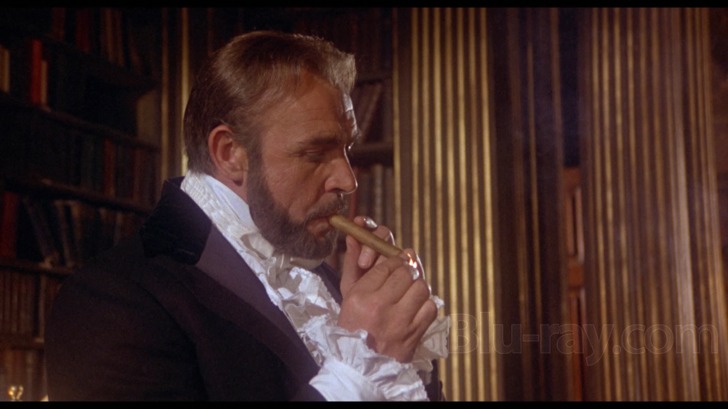
THE GREAT TRAIN ROBBERY is the US title for this fact-based, semi-serious heist lark from 1978. It was released elsewhere as The First Great Train Robbery, not just because the inspiration caper—“The Great Gold Robbery”—took place in 1855, but due to audiences in Britain (where it happened) and other countries were likely thinking of another real-life ripoff dubbed ‘The Great Train Robbery’ which rocked England in more recent 1963. The grim 1967 flick Robbery, with Stanley Baker, covered that escapade in a fictionalized manner while this lushly produced period piece mixed fact & fancy about the Victorian Era forerunner. Michael Crichton adapted his 1975 bestseller, writing the screenplay, taking on the direction. In lead roles he cast Sean Connery, 48, as suave scheme plotter ‘Edward Pierce’, Donald Sutherland, 42, as his half-dexterous/half clumsy chief accomplice ‘Robert Agar’ and Lesley-Anne Down, 24, as ‘Miriam’, Pierce’s saucy tres-seductive lover.
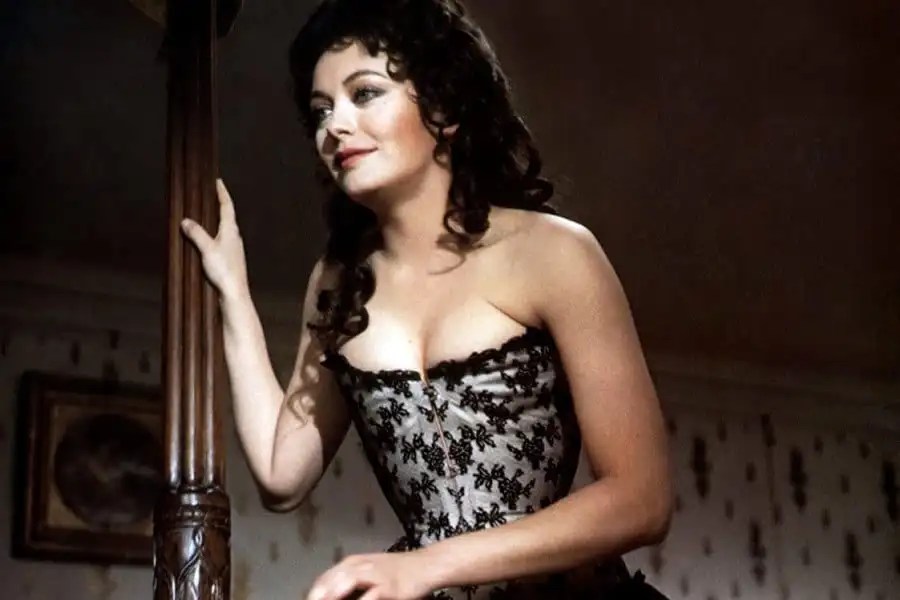
London, during the Crimean War. High social connections aren’t enough for Pierce: beneath cultivated charm he has a decided larcenous streak. Enlisting vetted ‘screwsman’ Agar and with his lascivious bedmate Miriam as bait, plus help from a few stray felonious fellows, the cheeky band sets out to steal a gold shipment (bound for the futile warfare in Crimea), and do so from a moving train. Several dicey mini-capers come first, copying well-guarded keys from secure locations. Skill, subterfuge and sex come into play, along with a smelly dead cat.
Miriam’s a purely fictional creation, and the characters of Pierce and Agar are fudged and switched about from their historical selves, but Crichton and crew weren’t making a documentary, just colorful entertainment. In the main they succeeded, even if it dawdles in the mid-section and is strained by Sutherland’s terrible attempt at a Brit accent; this must rank as his all-time weakest performance in an otherwise distinguished career.
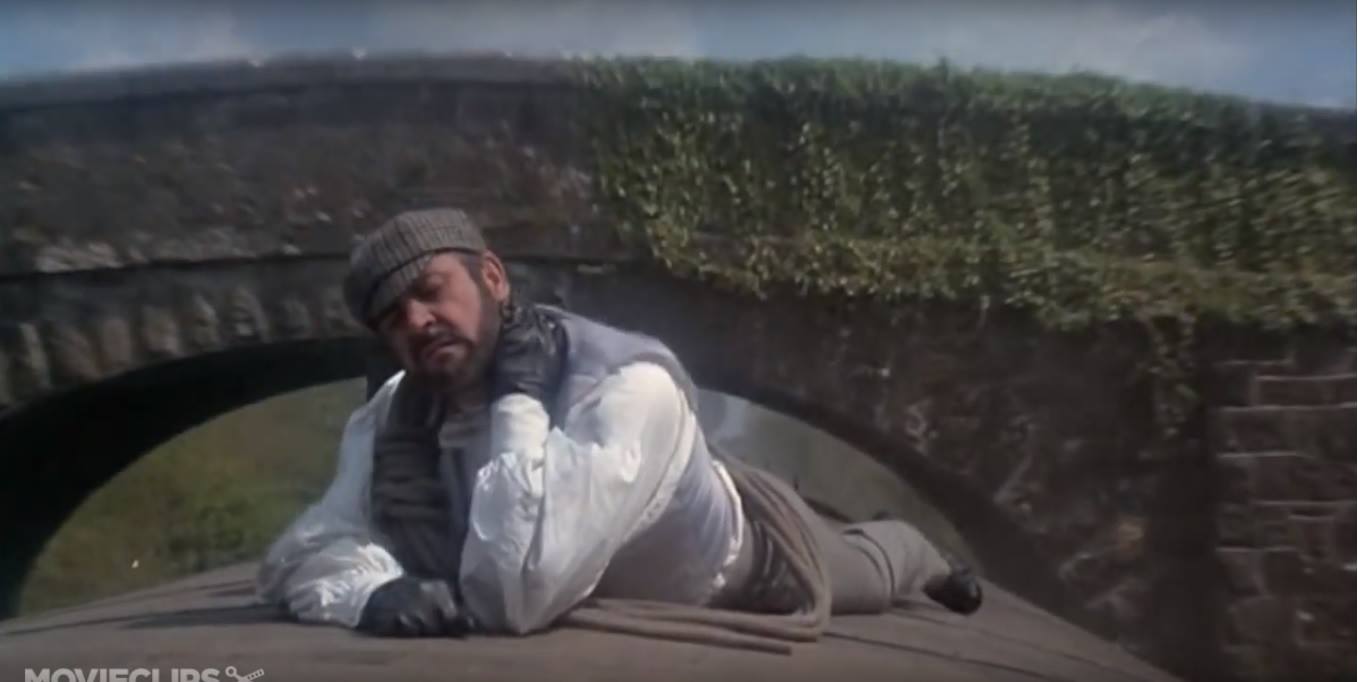
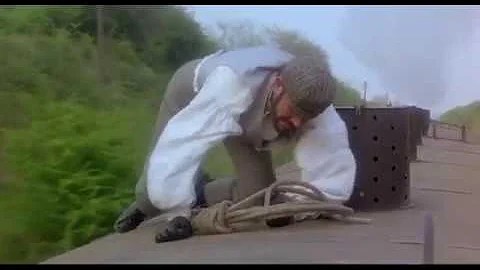
On the greater positive end, Sir Sean’s in great form, lovely Down is delightful, the costuming, sets and all-round period recreation plush with detailing sundry strata of homeland Pax Victoriana. By far the highlight is the insanely risky stunt action pulled off—survived, more like it—by Connery atop a speeding train, barely avoiding certain grievous injury (and likely sudden violent death) when ducking inches under bridges with split seconds to spare, half-blinded by cinders and smoke with the train, supposed to be going 20mph revealed afterwards to have gone more than double the speed. It’s gasp-aloud stuff: Sean fans love it.
In the main, critics were politely impressed, but financially the $7,000,000 affair under-performed, making just $11,700,000 in North America (51st place) with perhaps $2,000,000 elsewhere. Connery blamed lackluster distribution from United Artists.
Fun servings of pomposity are sputtered from Malcolm Terris, Alan Webb, Pamela Salem (later ‘Miss Moneypenny’ in Never Say Never Again) and Andre Morell. Also aboard are Michael Elphick, Wayne Sleep (famous ballet star daringly doing his own stunt work climbing a 60-foot wall) and Brian Glover. Jerry Goldsmith provides the music score. Filmed mostly in Ireland, with camerawork from the vaunted Geoffrey Unsworth: he passed away two months before the film was released; it’s dedicated to him. *
* Geoffrey Unsworth, 1914-1978—Scott Of The Antarctic, The Clouded Yellow, A Town Like Alice, The Purple Plain, A Night To Remember, Flame Over India, The World Of Suzie Wong, The 300 Spartans, Becket, 2001: A Space Odyssey, Cabaret, A Bridge Too Far, Superman, Tess.