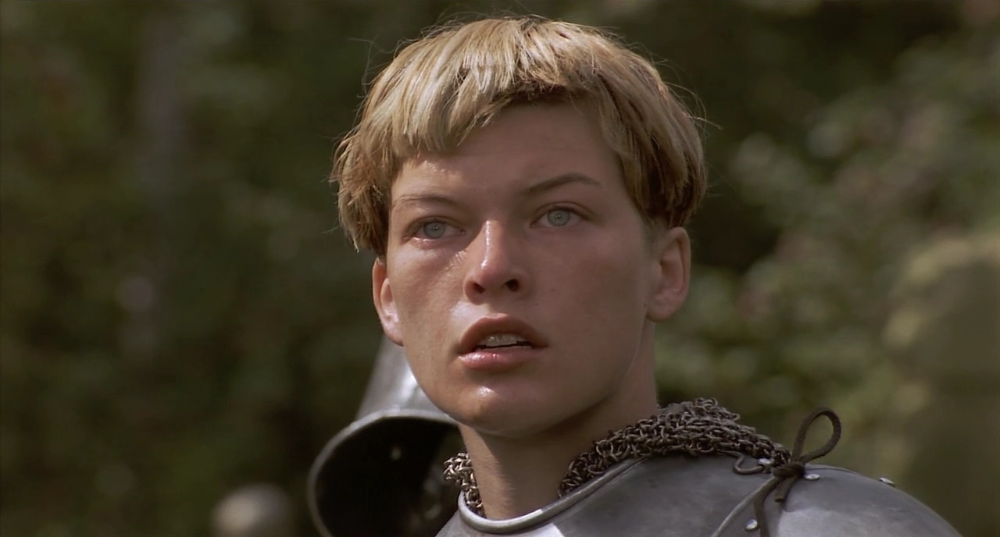
THE MESSENGER: The Story Of Joan Of Arc brought the sainted savior of France back to cinematic scrutiny and judgment in 1999, directed & co-written by Luc Besson, starring Milla Jovovich. Wed in late 1997, they were going thru a divorce during the arduous shoot, a lavish $63,000,000 recreation of war-ravaged France in the 1420’s. Andrew Berkin (The Cement Garden, Perfume: The Story Of A Murderer) collaborated on the screenplay. Reviews were mixed, worldwide box office a calamitous $66,976,000, the US share just $14,276,000, a medieval 103rd place. Yet the critics were overly harsh, the masses too fickle; the film has flaws but they’re bested by virtues. Like Joan. *
“You, who claimed to be my judges, you’ll be careful, for you too one day will be judged.”

The Hundred Years War. Blessed/afflicted by visions that she believes are divine inspirations, teenage French peasant girl Joan (Jovovich, 23) convinces the vain and indecisive Dauphin (John Malkovich), poised to become King Charles VII, that she indeed has some special gift and he allows her to take command of his soldiers besieging the English at the city of Orleans. Joan’s fervor and bravery wins over the troops and the cynical knights, routing the hated English. But when she attempts to complete her ‘mission’ and completely boot the Brits back across the Channel, her honesty and devotion runs afoul of political intrigue, court corruption and clerical intolerance. Thanks for the help, now go back to your hut.

Whereas earlier versions of the martyred maid’s epochal trip to glory take her deity-directed mission pretty much at face value, in this version, while her sincerity is unquestioned, the hallucinatory presentation of the visions allow room for considering more earth-bound mental afflictions. Regardless of what led her, the young lady’s effect on events was profound, the legacy impact immortal. Following an off-putting start—child Joan witnessing the awful rape-murder of her sister—this take is much grittier (and grislier) than earlier versions, so as to suit modern audiences (and convince with period evocation); the production design has impressive scale and detail. Malkovich is suitably flaky as the unworthy dimwit Charles, and Faye Dunaway has sly dark fun as exquisite schemer Yolande of Aragon. Dustin Hoffman is quietly forceful as ‘The Conscience’, baffling and bedeviling Joan when he/it appears to her during her imprisonment and the stacked-deck interrogation from ‘men of faith’ (will these bastards—and their corporeal witches— ever leave the rest us the f alone? No.) The combat-hearty knight lieutenants who serve her in battle are superbly embodied by Tchéky Karyo, Vincent Cassel, Richard Ridings, Pascal Greggory and Desmond Harrington. Their swagger and gallows humor airs authentic: ordinary crossbow-fodder in the ranks (people like you and me) were probably about as thrilled as we would be at the prospect, but professional warriors of those days would be the type who reveled in mayhem. At least they did it face-to-face, something deal-making & breaking overlords (then & now) always manage to leave to others. The desperate melee at the walls of Orleans is pretty wild, Braveheart having paved the visceral way.

Reviewers attacked Jovovich like they were clerics castigating a caged heretic, much in the way they’d pilloried Jean Seberg when she played the part 42 years earlier. The actress herself faulted the result, which she felt amounted to editing sabotage. For sure the pitch is generally geared high, but we’re in the minority who think the impassioned rawness works, the quivering tension in her slim form, voice cracking in urgency, eyes ablaze with zeal, all come across as deeply felt. Those last moments in the fire—of ‘purification’—are haunting, a few seconds of screen time that could speak for countless victims of officially sanctioned persecution. **

Photographed in the Czech Republic and France by Thierry Arbogast, scored by Éric Serra. Both are steadfast Besson collaborators; Thierry thirteen times by 2026, Serra sixteen as of 2024.
Serving ably: Timothy West (trying to spare Joan from immolation),Vincent Regan, Christian Erickson, Jane Valentine (Joan as a young girl), David Gant (who’d tormented William Wallace in Braveheart), Richard Leaf, Andrew Berkin (the co-writer) and Toby Jones. 158 minutes.

* Into the breach—the movie was originally to have been directed by Kathryn Bigelow, with Besson as producer. Bigelow spent a decade mining research, with casting proposals for Joan going thru Sinead O’Connor, Drew Barrymore and Claire Danes. After his smash with Milla in The Fifth Element, Besson insisted on her as heroine or he would withdraw; Bigelow bowed out, then sued Besson for stealing her material: they settled out of court. Good old-fashioned power-player jousting over the right way to honor a Saint. The Messenger also had to contend with a TV mini-series: backed by a host of star names, Leelee Sobieski took Joan Of Arc onto the small screen six months before Jovovich had her turn. They were preceded by Joan Of Arc from 1948 with Ingrid Bergman and 1957’s Saint Joan with Jean Seberg. Each drew measures of flak; both are better than their reps. None have topped the artistry of the 1928 silent The Passion Of Joan Of Arc starring Renée Falconetti.
Joan of Art—lest we be tried for the crime of Exemptianus Americanus—more refined cineastes may seek out the 65-minute The Trial Of Joan Of Arc from 1962, or Joan The Maid, a 1994 two-part opus that ran 5.6 hours. Peut-être, si je vis assez longtemps. Down to earth, in MovieAla’s hometown of Portland, Oregon, there is a large bronze statue of Joan that was donated to ‘City of Roses’ in 1925 by a pal of Teddy Roosevelt, honoring the Doughboys of WW1.
** Milla at the stakes— “Joan of Arc could have been an amazing movie. Unfortunately, my relationship with Luc at the time, maybe skewed his vision of what he wanted the movie to be. We were going through a divorce, at the time, it was tough on him. When I saw the finished product, I felt like he was mad at me. I felt bad about that because I felt like that was one of the greatest performances I’d ever given in my career. We had so many different levels from 1 to 100. And it felt like because of the emotional involvement, the edit ended up being like 100 the whole way. I didn’t want Joan to be so unhinged. I wish that things had been different with that movie. Cause it had everything in it to be a classic, and it just didn’t hit that mark.”
Tried & kinda-sorta true—like other historical tragedies centered around individuals or events (Christ, Cleopatra, the Alamo, the Titanic) Joan’s comet streak thru history is catnip that comes with a warning on the label; the stories and characters are fascinating but they arrive with critics and academics primed to nitpick and they finish with audiences often bummed by hours of hope that end in catastrophe. Plus the sheer cost of period recreation conspires against financially adequate returns. Luckily, like the fate-chosen folk and their timeless epics that they renew, the films outlast opinion snubs, corporate profit & loss statements and mass attention moods. On to Orleans!