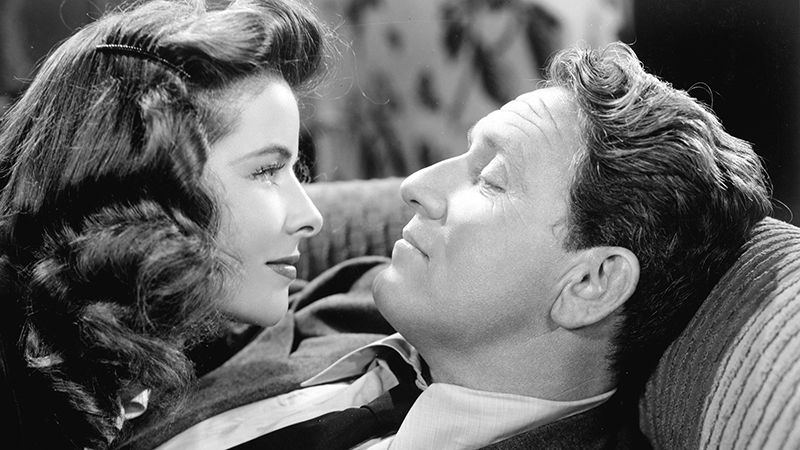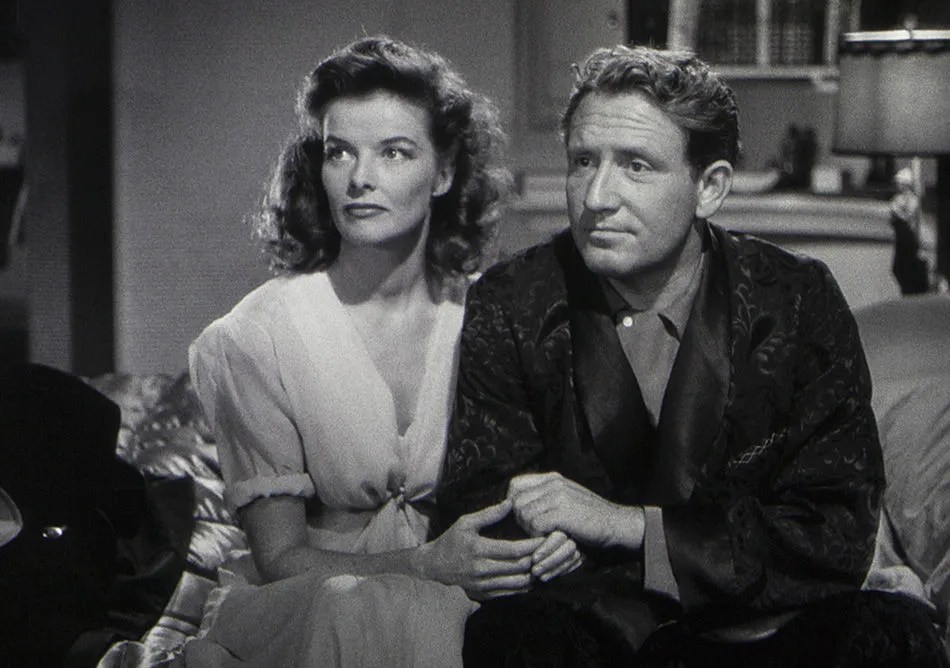
WOMAN OF THE YEAR brought some welcome rays of light to the dark days of 1942 with the first of nine screen pairings of Spencer Tracy and Katharine Hepburn (or the other way around if you wish) in a warm romantic comedy directed by George Stevens. Garson Kanin came up with the outline, basing Hepburn’s character on journalist & radio broadcaster Dorothy Thompson. Kanin’s brother Michael and Ring Lardner Jr. wrote the screenplay, with an uncredited John Lee Mahin tagging along to doctor the final scene: the script won an Oscar and Hepburn was nominated for Best Actress. As Hollyfate would have it, she’d asked for Tracy as her co-star, they then met for the first time, and during the shoot commenced the intimate relationship they’d share until his death in 1967. *
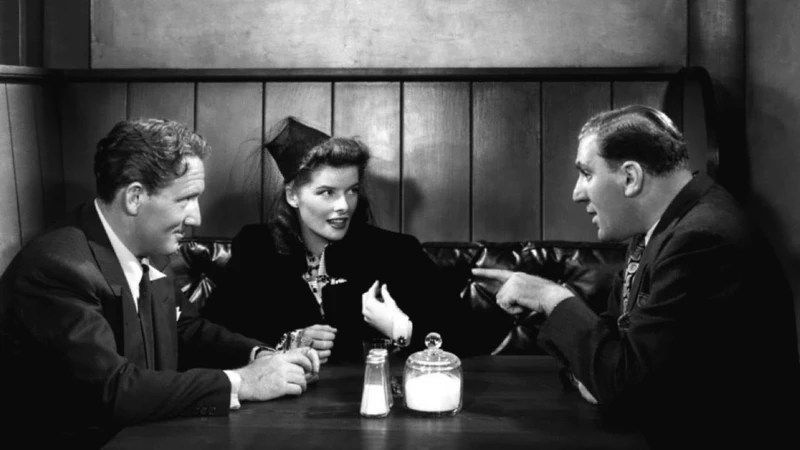
“Success is no fun unless you share it with someone.”
There’s an international war on, but intramural peace is declared between two newspaper columnists having a spat over the relative importance of baseball while the world burns. When they drop their typewriters and actually meet, sparks of a nice sort kindle between ‘Tess Harding’ (Hepburn, 34) and ‘Sam Craig’ (Tracy, 41), despite their different backgrounds, styles and interests. Sam’s a sportswriter, but his easygoing common guy persona is just part of his makeup; he has more on the ball than home runs, tackles and knockouts. Daughter of a diplomat, political affairs reporter Tess is a world traveler who’s been everywhere, knows everybody and speaks six languages. Admired, constantly in demand & on the go, she’s been selected ‘Woman Of The Year’. Yet opposites attract, sometimes the attraction leads to love, even—gulp!—marriage. Then, the hard part shows up: getting to know each other.
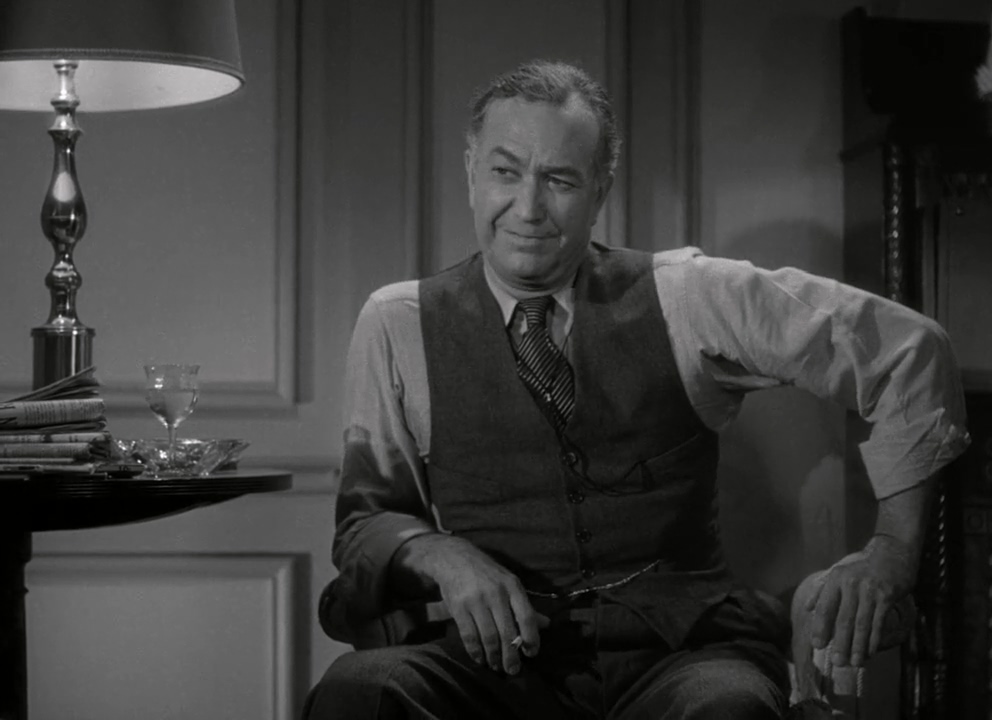
Minor Watson, 1889-1965. 111 feature films, ten in 1942 alone
Sensitive handling by Stevens balances the script’s deft mix of teasing romance, shared laughs and line-drawing drama that presents the attitudinal shifts of a country waking up to the seriousness of global responsibility while maintaining some sense of egalitarian breeziness. That larger messaging is done thru the lens of two seemingly incompatible types trying to make a go of togetherness when issues, actions and motivations serve to try and pull them apart. All accomplished with to & fro banter, social satire, sexual tension, gender reversal pressure, some pain (both self and other inflicted), errs in judgement and a dollop of slapstick healing to go out on. That last, whipped up for the finale, was added after preview audiences indicated displeasure with the original ending. The studio (MGM and Louis B. Mayer), producer Joseph L. Mankiewicz and Stevens mandated a re-shoot; this is when the uncredited John Lee Mahin stepped in. Hepburn didn’t like it, and modern reviews usually take it to task. Yes, it is a cop-out, but it’s also very funny, with Hepburn mangling breakfast with goofy clumsiness that’s beautifully performed. It’s mainly the very last moments that really feel tacked on, rushed, silly and obviously out-of-date with how most of us think today. Uh, wait, that’s right—it was 1942. Make the V for Victory effort and dial back getting tizzy about the compromised wrap-up: you’re not betraying history, feminism, progress or yourself by chuckling over a toaster, some eggs and a waffle.
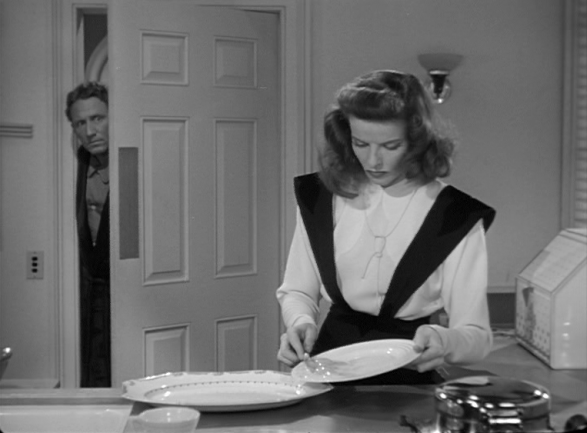
Hepburn and Tracy shine throughout, glowingly photographed by Joseph Ruttenberg, the stars genuine chemistry couldn’t be clearer; as one would hope for people in who are love, they each bring out the best in the other. Of course, they’re both great actors, but we can sense that the soulfulness in their eyes when they gaze at a soul mate isn’t practice-made-perfect fooling but instead is the real deal going down.
Beyond introducing twin legends to one another individually and to us as a pair, Woman Of The Year brought a new fella into play via the malleable mug of William Bendix. At 35, he scores smiles in one of seven parts won in his introductory year (including classics Wake Island and The Glass Key). There’s also a neat role for dependable character man Minor Watson, who plays Hepburn’s father: he’s allowed a heartfelt man-to-man (pop to son-in-law) chat with Tracy that’s a little gem.
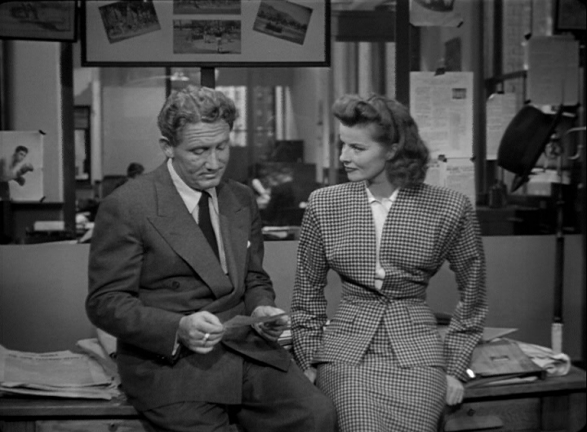
Produced by Mankiewicz for $1,000,000, ranking 32nd in ’42 with a gross of $5,500,000. With Fay Bainter (Tess’s maiden aunt who finally gets a break), Dan Tobin (Tess’s secretary ‘Gerald’, coded as just this side of fussy), Reginald Owen, Roscoe Karns (one of his numerous wiseacre reporters), Ludwig Stossel (eleven parts that year), Edith Evanson, George Kazas and Ray Teal (fifteen bits in ’42). 114 minutes.
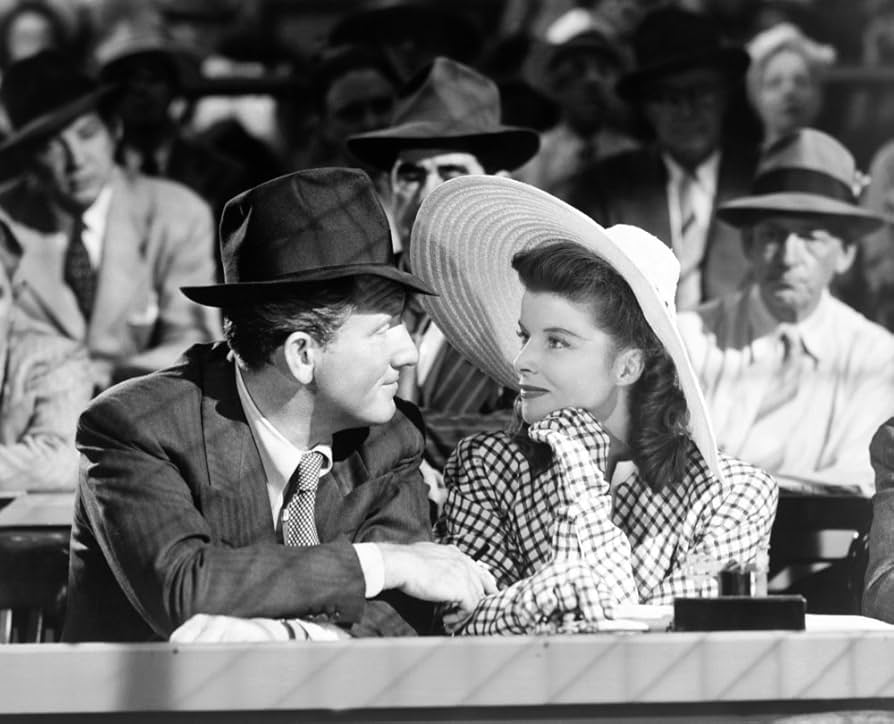
* Kate & Spence—they promptly followed that same year with a drama, Keeper Of The Flame. Then came Without Love (1945), The Sea Of Grass (1947), State Of The Union (1948), Adam’s Rib (1949), Pat And Mike (1952), Desk Set (1957) and Guess Who’s Coming To Dinner (’67).
Famous first words—when Hepburn, 5’9″ and wearing high heels, met 5’10½” Tracy she ventured “I’m afraid I’m a bit tall for you, Mr. Tracy”. Ever sharp, Mankiewicz cut in with “Don’t worry, Kate, he’ll cut you down to size.”