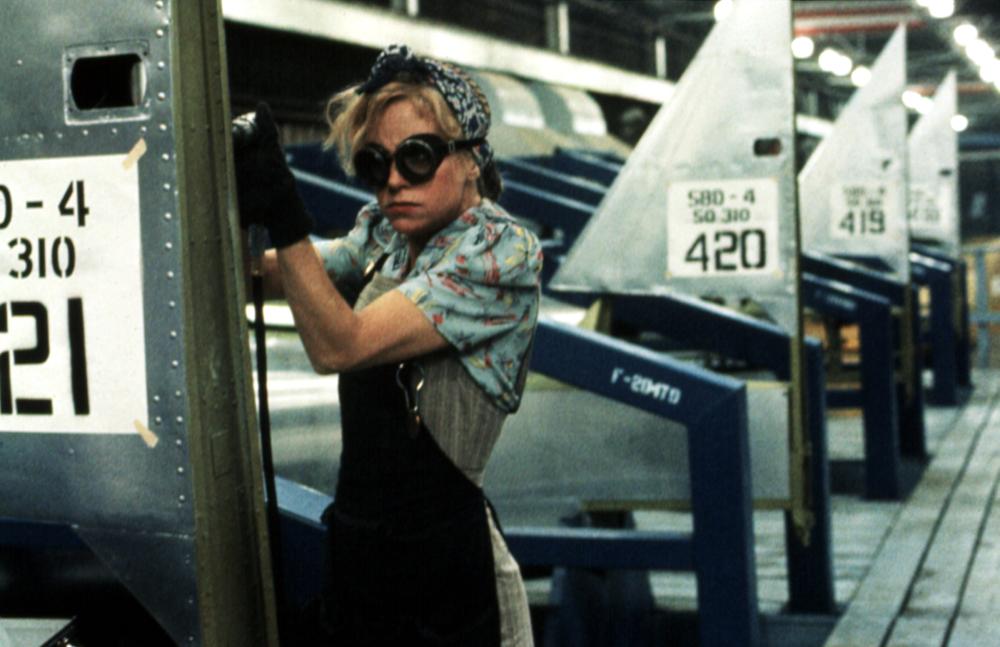
SWING SHIFT should have been a hit, a locked-in setup with a popular star, a squad of rising lights in supporting roles, and a hot director teaming up on an overdue slice of Americana joining the perennial national celebration of World War Two. But the filming was plagued by intramural arguments that pitted the power-playing leading lady and the studio against the director, fights that resulted in extensive and costly reshoots. When released in the spring of 1984 it was dissed by reviewers pre-armed to snort after parsing gossip about the production strife. Worse, the public didn’t troop in, turning heartfelt hopes into a major box office flub. graveyard shifting into 98th place when taps sounded for the year, with just $6,700,000 recovered against the $15,000,000 price tag. For one cast member, some consolation came via a well-earned Oscar nomination.
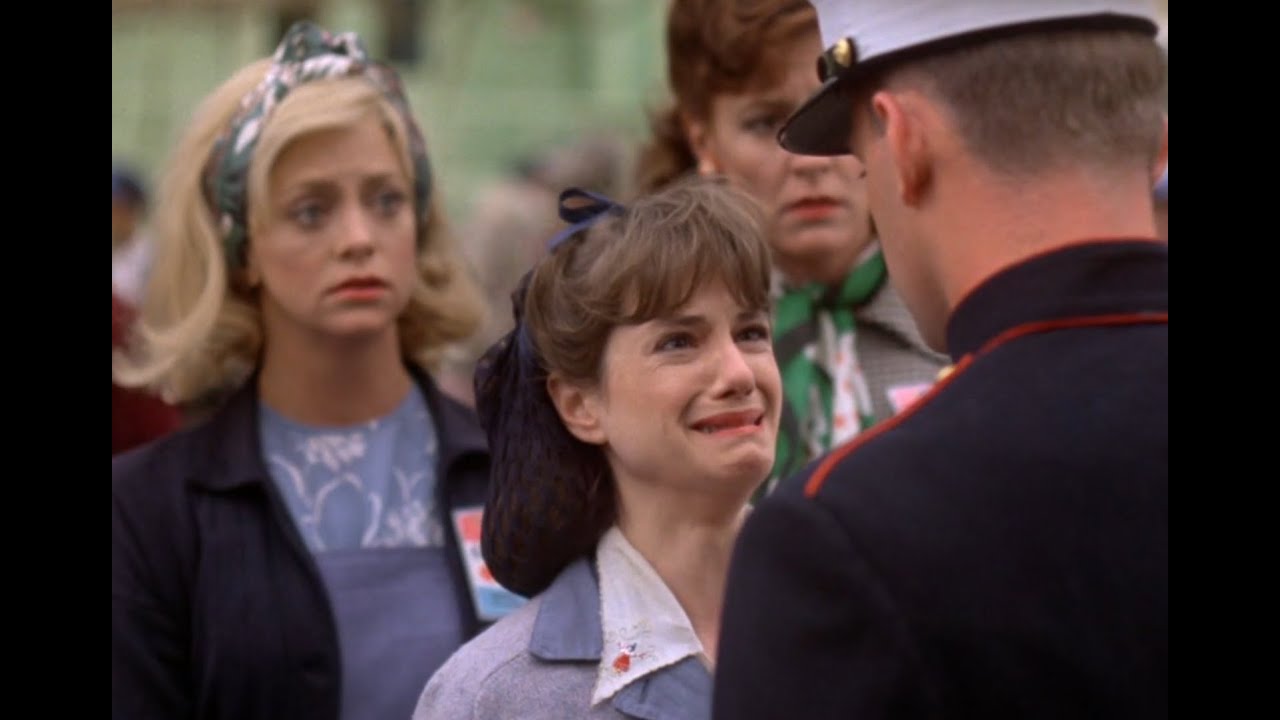
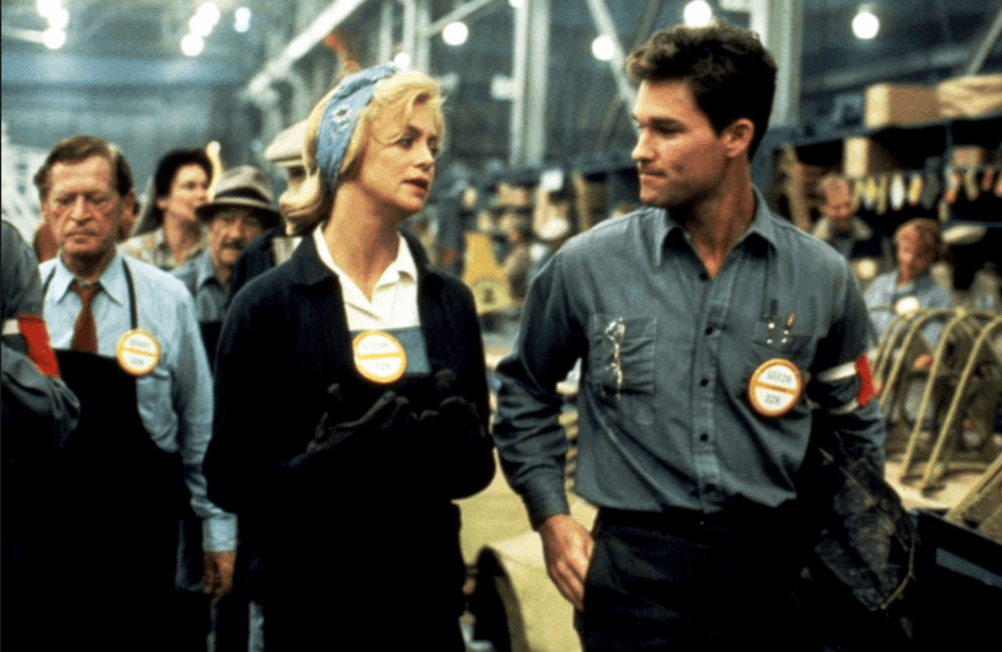
When the attack on Pearl Harbor blasts America full-bore into a global fight to the finish, it wasn’t just men joining the struggle. Millions of women entered the work force, taking on factory jobs (often dangerous) making the mountains of lethal hardware that the conflict demanded. In Southern California, cosseted housewife ‘Kay Walsh’ (Goldie Hawn, 38) steps into the fray as a ‘Rosie the Riveter’ in an aircraft assembly plant while doting husband ‘Jack’ (Ed Harris, 32) ships out in the Navy. During the course of the war, Kay masters her job, learns more about herself, and bonds with her co-workers. The strain of separation eventually sees her intimately entwined with ‘Lucky Lockhart’ (Kurt Russell), a musician whose bad heart kept him out of the service. The world turned upside down, roles and relationships fall into new and challenging territory. *
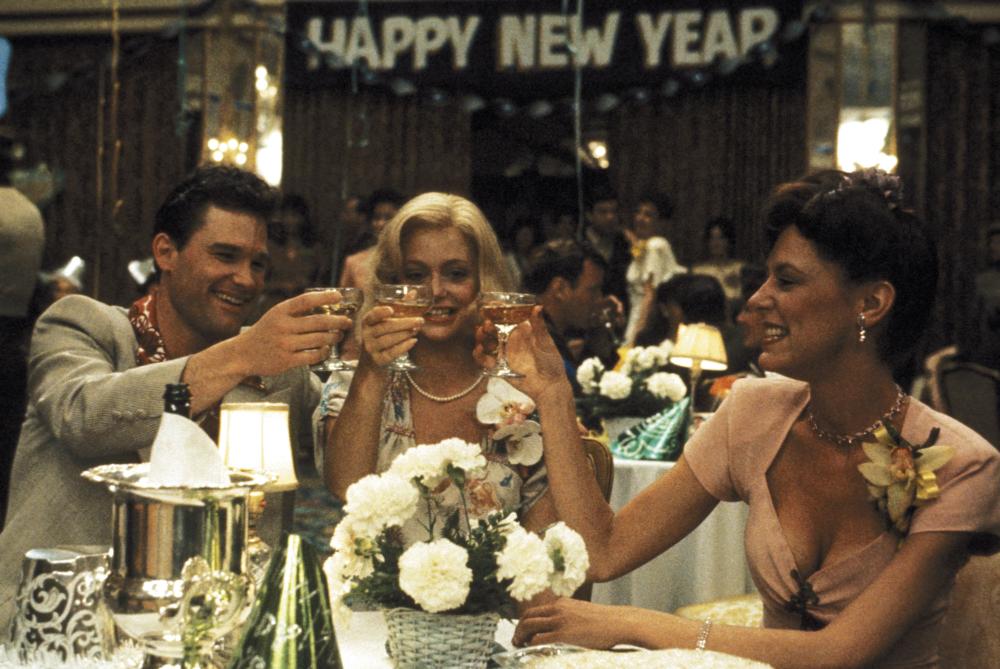
Hawn, 38, was coming off a slew of successes (Foul Play, Private Benjamin, Seems Like Old Times, Best Friends) and her clout as star and executive producer carried the day in picking Jonathan Demme to direct the elaborate period piece. Russell, 33, had been around since starting as a child actor in 1962 and had recently been gaining fan traction with Used Cars, Escape From New York, The Thing and Silkwood. Co-stars Harris, 32, and Fred Ward, 40, had been nicking colorful supporting roles (most notably in The Right Stuff) while 3rd-billed Christine Lahti, 33, had just three films to her credit. Everybody’s good, and Lahti is great; as brassy ‘Hazel Zanussi’, a singer and neighbor of Kay’s who becomes her good friend at the plant, she aced the movie’s Oscar nomination, going up for Supporting Actress. There are laughs, romance and drama, and it’s excellently photographed by Tak Fujimoto, deploying a ‘nostalgia glow’ tone.
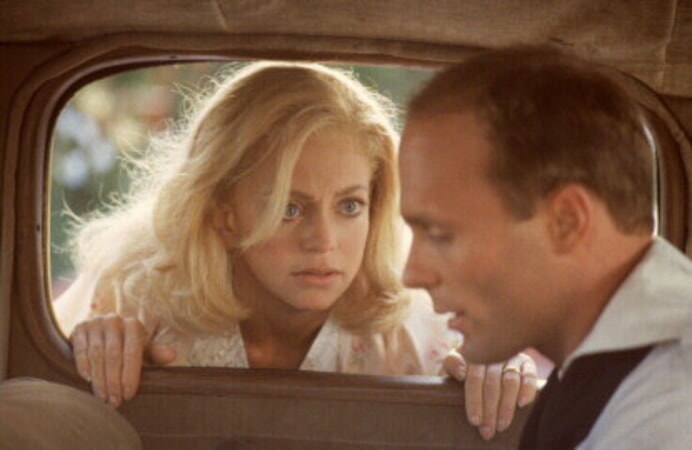
So what’s with the rebop? The original script by Nancy Dowd (Slap Shot) was rewritten, sans credit, first by Bo Goldman, then Ron Nyswaner, their work eventually filtered thru Robert Towne. A naturally miffed Dowd took credit under the pseudonym Rob Morton. Hawn and the studio insisted on changing Demme’s cut into one that favored the relationship between Kay and Lucky—coincidentally the one between Goldie and Kurt, who’d fallen for each other in the meantime. A half hour of new material was fashioned in, over Demme’s objections: he was so pissed he wanted his name removed and replaced by the cover-fiction known as ‘Alan Smithee’. Industry insiders who’ve seen video dupes of Demme’s original cut insist it was/is superior, and given his track record (Melvin And Howard, Stop Making Sense, The Silence Of The Lambs, Something Wild) we can imagine they’re right. Ultimately Hawn was hurt, too, by the fallout over the vision/control/blame game and the critical/financial clobbering. She did, however, walk away with a partner for life. **
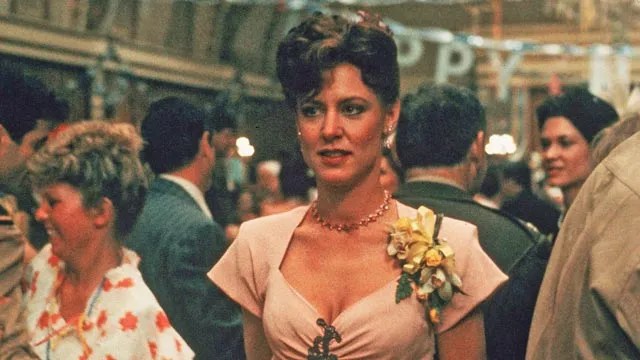
Conceding that the show isn’t the 4-star winner all involved hoped for, it’s still quite enjoyable, thanks largely to the cast, and the critical bashing was another case of piling on. That the public didn’t sign up was probably due to several things; partially the lame reviews, more that word-of-mouth was ‘meh, as the ad campaign and Hawn’s rep as a comedienne had people expecting silliness rather than something more thoughtful, and there is also the regrettable factor of a widespread lack of historical awareness and/or curiosity.
100 minutes, with Charles Napier, Holly Hunter (25, second feature film part, much of her work was missing in the final cut), Sudie Bond, Dennis Fimple, Stephen Tobolowsky, Patty Maloney, Belinda Carlisle (of The Go-Go’s), Roger Corman, Alana Stewart and Lisa Chadwick. Hawn’s other ’84 release, Protocol, ranked 59 spots higher on the year’s money tree. Demme’s second entry that year is a classic, the concert capture of The Talking Heads in Stop Making Sense.
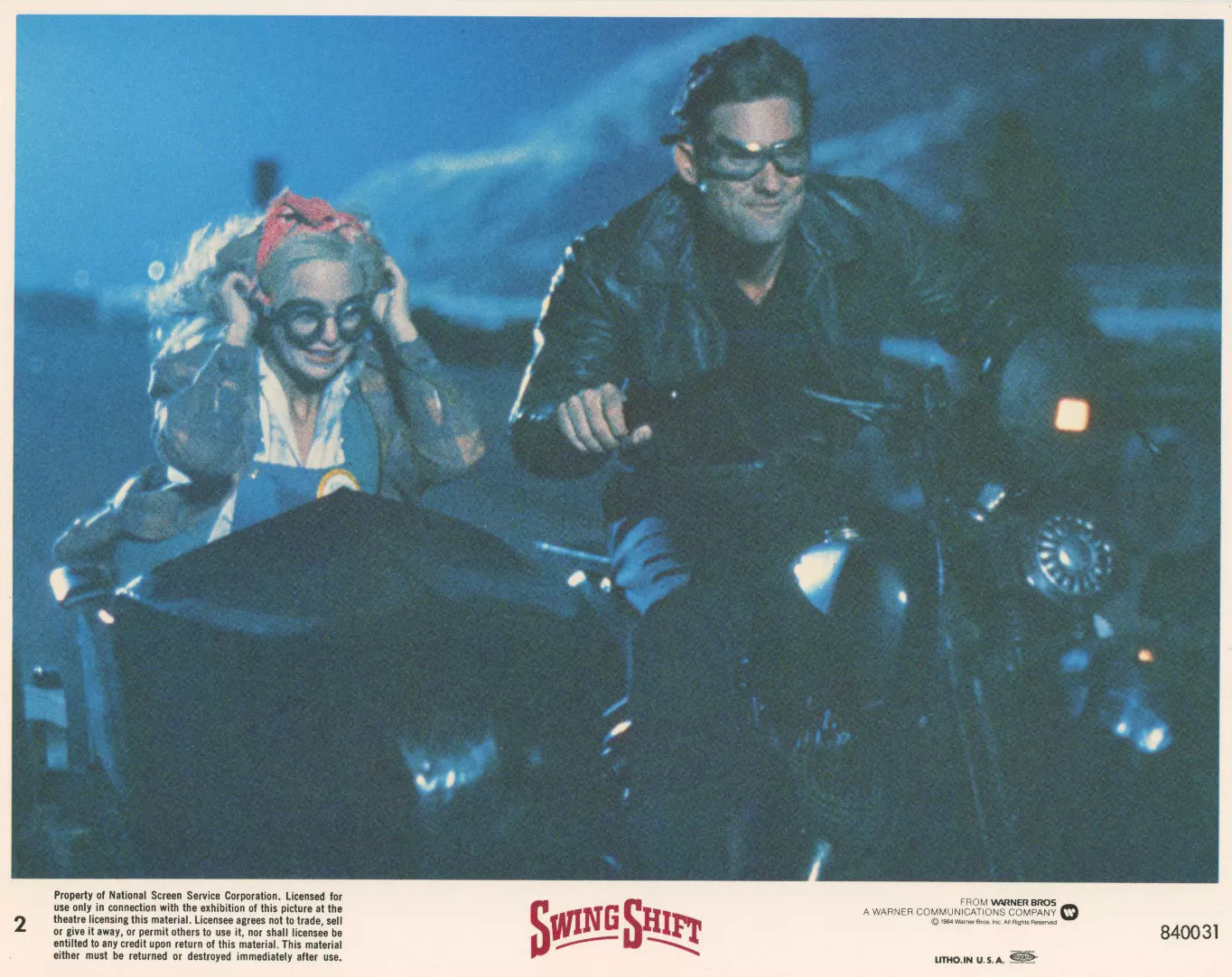
* Hiring Line—‘Call of Duty’ wasn’t always a video game. 1941-45 saw 6,650,000 women showing up for factory work, churning out tanks, planes, ships and assorted paraphernalia bound for use across the oceans. Another 3,000,000 ladies bolstered the Red Cross. And the various branches of armed services found female volunteers totaling more than 350,000. With my father away in the Merchant Marine, my mother (28 in 1943) did her bit as a welder in the Kaiser shipyards of Portland, Oregon, helping build ‘Liberty Ships’. She witnessed some gruesome accidents (like a ship’s siding plate dropped from a crane, cleaving a friend in half, right in front of her). To say I’m proud of what my parents (and Mom’s younger brother) did during WW2 doesn’t begin to cover it.
** Demme dishing: “For a film-maker, in your professional life, it’s hard to imagine anything more devastating, because you haven’t just had your work taken away from you. You’ve worked on it for more than two years, first with writers, then through pre-production, then with the editors and the composers, etc. etc., so everybody else’s work is being taken away. And the director is the kind of custodian of all the collaborative artists’ good work and it is his job to maximize everybody’s work and present it in the best way possible. So when they took this movie away and started chopping it up I knew that this would happen, so it wasn’t the usual ego thing – like my God, they’re going to take my movie away – it was also this investment of everybody else’s hard work.”
To be fair to Goldie, she effectively offers her side of the brouhaha in her book “A Lotus Grows In The Mud”.


I love this film. Wish it would get a DVD release over here.
Hi Maddy, I ‘d love to see the director’s cut and compare them. Given Demme, it’s likely better, but then again reviewers tend to opt for siding with directors they’ve fixated on vs. actors they imagine are overly self-enamored. Plus there is the overlooked ‘spoilsport factor’ and those who love to pile on for the malicious heck of it. And even if his was better and earned critical praise I don’t know if that would have worked with the public: I’m guessing Hawn had at least as good a grasp of what they/we want as he did. As for myself, I don’t automatically dismiss a movie that might “just” be a ** or **1/2 (unless it’s a 1/4 like “Dans Paris”…). Cheers, Mark