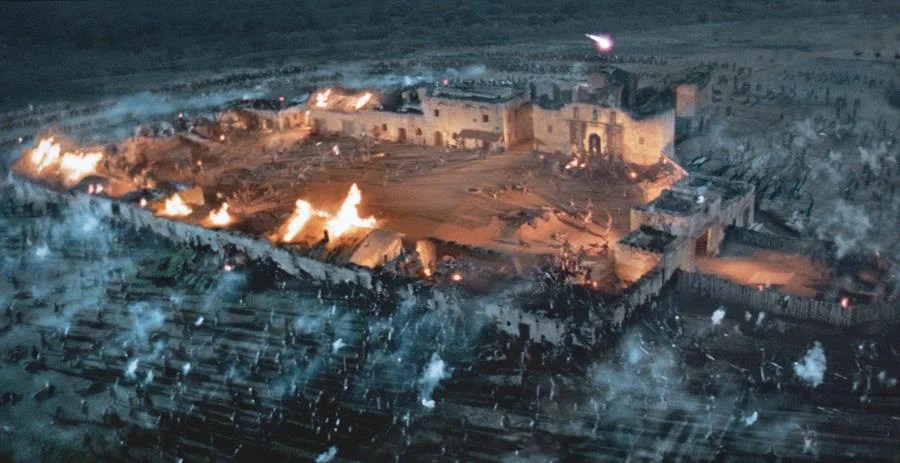
THE ALAMO, the ill-fated, underrated 2004 look at the immortal 1836 battle, despite valiant work in a number of its component parts, went down as a critical defeat and—more tellingly—a commercial massacre, overwhelmingly outnumbered by crushing box office numbers. While quite a bit more historically accurate than the legend-summoning 1960 version, it sorely lacked that epic’s passion, flair and excitement. Though frustrating for some glaring missteps—especially to fans of the John Wayne spectacle that made lifelong Alamo buffs of many—this sincere revisit is worthy for all it does right and is certainly much better than a lame reputation indicates. *
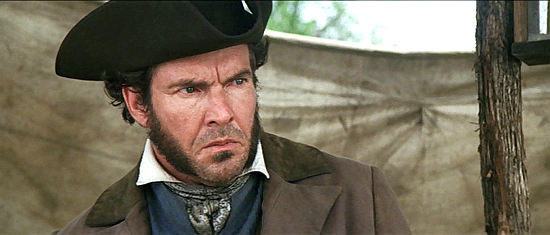
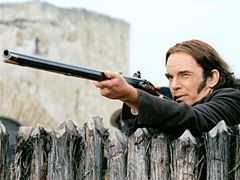
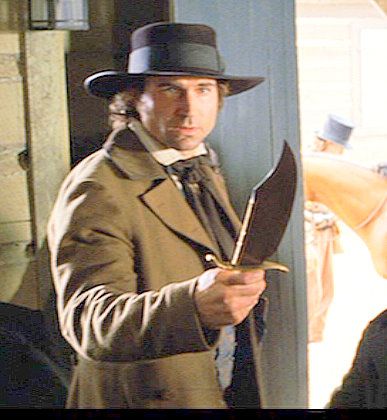
The Mexican province of Texas, 1836. A fractious collection of ambitious colonists from the United States (and several European countries) and a disgruntled segment of the local Tejanos revolt against the tyranny of Antonio Lopez de Santa Anna, the Mexican president. While Texican leader Sam Houston, 43 (Dennis Quaid, 39), tries to rally forces, Santa Anna and his army of thousands trap less than 200 rebels in San Antonio. Surrounded in a debilitated mission known as the Alamo are cause-seeking lawyer William Barret Travis, 26 (Patrick Wilson, 30, feature debut), given command; renowned hard-case rascal Jim Bowie, 39 (Jason Patric, 38), lethal but seriously ill; and famous frontiersman/politician/storyteller David Crockett, 50 (Billy Bob Thornton, 48). Escape unlikely, Santa Anna not inclined to mercy, a fight to the death is at hand.
Conceived as a graphic, huge-budget event to be directed by Ron Howard and starring Russell Crowe, scripts from various parties including John Sayles were drawn up, ultimately ending with Howard as producer (Crowe moving on) and relative newcomer John Lee Hancock (The Rookie) taking the director’s chair, co-writing the eventually accepted screenplay with Stephen Gaghan (Traffic, Syriana) and Leslie Bohem. Though downsized from Ronny’s original blockbuster, a prodigious tranche of money still poured in, and a magnificent fifty-one acre set was erected near Austin.
 Well over a million feet of film was shot, 52 hours worth. Hancock and editor Eric L. Season (The Last Seduction, A Simple Plan) waded thru the mass and delivered a three-hour cut, but nervousness at the top of the studio food chain had them whack that down by nearly a third. Then fifteen minutes were put back, leaving the eviscerated result to sally forth clocking at 138. Release was delayed, The Passion Of The Christ (three times as violent) wrested audiences away, critics pooh-poohed, the Oscars were AWOL. When
 casualties stats were tallied, receipts in the States were a mute $22,415,000 (100th in ’04), with but $3,400,000 traced abroad. Slammed (like scaling ladders against an adobe wall) under the production tab of $107,000,000, with at least $35,000,000 added for marketing, this knotty but noble stand went down as a take-no-prisoners slaughter.
The critical pasting was another of those pile-on overkill situations that occur from time to time (usually if the target is high-profile, costly and stalked by production squabbles), sometimes warranted, often merely lazily malicious. The faults in this version are notable, but they’re outweighed by what works. The meh box office response is more understandable: a lack of charismatic stars, grim subject matter, audience ignorance of history and attention diversion (Mel’s flayed Jesus swiping the gory glory) all leading to negative word-of-mouth. Though Howard, Hancock and their crew were motivated by genuine desire to tell the old story in a new way, they simply miscalculated the crucial appetite v. cost factor—ironically mimicking the event itself by committing to gamble on rescue from an unwinnable position. Crockett, Bowie and Travis won historical valediction; the filmmakers more unforgiving environment involved losing tons of money: corporate behemoths are at least as cold-blooded as snappily uniformed dictators.
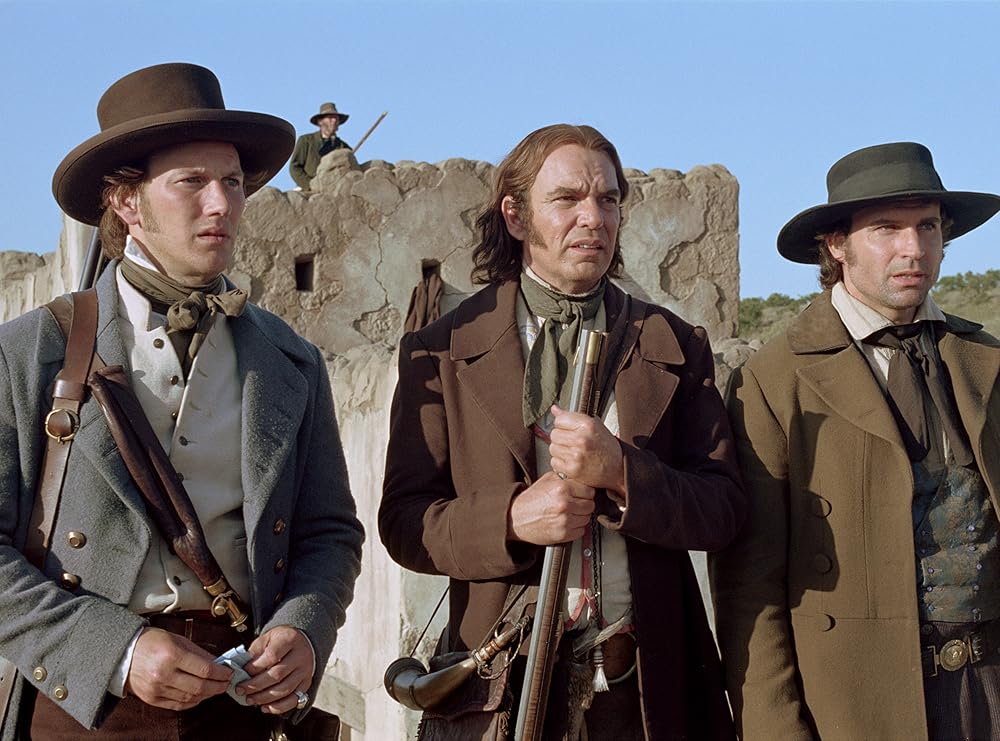
Breaches in the North wall—-a funereal tone is set from the start, the truncated editing introduces a score of interesting secondary characters and then abandons them, Carter Burwell’s score is lackluster, and someone made the odd call to have the sound effects dulled so that muskets (which make a definite boom, trust me) are no louder than hand claps: was this to somehow emotionally reduce the heroism element to assuage the p.c. crowd? So, uh, Guilt means we’re not supposed to be stirred—by something that by its very nature was rousing? Dennis Quaid came in for a lot of flak on his impression of Houston: we think he’s okay even if his costuming pick is on the goofy side. Worse, newcomer Wilson is a washout as Travis, with none of the vitality of that brash romantic, leaving Laurence Harvey’s flamboyant portrayal in the 1960 epic unchallenged as the go-to interpretation. Wilson is so bland he makes Richard Carlson’s turn from The Last Command seem inspired.
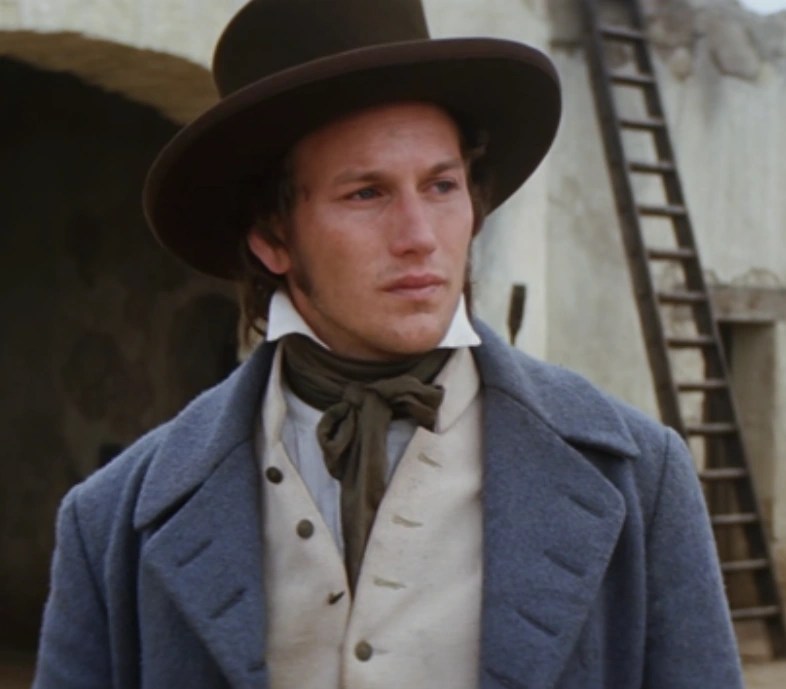 TRAVIS: “We could try to get you out with an escort. If you’re captured, perhaps given your condition, mercy would be extended.” BOWIE: “I don’t deserve mercy. I do deserve a drink. You got anything stronger than water?” TRAVIS: “I don’t drink, Jim, you know that. I gamble, go to whores, run off on wives… but drinking, I draw the line.” BOWIE: “You know, if you live five more years, you might just be a great man.” TRAVIS: “I think I will probably have to settle for what I am now.”
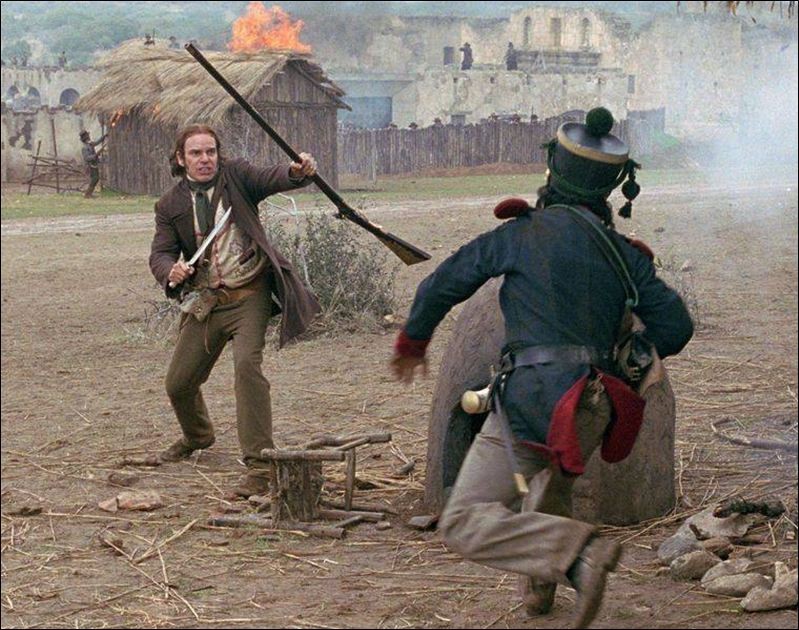
Dying Harder—-the accuracy level isn’t perfect, but for once it is fairly high and the script is commendable for covering so much ground, even if fleetingly, and trying to play fair. That expansive set is a superlative work of art direction, going the famous set for the Wayne version one better. Though the doleful post-Alamo massacre at Goliad is mentioned, it’s not shown, but the San Jacinto revenge melee is well-presented. While not as compelling a presence as Richard Widmark (from ’60), Patric does well conveying Bowie’s aura mix of charm and danger. Emilio Echevarría, 59, is somewhat older than Santa Anna (42 at the time) but he vividly puts across the casual imperiousness and cruelty of that nasty gentleman; it’s by far the best screen take on the Generalissimo. Best of all is Thornton, who essays Crockett with a relaxed jocularity and tinge of weariness; his Davy is not as ‘large’ or as fun Wayne’s (or Arthur Hunnicutt’s from The Last Command) but feels lived-in and authentic. Finally, how about The Battle?—i.e The Reason to Stick Around. Unlike all earlier versions, this one does history a favor and plays out not in broad daylight but correctly in pre-dawn. Though those muted sound effects are pesky, it is a very impressive sequence; big, tense and fittingly furious and includes an outstanding overhead shot of the fury that is truly sensational. Dean Semler’s cinematography excels throughout.
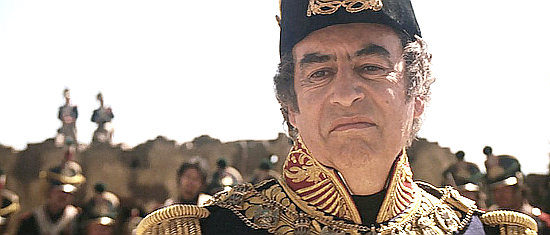
“If it was just me, simple old David from Tennessee, I might drop over that wall some night, take my chances. But that Davy Crockett feller…they’re all watchin’ him.”
With Jordi Mollà (a smart pick as Juan Seguin, then lost in the editing), Leon Rippy (colorful), Kevin Page (not good), Stephen Bruton (56, flatlined as Capt. Dickinson, who was 35), Castulo Guerra (gallant Gen. Manuel Castrillón), Edwin Hodge (as Travis’s slave Joe, the only adult male survivor, included for the first time in a movie version), Afemo Omilami, Rance Howard, Laura Clifton (as Susannah Dickinson, another editing victim), Emily Deschanel (as Travis’s wife Rosanna, barely there) and Buck Taylor.
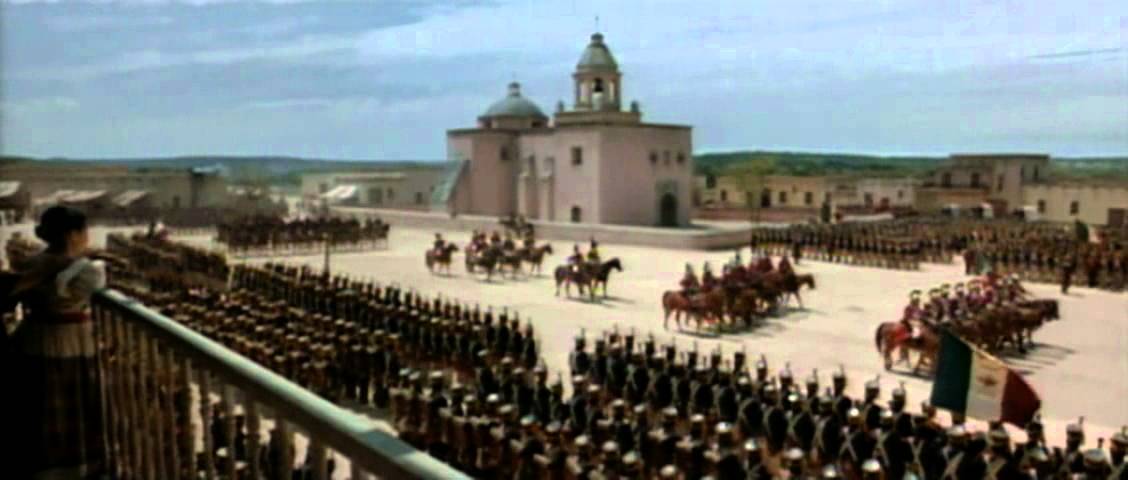
* History repeated—the Texian revolt was marked not just by three utter wipeouts but by confounding responsibility and command wrangles. Life or death back in 1836, but in the case of the 2004 movie the tug of war was between non-heroes in suits and suites at Touchstone, Imagine and Disney.
To his credit, Wilson did better later and offbeat Patric hewed to his craft, though in each case drawing power as a lead didn’t follow. Quaid’s previously impressive resume downshifted. Widely praised, Thornton emerged with his rep enhanced. Bloodied but unbowed, Howard delivered new wins with Cinderella Man, Frost/Nixon, The Da Vinci Code and the unsung In The Heart Of The Sea. Hancock recovered to do fine jobs directing Saving Mr. Banks and The Founder.
As a lifelong Alamo defender, thanks to the double whammy of John Wayne’s classic and Uncle Walt’s charmer Davy Crockett, I hope someday to see a Director’s Cut of this version. While Hancock’s somber recreation of the final fight, Duke’s bravura display and the rowdy one whipped up for 1955’s The Last Command are all mucho impressive, we venture that the least-known, most realistic treatment can be found in the 1988 IMAX documentary item Alamo: The Price Of Freedom, shown continuously at San Antonio’s Rivercenter theater. As with any number of history’s events and characters, we’ll never know for certain what really, truly went down at that time, in that place, with those men: we muse, fuse and use our own perceptions, ideals and prejudices to suit ourselves and the period we inhabit. Fine, with quiche now forked out of the way—would you cross the line? Why and what for? And when: hasn’t a big one (“like no one’s ever seen before”) recently been drawn? Though it happened almost two centuries ago, there are any number of reasons today to remember the Alamo.
 Movies ala Mark