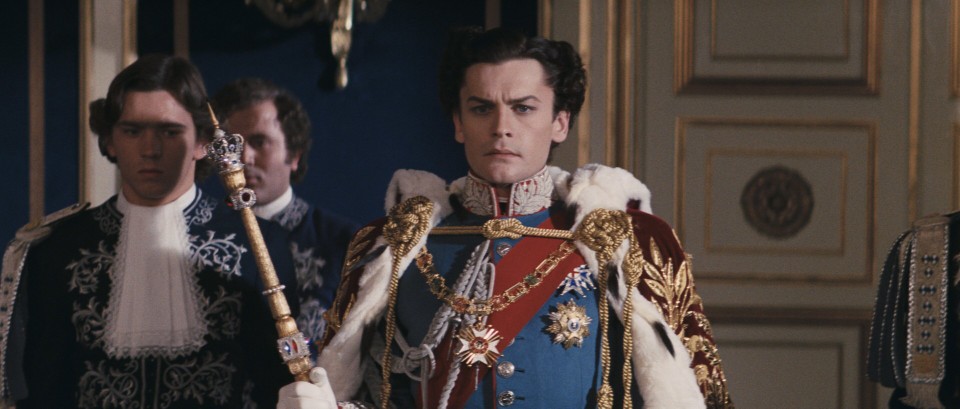
LUDWIG, the “Mad King” of Bavaria, misruled his German state for 22 years, to the admiration of his subjects and bafflement of his ministers, advisors and relatives. The pensive 1972 biopic directed & co-written by Luchino Visconti skipped admiration and went directly to bafflement when it was released, an original four hour running time whacked down for various markets, with the US premiere cut by over an hour. Reviews were rough, even brutal. The general release, further mutilated down to 135 minutes, left what remained incomprehensible to the average serf, even those aware of inbred 19th-century German homosexual nobles with a passion for fairy tale architecture and turgid Richard Wagner operas. Coin of the realm in the States was just $1,400,000, an un-royal 143rd place. A de rigueur Academy Award nomination came for Costume Design. The lush production (DM12,000,000) did considerably better in Europe, but the tag as an indulgent, lugubrious drag lingered until the restored 238 minute version landed four decades later on Blu-ray, the rep rising considerably. *
“I wish to remain an eternal enigma to myself and to others.”
Munich, 1864. At eighteen Ludwig Wilhelm (Ludwig II, grandson of Ludwig I) becomes King of Bavaria. Heredity hierarchy is his only qualification: he cares nothing for governing or diplomacy, in peacetime or war, instead bent on indulging flamboyant artistic whims and scandal-inviting relationships. He drains the treasury by commissioning the building of huge, ornate but needless castles, and in financing the works, lifestyle (and debts) of composer Richard Wagner, whom he idolizes; Wagner taking full advantage of the situation. Fondness for his elegant cousin, Austria’s Empress Elisabeth, ends in disappointment, and he outrages protocol and dignity by canceling his arranged marriage to her sweet and lovely sister, Princess Sophie. Though initially hurtful, that’s ultimately no loss for her, as his repressed sexual preferences lie with men; he arranges liaisons to suit, ranging from a well-known actor to servants, even soldiers in drunken orgies. Over time he sinks further into isolation, fantasy and excess, ultimately becoming so unstable that a movement takes hold to have him deposed.
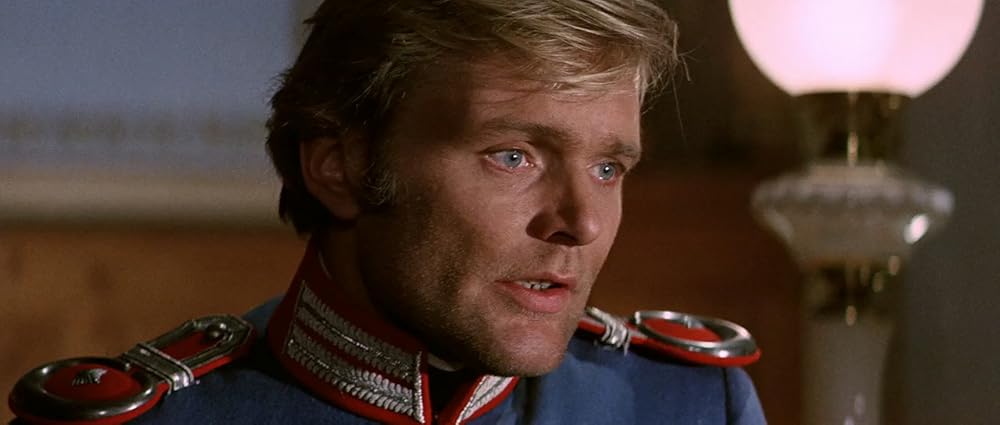
Helmut Griem, 1932-2004
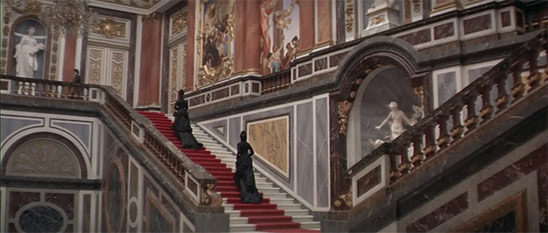
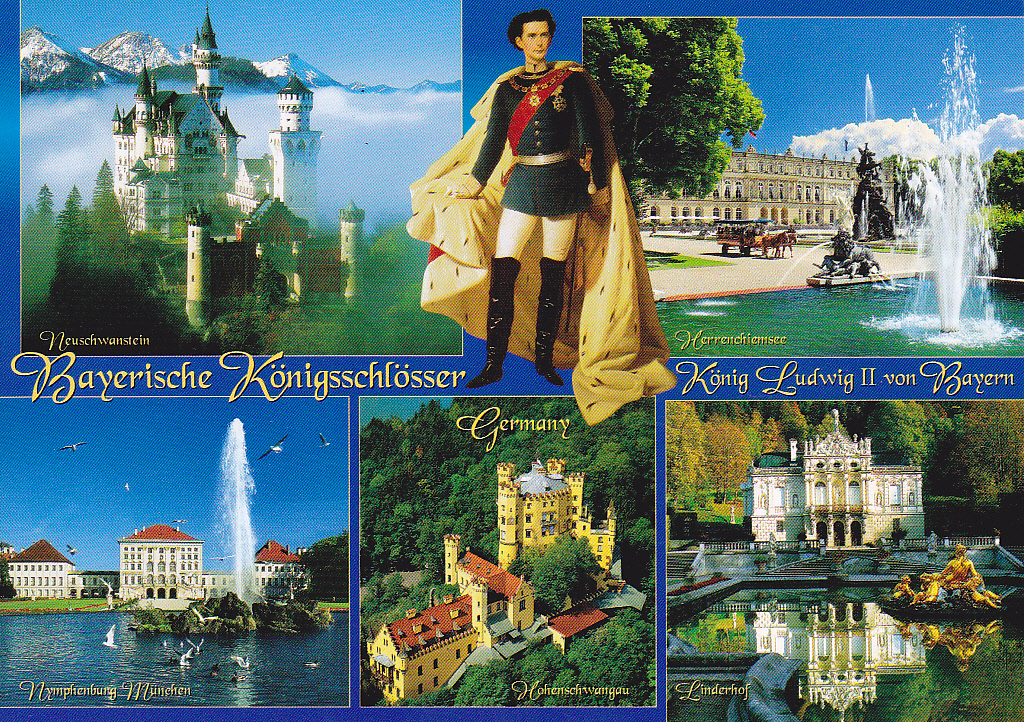
Though subject and setting are Germanic, the show is a Euro-national affair; reasonable, since once history happens it belongs to all of us. Visconti, his co-scenarists and most of the crew were Italian; the cast German, English, Italian, Austrian and French. The six month shoot took place in Germany, Austria and Italy. Bavarian locations include Ludwig’s lasting legacy, his art-ocracy castles Herrenchiemsee, Hohenschwangau, Linderhof and everyone’s favorite, the sire-inspired spires of Neuschwanstein, the model for Uncle Walt’s Disney icons. Linderhof’s ‘Venus grotto’ is an artificial stalactite cave, colorfully lit, with a waterfall feeding an underground lake bearing a golden swan-boat that would glide the monarch (and hand-picked playmates) past live swans to the echo of Wagnerian themes. At least he had the ear-sense not to add peacocks.

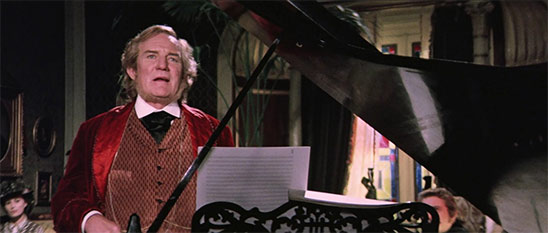
Ludwig is played—to the razor-edged hilt—by Helmut Berger, 27, who’d drawn attention for his outrageous camp turn in Visconti’s The Damned; he was also the 65-year-old director’s lover at the time. It’s a difficult role to pull off in that he’s not only the main focus, on-screen for hours, but due to the relate & care hurdle: while Ludwig may be pitiable he’s neither warm nor sympathetic. Berger does a splendid job conveying someone in way over his depth who both knows it and can’t admit it, trapped between position and duty against suitability and desire. In a large cast swirling around him the key players are Romy Schneider as Elisabeth, Trevor Howard as Wagner and Helmut Griem as Count Dürckheim, a general who was the King’s aide-de-campe. Schneider broke thru in the mid-50’s as a teenager playing Elisabeth in the widely popular Austrian films Sissi, The Young Empress, and Fateful Years Of An Empress. Radiant at 34, she exudes an aura of unquestioned aristocratic command to go with a teasing sensuality. Venerable pro Howard, 58, digs into one of his most-energized post-Mutiny On The Bounty roles (along with 1968’s The Charge Of The Light Brigade) as the controversial and calculating Musikgenie whose Valhalla odes swooned already flighty Ludwig into his rhapsodic irrationality. Fans of the handsome Griem (the Robert Redford of the Rhine—I hereby coin it!) will enjoy seeing him in a sympathetic role as a loyal officer and friend, a pleasing counter to his numerous icy Nazis, that casting curse/job security of blonde German actors.
 Throughout, the cinematography from Armando Nannuzzi (The Damned, Waterloo) is plush, the costumes are resplendent, the locations (and cold weather) used for mood rather than eye candy. Instead of having a composer create an original score, Visconti opted to use period selections from Jacques Offenbach, Robert Schumann and prominently, Wagner operas, 1845’s Tannhäuser, 1850’s Lohengrin and 1865’s Tristan und Isolda. He also employed the commentary framing device where several characters interview-introduce upcoming sections of the narrative, something prefigured by Orson Welles for Citizen Kane and later used by Warren Beatty with the “witnesses” of Reds.
Since different print lengths are available, enjoyment and appreciation of—or ability to decipher or stay awake thru—the meditative, action-absent presentation may depend on which version one watches; I saw the long one, watching in half-hour segments (it was also presented in Europe as a mini-series), which made for easier going in the slow(er) patches. The dubbing of the assorted releases also varies between German, Italian and English: Visconti shot it without sound recording on the takes so that dialogue could be post-dubbed. Watching the familiar face of Trevor Howard with his voice coming out in German doesn’t detract from the obvious gusto and guile of his performance. Running time, if you have a modicum of patience, isn’t so much of an issue as editing and pace. In this instance, it is ‘too long’ because there are a good number of simple cross-room-open-door scenes that are unnecessarily drawn out, with a few entire sequences that could/ought to have been jettisoned. Paring twenty-five or thirty minutes from the full-length version would lose nothing vital.
Though restlessness with the pace occasionally nags, when the show was over I not only wanted to find out more about the title subject and some of the other historical characters, I knew I’d want to watch the movie again.

With fine work from Gert Fröbe, Silvana Mangano (as Cosima von Bulow, Wagner’s mistress/wife), Umberto Orsini, John Mulder-Brown (Prince Otto, Ludwig’s ill-fated younger brother), Sonia Petrovna (spurned Princess Sophie—she was a class act royal personage), Volker Bohnet, Marc Porel, Heinz Moog, Adriana Asti, Morizio Benuglia, Helmut Stern, Gérard Herter, Friedrich von Ledebur. The co-writers were Enrico Medioli (Rocco And His Brothers, The Leopard) and Suso Cecchi d’Amico (Senso, Big Deal On Madonna Street).
* He’s a Mad, Mad, Mad, Mad World Figure—to date Ludwig has been portrayed in eight movies and the 1983 British miniseries Wagner. There were silents from Austria in 1922 (Ludwig II) and 1930 Germany (Ludwig II: King of Bavaria). 1955 had Germany’s Ludwig II: Glanz und Ende eines Königs (Splendor and End of a King) and a Hollywood bio of Wagner, Magic Fire, shot in Italy and Germany. Jumping the gun on Visconti’s epic by a year, 1972’s Ludwig: Requiem for a Virgin King was heimat-made in Germany. 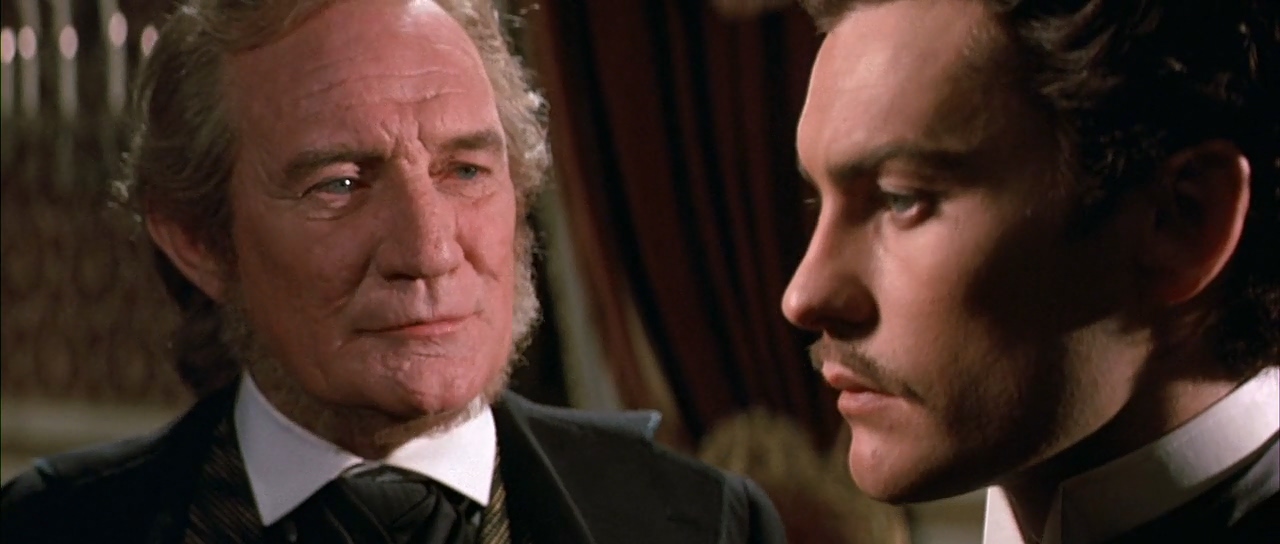 Post-Visconti, Austria provided yet another Ludwig II in 2012. As kingly madness flexes in the mid-2020’s, is it possible cinema is not quite finished with Ludwig Otto Friedrich Wilhelm, King of Bavaria, Count Palatine of the Rhine, Duke of Franconia, and Duke in Swabia? Ist das ein Fleck in deiner Tasche oder…?
Along with leaving out expected historical epic goodies like parades, big ballroom waltz sequences, and cavalry charges (let’s hear it for the Franco-Prussian War!) the choice to not include some of Wagner’s Der Ring des Nibelungen is a bit of a cheat, since we don’t get even a smidge of “Ride Of The Valkyries”, or as it’s more commonly known today “Charlie don’t surf!”
It may be that Ludwig, deposed on grounds of mental illness, wasn’t truly bonkers, but he was careless, more than a bit eccentric, a lonely, artsy soul with verboten desires. History’s losers don’t write it.
Jury deliberation on Ludwig’s ‘sanity’ aside, it’s inarguable that anyone who’s ever been to Disneyland/World owes His Highness a volley of toasts with quality schnapps. Open fire with Jägermeister, advance to Rumple Minze. There’s also Wurzelpeter: maybe play safe and let someone else order that one for you.


 Movies ala Mark