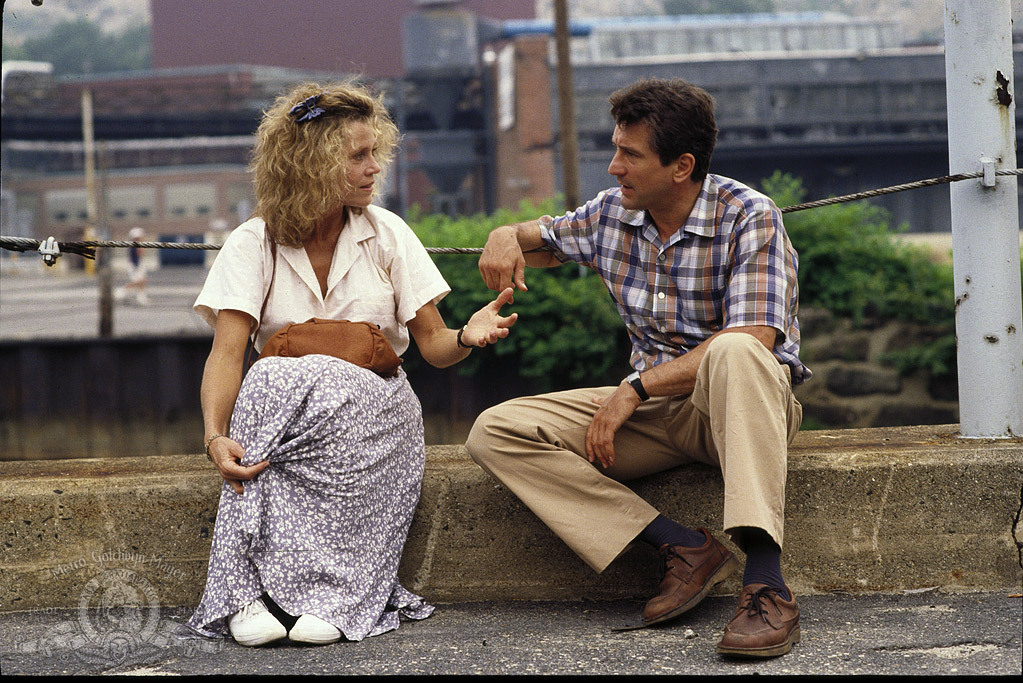
STANLEY & IRIS, a sappy star vehicle for Jane Fonda and Robert De Niro, unfortunately closed director Martin Ritt’s impressive career with a dud in 1990, backhanded by critics and cold-cocked at the box office. The script came from Harriet Frank Jr. and Irving Ravetch, who’d served up screenplays for seven other Ritt films, six of which are more enjoyable and convincing than this synthetic peek at the struggling lower-middle class. *
Waterbury, Connecticut. Recently widowed, with two kids, middle-aged ‘Iris King’ (Fonda, 52) works in a factory making baked goods. The routine of the assembly line job is numbing, her teenage daughter is pregnant, her volatile sister and slug brother-in-law are living with them and fighting all the time. Iris meets canteen line cook ‘Stanley Cox’ (De Niro, 46) and they gradually develop a friendship, which deepens when it is revealed that Stanley cannot read or write. Iris starts to teach him.
 The idea was mutated from English author Pat Barker’s 1982 novel “Union Street”, 270 unflinchingly harsh pages of interwoven stories about seven working class women in 1970’s London, their miserable, dead-end lives blighted by poverty, domestic sexual abuse, rape and sickness: the only things the mushy, hollow, ‘fake real’ movie version lifted from the book were a character named Iris and the mention of her brutish husband being illiterate.
De Niro has a telling scene with his father, played by Feodor Chaliapin, but overall it’s one of his less convincing performances; he did much better in his other roles that year, playing another socially constricted character in Awakenings, and in the instant classic Goodfellas as a wiseguy was literate but unwilling to see the writing on the wall. As the daughter, Martha Plimpton easily carries off a troubled teen like she’d done so well for bigger parts in the much better Shy People, The Mosquito Coast and Parenthood). Stray effective moments don’t save it. Unlike the book, the scripted adaptation is pretentious faux honesty, “ordinary folks” writing that isn’t incisive but infuriating. We’re not with the camp that have a problem with Fonda because of her fiery public stance during the Vietnam War (Jane’s tactics were sloppy but she was on time on target about its obscenity), but too many of her performances, while technically sharp, also come off as emotionally inauthentic: it asks a lot to buy her as someone who’s ever had to worry about a check clearing or that the power may be disconnected. **
The production cost ran to $23,000,000 (30% for the two stars) with patronage from the ‘average’ Stanley’s & Iris’s out in the boondocks only coughing up $5,800,000, a dejected 113th place in the 1990 lineup.
From the credits onward, John Williams syrupy score feels better suited to a Lifetime made-for-TV flick. The shoot was done in Toronto and in Waterbury, Connecticut. 104 minutes, with Swoosie Kurtz (the unhappy sister),Jamey Sheridan (as the sister’s jerk husband; never convincing, but then, so is the script), Harley Cross (Iris’ son), Stephen Root, Loretta Devine and Zohra Lampert.

Did Ritt direct her to “just pretend” she knew what it’s like to have to do your wardrobe—oops, clothes—in a laundromat?
* The married writing team of Irving Ravetch and Harriet Frank Jr. not only did eight assignments for Ritt (The Long Hot Summer, The Sound And The Fury, Hud, Hombre, Conrack, Norma Rae, Murphy’s Romance and this) but signed off on Home From The Hill, The Dark At The Top Of The Stairs, The Reivers and The Cowboys. With the exception of The Sound And The Fury (the sound of furious snoring) and the reach & stumble Stanley And Iris, a worthy resume of good to excellent fare.
** “You–Jane!” Stow the bash, man, and show some gallantry. She’s fun as Cat Ballou and excellent in They Shoot Horses, Don’t They?, Julia, Coming Home, California Suite, The China Syndrome and The Morning After.

Teach me about the working poor, Jane.
 Movies ala Mark