
I tell you a young boy named Billy Crystal is recording this!
SANGAREE, a wheeze of cheese from 1953, which was flush with more than two dozen mostly silly adventure sagas. It was also the big year for 3-D flicks. This fits into both categories, and thuds out in each. As adventure drama it’s way too talky and dull, and the scant 3-D effects don’t perk it up. If you want to work on your Fernando Lamas impression, check out Arlene Dahl and Patricia Medina vamping contrails of steam in Technicolor, or are doing a thesis on Colorful Goofy Costumes in Forgotten B-Pictures, it may serve—if you can stay awake during all the blather.
“There, beneath you, you see the cream of Savannah society. Now, let me point out your enemies.”
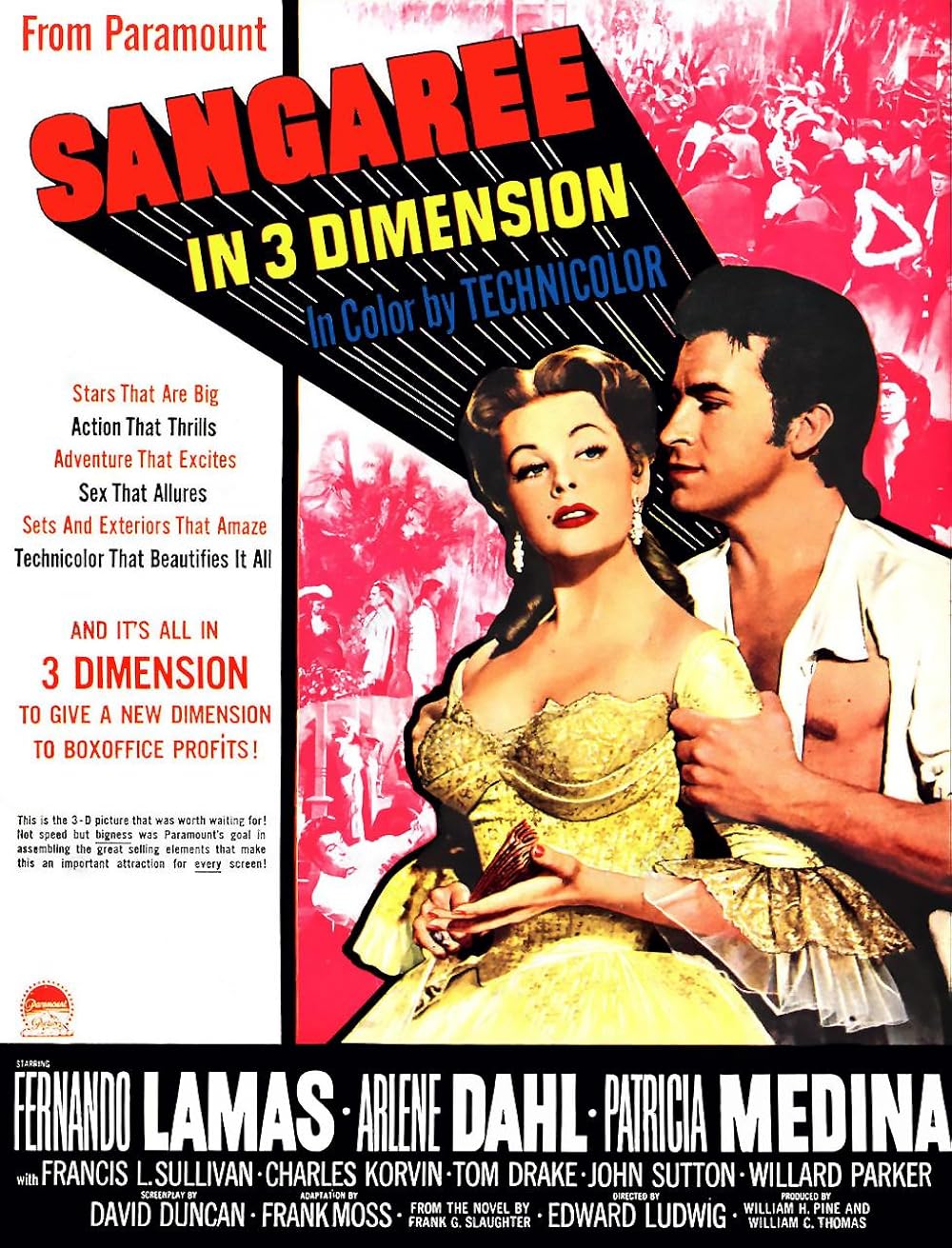
Click to enlarge for educational reading fun!
The Revolutionary War has been won. Down in Georgia, a dying general wills his important estate (the title bearer, one of those white edifices with graceful columns and ‘grateful’ servants) to ‘Dr. Carlos Morales’ (Lamas, 38), son of an indentured servant. Morales’ low-born status clashes with the born-to-rule aristocracy in Savannah, and as he proves himself in court, in brawls, and battling pirates and a plague outbreak, he also finds time to get ardent with vie-for-the-guy damsels, sisters ‘Nancy and Martha Darby’ (Dahl, 27, and Patricia Medina, 33) who have their respective way with wiles. Expect bared shoulders, looks signalling pent-up desire and cross-purposes of various sorts. Lamas struts, shirtless 30% of the time—to show he’s (a) from the earthier class, (b) a man among dudes, and (c) at least as virile as Ricardo Montalban or Gilbert Roland. The actresses pant, gleam, swoon, even bite (hey, this is getting good). Though their acting leaves something to be desired, there is obvious cut-to-the-clutch chemistry between Lamas and Dahl, complete with f-me-right-now gazes and liplocking furious enough to have a dentist on call; they married after this. *

Are you trying to give dockside wenches a bad name?
The script by David Duncan (Rodan, Monster On The Campus) and Frank L. Moss (mucho TV) tackles the 300+ pages of Frank G. Slaughter’s novel, one of 58 that often wove around history and medicine: he was a physician, his books sold sixty million copies. The assorted subplots are too much to adequately cover in 94 minutes of running time and the situations and resolutions presented don’t stand up to casual scrutiny. Apart from a pretty good tavern brawl where Fernando and a big bruiser (ugly, natch) throw beer casks at each other—at us in 3-D, the few action scenes aren’t exciting. Except for a few laughable passion-on-the-spot scenes between Lamas and the ladies, the dialogue is neither interesting nor bad enough to provide consistent entertainment. The color is nice but the contrast between the exterior location footage and the obvious studio sets undercuts the required suspension of disbelief. Edward Ludwig directed some good features (Swiss Family Robinson, Wake Of The Red Witch), some amusing fodder (The Fighting Seabees, The Black Scorpion) and some real bow-wows (Big Jim McLain). This one comes off as a dutiful chore.

My gown? Oh, this little thing…
Capable supporting players Tom Drake (as a good guy but so nice he’s a wuss), Francis L. Sullivan (trying to out-pout Charles Laughton) and John Sutton (sneer alert) are stuck in the dialog bogs, with lesser roles occupied by Charles Korvin (Hungarian playing French, his accent dueling Fernando’s Spaniard by way of Argentina) and Willard Parker (all but forgotten today, he had leads in a slug of B-pictures and oldsters may recall him from TVs Tales Of The Texas Rangers). Buffs who stick with it can spot Emile Meyer (key that year as ‘Ryker’ in Shane) and Don Megowan. Gross was $5,500,000, ’53’s 57th out of more than 400 features in the dough-pay-me line.
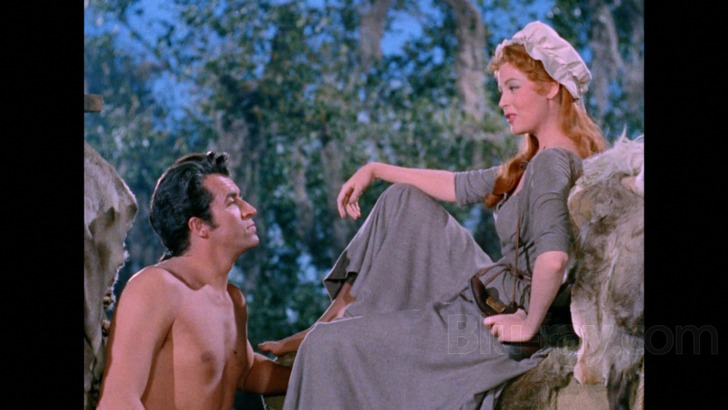
Torrid swamp. Animal skin pillows. Bare foot to bare chest. Don’t get any cute ideas, Mr. Man.
* Sacrifice for Art’s sake…Dahl: “Actually, Fernando directed the love scenes. Before we shot the scene in the morning, the night before, we would rehearse and decide what we would do, and how we would do it, so we came prepared with each scene, much to the director’s delight and chagrin…”
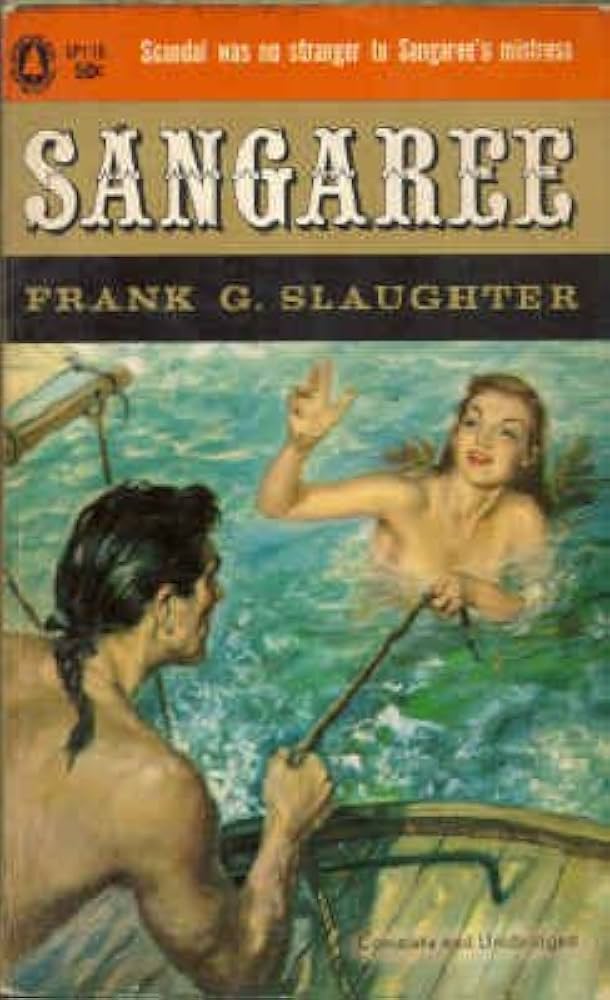
Now, when book covers tease you, shouldn’t there be like a law or somethin’?
 Movies ala Mark