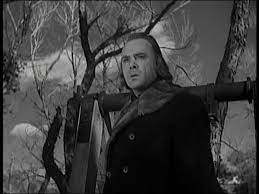
BRIGHAM YOUNG, as parlayed by Dean Jagger, levels with worried Mormons: “Indians can’t be any worse than some Christians I know.” History bears that out pretty much every day of a given week, but the fierce prophet in the intolerant America of the 1840’s (just wait) was referring to the God-fearing neighbors of his God-trusting followers, who had the rude habit of practicing their version of devotion by murdering Mormon’s and driving them from state to state. The wide-open West seemed the only viable escape route: maybe its long-time inhabitants would be more tolerant? Divinely inspired, destiny bound or just desperate, Young led 20,000 ‘Latter-day Saints’ on an epic trek across 1,400 miles. Nearly 1,900 perished on the way. And the rest is…Salt Lake City. *

Them friendly local Protestants ain’t talkin’ about wolves.
After 1939 rolled out a prairie-load of westerns, the studios, sensing new veins of gold in the old frontier, doubled down in 1940 with Northwest Passage, The Mark Of Zorro, Sante Fe Trail, Virginia City, Northwest Mounted Police, The Return Of Frank James, The Westerner, Arizona, Dark Command and When The Dalton’s Rode. Canny Fox honcho Darryl F. Zanuck gambled on a fact-based, fiction-buffered pioneer story that revolved around a religious subset of the country’s theosophical stewpot. He tasked hard-nosed Henry Hathaway to direct, even after Hathaway scoffed that “the two dullest things in the whole world are a wagon train and religion. Now you take them and put them together.” Zanuck answered that “This man Brigham Young is more important than the story.” But to play it safe on a $2,700,000 dice roll, DFZ put 20th’s big draw Tyrone Power into play along with beautiful newcomer Linda Darnell so they could add some dashes of romance to 114 minutes of toil and tribulation.
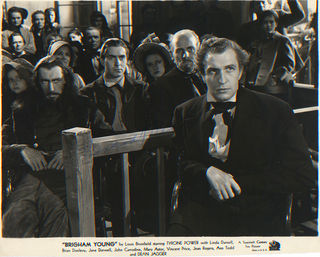
Though top-billed, Power, 25, and Darnell (her age a studio secret–she was just 16) are in secondary roles to Dean Jagger, 36 in his dynamic career breakthrough as Brigham. Other aces in the deck: Brian Donlevy (an amalgam of Young’s opponents for leadership); Mary Astor (33, as Young’s ‘favorite’ wife Mary Ann Angell, 1808-1882, his second of sixty-six wives–try writing that with a straight face); Jane Darwell (representing resolute determination as she did that same year in The Grapes Of Wrath); ‘Wrath‘ alumnus John Carradine (wild as legendary lawman/executioner Porter Rockwell); and Vincent Price, excellent in the opening portion of the saga as church founder and mob victim Joseph Smith.

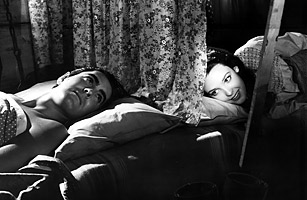
A lavish production that took 133 days to shoot, with numerous sprawling crowd scenes bolstered by effective matte work and special effects. The exciting big-scale stuff is balanced by a solid (if carefully calibrated) screenplay from Louis Bromfield and Lamar Trotti that gifts the principals a number of shots at delivering rousing speeches; they do them justice. Power and Darnell (teamed for the second of four—Day-time Wife, The Mark Of Zorro, Blood And Sand) have touching moments together; you would never guess she was sixteen; Price is quietly eloquent in his brief segments; and character fave Marc Lawrence has one of his finest turns as an impassioned prosecutor raging against Smith and his followers. But the main performance plaudits go to a clearly inspired Jagger, who gives his all as Young (Jagger later converted to the LDS) in what should have garnered him an Oscar nomination.
The expansive sequences include the urgent mass-crossing of the frozen Mississippi while their mob-torched homes burn behind them; another hazardous fording of a swift-flowing river where teams and wagons are swept away (stuntmen and livestock earning their oats); and as a grand finale a seemingly futile fight against an onslaught of insects. The cricket plague segment was filmed in Elko, Nevada, where fortuitously (for the movie, anyway) an actual cricket invasion was underway. The voracious bugs were gobbling at a half-mile per day in a band two miles wide and six miles long. Other very impressive scenes were shot in California at Lone Pine, Big Bear and Mt. Whitney, and in Utah around Kanab. Stunning work all the way comes from 2nd-unit director Otto Brewer and cinematographer Arthur C. Miller. The only embroidery debit emits via composer Alfred Newman, one of the industry greats whom we would normally extol. He has a decent main theme but it’s used so often during the proceedings that it becomes an irritant. Counting on time foxing memories, the theme would be recycled eight years later for Yellow Sky and once more three years after that for Rawhide.

The box office of $4,300,000 and 27th place was okay, but not nearly enough to offset the expenditure. With Willard Robertson, Jean Rogers, Russell Simpson, Ann E. Todd, Stanley Andrews, Chief John Big Tree, Fuzzy Knight, Hank Worden.
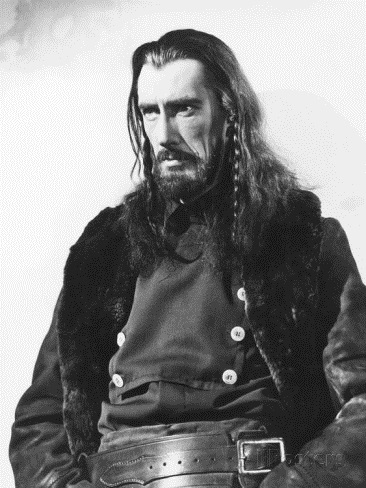
Carradine as the long sidearm of the Lord
* Dealing with The R-word in the movies (or anywhere else for that matter) requires some degree of market compromise and legal delicacy, let alone expected complaints about whatever one side sees fair or unfair (the offended can get downright ornery–and there are guilty parties galore eager to prove love by hurting other people). Not caring to wade further into our planet-engulfing morass of make-believe (theocratic, not cinematic) we salute Zanuck, Hathaway and crew for a surprisingly good job on this one. Sinner that I am, I approached this picture with resigned trepidation, and was pleasantly surprised. Still, sixty-six…?

Uh, a mite shy there on the count, reverend…
 Movies ala Mark