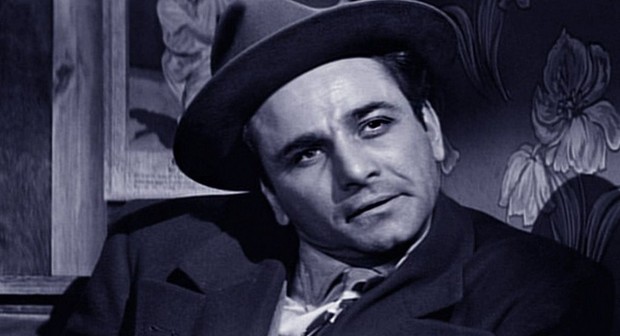
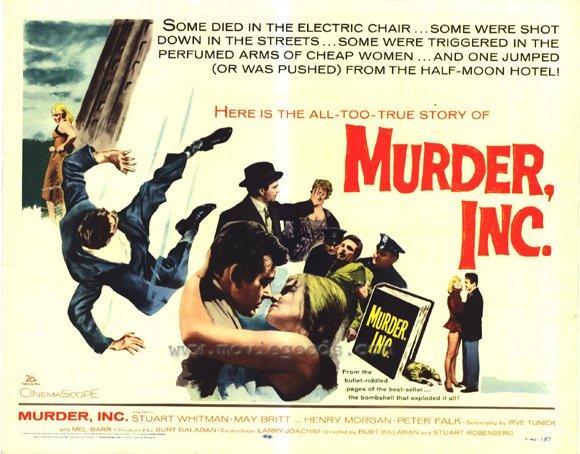
MURDER, INC. is maybe the best of the crop of gangster flicks that starting shooting their way back into the spotlight in the late 50’s, further spurred by the success of TVs The Untouchables. All were rough customers, and were based on the much rougher real life parasites who made the 1920’s & 30’s even harder than they already were. This 1960 entry is the most true-to-truth of the lot, done in semi-documentary style. Burt Balaban and first-timer Stuart Rosenberg (Cool Hand Luke) co-directed a smart script by Irve Tunick and Mel Barr (Hang ‘Em High), based on the 1951 non-fiction book by attorney Burton Turkus. He’s played by longtime humorist and talk-show guest Henry Morgan, who does a naturalistic, no-nonsense job. The tense and unsettling show is marked by good acting, especially the career-making performance turned in by a 32-year-old New York City stage-actor in his film debut: Peter Falk.
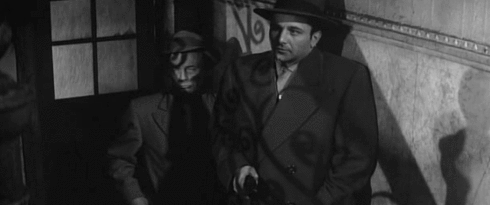
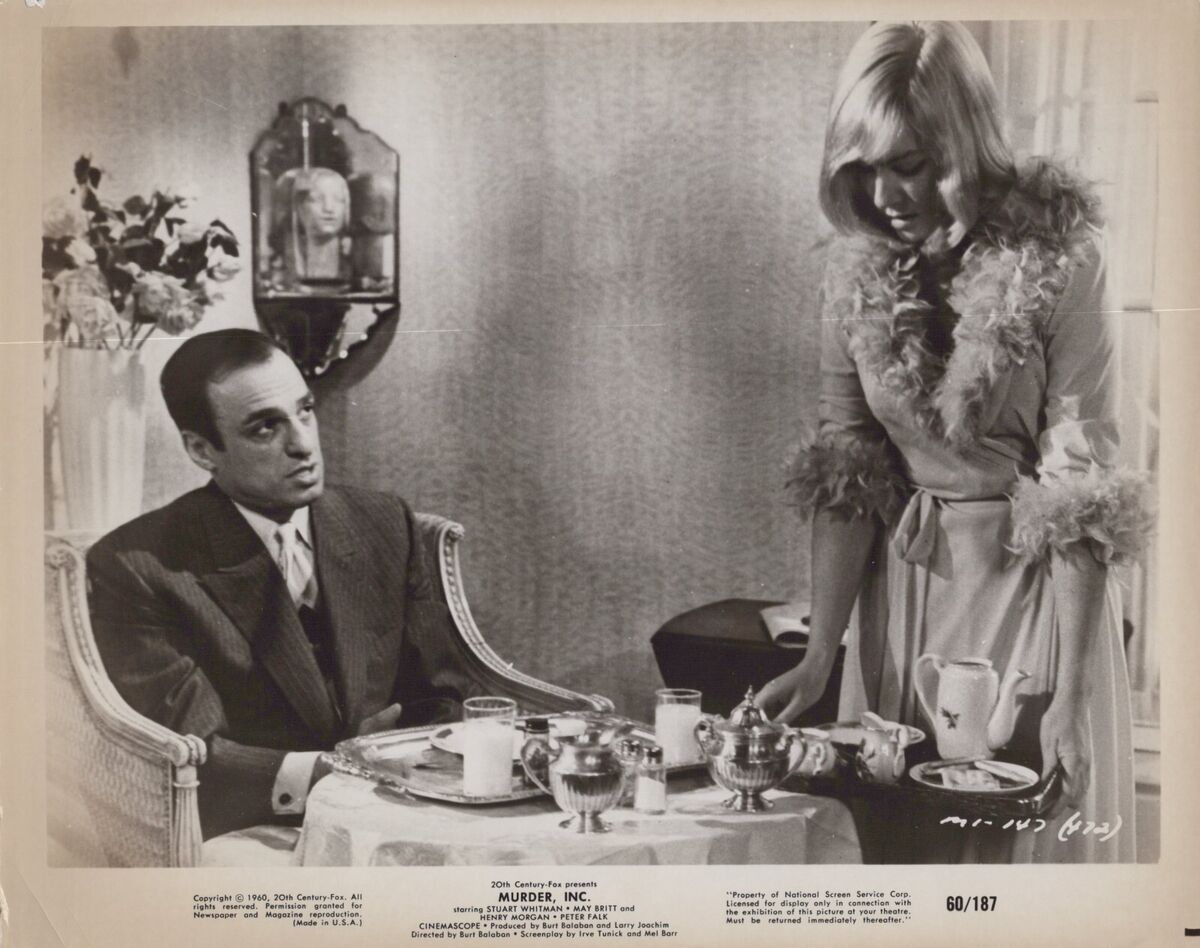
Brooklyn, the mid-1930’s. Local racketeer and ruthless killer Abe Reles (Falk) agrees to go to work for bigwig bastard Louis “Lepke” Buchalter (great slithery-skin job from David J. Stewart) who—with other leading lights of larceny like Albert Anastasia—designed a plan for hiring freelance killers by the hit, insulated from the higher echelons of the rackets incursions into business, political connections and corrupted police departments. Abe browbeats indebted singer ‘Joey Collins’ (Stuart Whitman) into driving on “a job”; this ensnares Joey and eventually his Swedish immigrant wife ‘Eadie’ (May Britt) into a web of constant threat—implied and delivered—that they can’t escape from. At length, the acts of The Syndicate grow to the point where the Feds, led by Thomas E. Dewey, go after them. Among the lawmen is Burton Turkus, but without cooperation from terrified witness/victims like Joey & Eadie it seems as though the mob has and will keep the upper hand. In other words, like the people we foolishly elect.

Whitman’s fine as the situation-emasculated Joey (he hadn’t yet developed the husky growl he’d employ for most of his career), and undervalued Britt is quite good—Eadie is trapped in a nightmare—in the last role of her brief run in the sun until one final part in 1976. Also in the mix, “introduced” (for a few minutes) is established singer Sarah Vaughan, who does a couple numbers in a nightclub scene. Since she’d just had a big pop hit with “Broken Hearted Melody” (love it!) perhaps the moviemakers thought to capitalize on that and maybe grab an Oscar nom from one of the songs. But they’re nothing special, she has no dialogue, and the introduction was a semi-fib: Sarah had been one of the performers in a 1951 programmer called Disc Jockey.
But in the main the stage belongs to the unique Mr. Falk, riveting as the smart & touchy, vicious & conscience-absent Reles, infusing street wit and believable personality traits into what a less-savvy actor might have spoiled with ‘psycho’ tics. He was so real that in this first time out he drew an Oscar nomination as Supporting Actor: alas Peter Ustinov’s earlier-epoch conniver from Spartacus took the prize. Those who are mainly familiar with ‘funny’ and ‘endearing’ Falk from Colombo and a slew of comedies will be taken aback by his sterling scumbag Abe Reles. A star was born. **

In a break with the typical cross-bearing anti-death penalty movies, this one ends with the cut-the-bull notice “Lepke was the first of the ganglords to pay up in full in the electric chair. The first and, to date, the one and only. But his execution proves that it can be done, that the kingpins and their rackets can be brought to justice. It can be done. It must be done. Again and again and again.”
Camera from Gayne Rescher (A Face In The Crowd, Star Trek II: The Wrath Of Khan), scored to effect by Frank De Vol. Shot efficiently for $750,000, returning $2,600,000, 1960’s 89th place on the receipt line.
In the cast: Simon Oakland (as a good guy cop), Joseph Bernard (creepy as Mendy Weiss), Morey Amsterdam (schmuck who didn’t pay up), Vincent Gardenia (mob lawyer), Howard Smith (odd choice as Albert Anastasia), Warren Finnerty (as ‘Bug’), Joseph Campanella (ya should’a paid), Sylvia Miles (debut) and Seymour Cassel. 103 minutes.

* 1960’s crime spree saw the very good Pay Or Die!, with Ernest Borgnine as crusader cop Joseph Petrocelli, the snappy The Rise And Fall Of Legs Diamond, with slick Ray Danton as the title snake and the pretty damn lousy Pretty Boy Floyd, with John Ericson sandbagged by the whole cheap schmear: best look at that outlaw comes in 1973’s Dillinger.
** Falk: “for me, Murder, Inc. was more than a big deal – it was a miracle. Like being touched from above. Of all the thousands of obscure actors, they picked me.” He followed up a year later with another nomination, this time stealing laughs as a comic gangster in Pocketful Of Miracles. Then came It’s A Mad, Mad, Mad, Mad World, The Balcony (one of the funniest soliloquies ever), Robin And The 7 Hoods, The Great Race, Husbands, Murder By Death, The Cheap Detective, The In-Laws…
 Movies ala Mark