
BABY FACE NELSON aka Lester Joseph Gillis, only made it to his 25th year before succumbing to a well-earned bout of sudden lead poisoning, distributed by a couple of FBI agents on November 27, 1934. His career as a bank robber, killer and eventual associate of John Dillinger (also exiting quickly stage-left in ’34) made a splash at the time and his catchy moniker has endured over the decades, framing him as one of the Depression’s more peculiarly popular punks. Have Tommygun, Will Travel. *

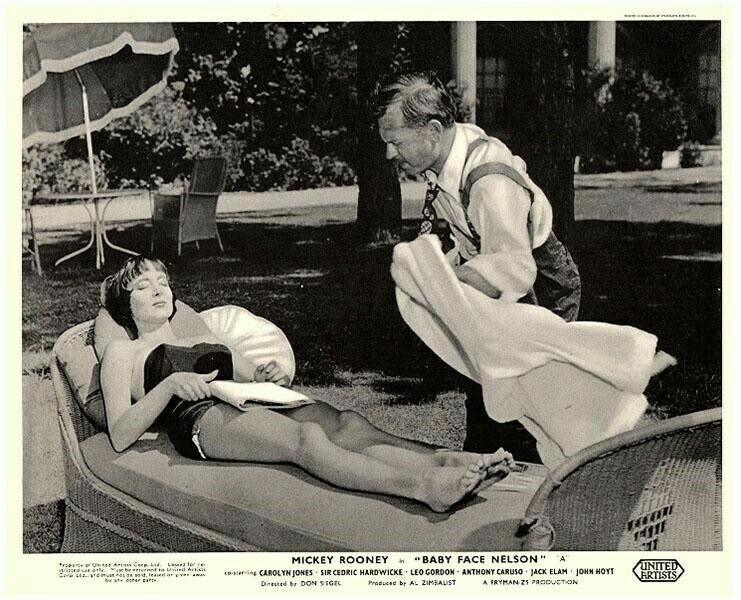
Sprung from stir by mob boss ‘Rocca’ (Ted de Corsia, chuckling with malicious mischief), pint-sized but guff-averse Lester Gillis (Mickey Rooney, 37, revved to rumble) wastes no time hooking up with his moll squeeze ‘Sue Nelson’ (Carolyn Jones, 27, hot as a female panther) who lends him not just charms and loyalty but her last name as a cover after Les mows down Rocca and a couple of his goombahs. Nicknamed ‘Baby Face’, Gillis/Nelson links up with the well-known (and Most Wanted) crew working for John Dillinger (Leo Gordon, imposing as ever) and proceeds to show everyone within ‘chopper’-range just how loose of a cannon he is.
Sped by jazzy scoring from Van Alexander, the fact & fiction mix was stewed up by writers Daniel Mainwaring and Irving Schulman, and directed with a certain degree of pep by Don Siegel, working a bare-bones budget ($175,000) into 85 minutes of—what was for the time—mayhem, compelling enough to claw 57’s 68th place with a haul of $3,600,000.

Every reptile who reads knows kids go thru the cherished, apparently universal Dinosaur Period, followed in due course by whatever lineup of heroes/superheroes/witches and/or monsters are in vogue at the time. For many Boomer’s (boydudes, anyhow) there was also a Gangster Passage, a fascination with crooks of the 1920s & 30s: Nelson, Dillinger, ‘Pretty Boy’ Floyd, ‘Machine Gun’ Kelly, Al Capone, Bonnie & Clyde, ‘Ma’Barker…I recall seeing this rather nasty little picture many moons ago and being duly impressed by the non-nice Rooney, all the shooting (hey, get real–Tommyguns are impressive) and the little boy crush realization that Carolyn Jones aka ‘Morticia’ of The Addams Family was worth knocking off banks over. Maybe skip the hail of G-man bullets, but still…

Whip-smart, dangerously alluring Jones secured a banner year, acing a brief but memorable role in The Bachelor Party that got her an Academy Award nomination. Rooney had just notched his 4th Oscar bid (for The Bold And The Brave) and also stole the show in the service comedy Operation Mad Ball . Changing into a new, nastier gear, he rips into the volatile trigger-man gambol with his customary vigor, as such promoting several more check-in’s to gangster-land over the next few years. **
Solid support: old pro Cedric Hardwicke (seedy doctor who should’a kept his paws off Carolyn Nelson’s dame), Anthony Caruso, Jack Elam, John Hoyt, Elisha Cook Jr.(getting slapped around, naturally), Robert Osterloh, Thayer David, Dabbs Greer, George E. Stone and Emile Meyer.
* Baby pictures—-familiar 50s face William Phipps, in one of the best scenes from 1959’s The FBI Story; new bantam on the block Richard Dreyfuss, going bonkers in 1973’s Dillinger; C. Thomas Howell for 1995’s Baby Face Nelson—who saw that? no one; Michael Badalucco raising 2000 heck in O Brother, Where Art Thou?; Stephen Graham with the elaborate 2009 b.s. of Public Enemies.
** Don Siegel: “Mickey Rooney, who’s one of the most difficult people I’ve ever worked with, was absolutely superb in the role. It was marvelously photographed by Hal Mohr. I thought it had a great deal of vigor. It was made under enormous handicaps. It was made under an aura of unpleasantness, throughout, which maybe was reflected in the viciousness, because I took out my anger against everybody in the picture. It was very cheap. It cost 175,000 dollars to make and it took a lot of book-keeping to make it up to 175,000.”

 Movies ala Mark