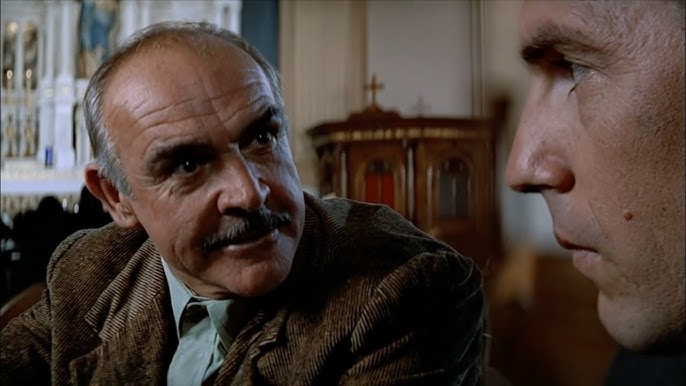
THE UNTOUCHABLES “brings a knife to a gunfight“, with one of its better lines of dialogue summing up the opulently packaged movie in toto. Generally entertaining, often impressive yet ultimately also a bit of a let-down, at least for longtime fans of the classic TV series that shot its way into living rooms from 1959 to 1963. Eagerly anticipated, bear-loaded in cast, crew and embellishment detail, the 6th most-attended picture of 1987 got mostly good reviews, made a lot of loot and put feathers in a half-dozen caps. Yet likely its lasting win was in bringing a new generation of fans to the vintage television show. Where are you, Robert Stack? *

“What are you prepared to do?”
Chicago. 1930. Prohibition. Nationally infamous racketeer Al Capone runs the corrupt city like his personal kingdom: citizens cowed, cops and politicians on his payroll, an army of hoods at his beck. Honest, idealistic and determined U.S. government agent Eliot Ness (Kevin Costner) sets out to topple Capone’s throne. But how to do it? Who will help him? If the other side is ready and willing to murder you, what rules of conduct will you consider bending? Or, if need be, breaking? “You wanna know how to get Capone? They pull a knife, you pull a gun. He sends one of yours to the hospital, you send one of his to the morgue. That’s the Chicago way!”

Canny producer Art Linson (Melvin and Howard, Fast Times At Ridgemont High, Heat, Fight Club) pegged David Mamet to write the screenplay, which, other than the real-life characters of Ness, Capone and Al’s lieutenant Frank Nitti, ignored facts as freely as Ness and Oscar Fraley had with their 336-page ‘truthy’ novel published in 1957. The subsequent hit TV series fibbed as well. Mamet (who aced House Of Games that same year) stirs up some barbed and catchy speeches and one-liners but throws the proverbial bathwater babe out the window—or, in this case, off a roof, when Ness impishly allows vicious enforcer Frank Nitti (played to the hilt by Billy Drago) to take a private elevator to the street. It didn’t happen (Nitti shot himself in 1943), nor did any of the shootouts staged for the film. The bloody, minutely choreographed murders and gun battles allow director Brian De Palma to play his strong suit of stylization and add in the contemporary era’s penchant for overkill excess. Component parts work better than the whole.

After impressing in the greatly underrated Silverado, this marked a big break for Costner, 32, who promptly shot to front-rank stardom. He’s okay as Ness, though the terse black & white shadow cast by Robert Stack hangs over the role, so fixed was his identification with the part. Scoring higher are the supporting players, stars in their own right, nailing the more colorful characters. Like the TV show, in this version Ness has three “untouchables” on his squad (the real-life Ness had nine); the junior good cops are allotted to Charles Martin Smith (33, popular from American Graffiti and Never Cry Wolf) and new dude on the burner Andy Garcia, 30. Basically doing an extended cameo, a beefed-up Robert De Niro enjoys a swell turn as Capone, and De Palma makes sure he full-force delivers the famous baseball-bat lesson to dinner guests (and possibly inspiring future implement use in Inglorious Basterds and The Walking Dead). The #2 hero on the Ness team is fictional Irish beat cop ‘Jim Malone’, done with such elan by Sean Connery that the Dude Among Dudes not only stole the movie but was finally given some due from peers, striding away with an Oscar for Supporting Actor. Connery gets some of the better dialogue exchanges and also has one heck of an alley-fight with a crooked cop, excellently played by the always strong, oddly unsung Richard Bradford. **

Besides Sean’s overdue coup, further Academy Award nominations went up for Music Score, Art Direction and Costume Design, all deserved. Ennio Morricone’s dramatic main theme sets the stage for the dark deeds to follow. Good as his scoring is, we in the fogey seats are hard pressed to shake off the haunting power of Nelson Riddle’s theme music from the old series, one of the most dynamic small-screen musical backdrops ever composed.

“In Roman times, when a when a fellow was convicted of trying to bribe a public official, they would cut off his nose, and sew him in a bag with a wild animal, and throw him in a river.”
The $25,000,000 production grossed $76,300,000 in North America and another $30,000,000 abroad. Law & Order was down & dirty in cynicism-saturated ’87, witness Lethal Weapon, Robocop, Angel Heart and Extreme Prejudice. 119 minutes, with Patricia Clarkson (27, debut, in a thankless fictionalized role as Ness’s wife), Jack Kehoe, Brad Sullivan, Del Close and (unbilled) Clifton James.
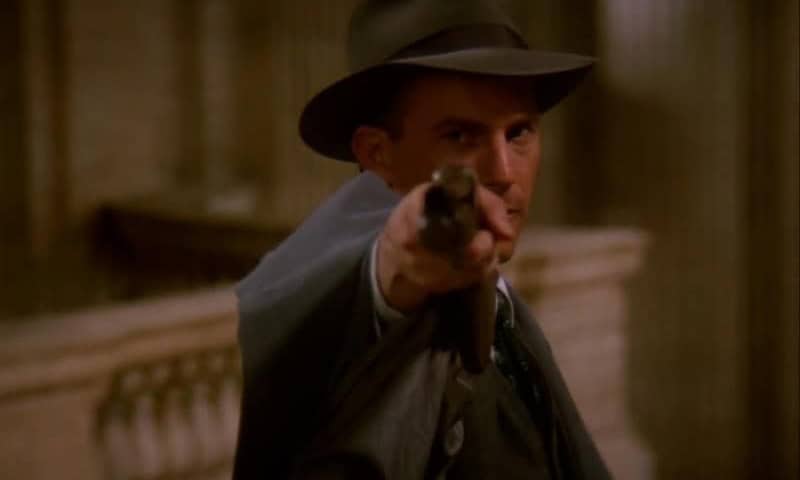
* What did Robert Stack (1919-2003), who was in his early 40s when the series ran (Ness in his late 20s when he went for Big Al), and was 69 when the movie came out, think of the flick and Costner’s Eliot? He told the L.A. Times in 1991 “They got a bright young actor to play Ness, which at first peed me off”. That volley off his straight-shooting chest, he credited the film with renewing interest in Ness, the old series and in getting him a shot to do the 91′ TV movie The Return Of Eliot Ness. As for the self-immortalized Ness, he died at 54 of a heart attack, a few months before his legend-spawning book went into print. A second TV series ran for two seasons in 1993-94 with Tom Amandes as Ness and William Forsythe as Capone.
** Hey, we quail to take any glory away from Connery, but it was probable that the Academy gave him his statue not just because of a good performance but to CYA for never putting him up before—for Goldfinger (007 ne plus ultra), The Hill, The Offence and The Man Who Would Be King. We do think the supporting award that year really ought to have gone to another stalwart, Morgan Freeman, for his chilly-to-the-bone pimp from Street Smart. Now, would I say that to Sean’s face? Uh, “Pardon me while I fall down laughing.”

 Movies ala Mark