
SLAVE SHIP—while it’s commendable that Hollywood in 1937 would produce a movie about the Atlantic slave trade and have impressive scenes that gave some faint hint about its brutality it also must be noted that only in 1937 Hollywood could such a movie have a happy ending. On a plantation, yet. *
1860. The slave trade has been outlawed decades earlier, but despite the risk —it was a hanging offense —some renegade exploiters and their vessels kept at the decidedly evil but definitely lucrative work. The Wanderer, piloted by veteran captain ‘Jim Lovett’ (Warner Baxter), with longtime first mate ‘Jack Thompson’ (Wallace Beery) is one such ship, until Lovett experiences a career-&-life-altering change of heart after falling for a lovely maid ‘Nancy Marlowe’ (Elizabeth Allan) who detests the institution. When Lovett tells his crew that the game is up and over, they mutiny. They’re led by Thompson, aided by cabin boy ‘Swifty’ (Mickey Rooney) and ‘Lefty’ (George Sanders), the qualms-free 2nd-mate. Nancy is on the voyage when this happens, and she witnesses firsthand the treatment meted out to the captured African natives. Will Jim do the right thing? The odds do not favor justice.
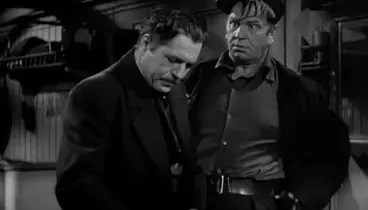
The very idea of the horror of the slaving vessels fits uneasily with an adventure story buffered by romance and laced with rough humor. Directed by Tay Garnett (China Seas, Bataan, Since You Went Away, The Postman Always Rings Twice), the well-mounted $1,000,000 production was taken from the George S. King novel “The Last Slaver”, its 322 pages based on the actual Wanderer. The screenplay was shared by Lamar Trotti, Sam Hellman and Gladys Lehman, with some uncredited polishing from William Faulkner. **
Baxter’s okay (he’d just done a fine job as The Prisoner Of Shark Island) and Beery is in his usual coarse element. Classy English actress Elizabeth Allan, 26, was an odd fit for an entry like this. At 16, already a veteran and a true natural (at least as an actor) Rooney broke big that year, with the first two ‘Andy Hardy’ outings.

The wobbly construction (scenes of cruelty mixed with others done for laughs or sentiment) torpedoes what could have been a thoughtful, important film. It kicks off with appropriate harshness in a quick, jarring moment with upcoming Lon Chaney Jr., unbilled in one of 19 bit parts he landed in ’37. He had a few more years to go before breaking thru in Of Mice And Men. At the start of the movie he’s the poor guy who gets crushed by the ship when it was launched. Later there are impressively dire sequences of the slaves, masses of terrified, confused captives being chained, whipped, beaten and drowned. At the fiery finale there’s a violent action setpiece. In between come the romance falderol and the loutish humor. Let’s assume it no doubt played better back in the era when Jim Crow was in place and there was only so much feather-ruffling a large section of the country could stomach. Good thing no-one denies reality today….
Placement at the box office was 31st, bringing in $4,400,000. Aboard or ashore: Jane Darwell, Joseph Schildkraut (with dark makeup and accent-equipped, as a merrily sleazy Portuguese slave trader), Francis Ford (director John Ford’s brother, doing a comic drunk number), J. Farrell McDonald, Paul Hurst (boozily declaring “I’m a reptile!) and Miles Mander. 92 minutes.
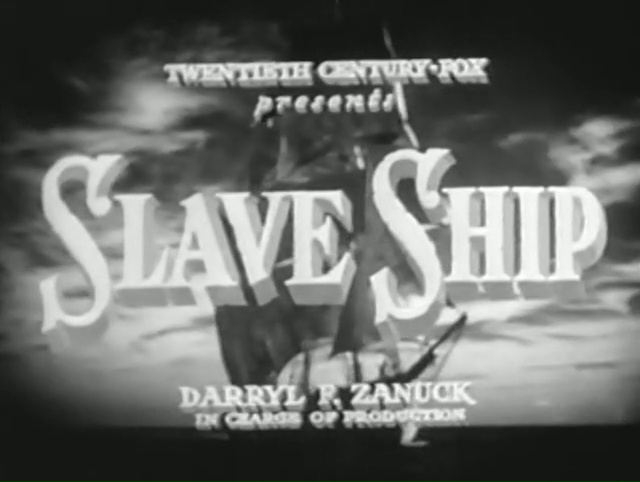
* Excerpt from a studio conference (it was a 20th Century Fox picture)—“While in all probability the picture will be produced on a large scale, it is unlikely that we will have a name like Gable, for instance, to cover up any of its possible weaknesses. Therefore, Mr. Zanuck feels that he cannot stress too much the fact that we must concentrate on the writing of an expert script that stands completely on its own….Watch, too, that the British are not made to appear stupid….Note: It is very important for censorship purposes that we indicate very plainly that the South is as radically opposed to slave-running as the North.” Why does this recall the famous Jack Nicholson line from A Few Good Men ?
The Wanderer was the next-to-last ship that brought slaves from Africa to the United States, unloading its ‘cargo’ of 409 human beings onto the ironically named Jekyll Island, off Georgia, on November 28, 1858. As many as 200 had perished on the six-week passage from the Congo.
** 1937 saw another nautical adventure in Souls At Sea, also with some factual link and likewise dealing with the slave trade. It’s a much better film. Both were trounced at the box office by the year’s exciting—but certainly gentler—oceangoing saga, Captains Courageous.

 Movies ala Mark