
“Charles Chan to the White courtesy telephone.”
THE ROAD TO HONG KONG was (mis)taken by Bob Hope & Bing Crosby in 1962, the 7th and last of their ‘Road’ junkets, nine years after Road To Bali. That one—coming 13 years and two wars after Road To Singapore launched the hit series—though showing seams, was still funny and had the bonus of a bright Technicolor polish. This time, two years into the Kennedy Era and Space Age, it was back to black & white. Apt enough, reflecting how some things had changed (adapted and matured) and others had stubbornly stayed the same (in this case, the patented shticks, separately and as a team, of Bing & Bob). Done for $2,000,000, it made $7,400,000, placing 35th for the year. Inflation adjusted that was the lowest take of the Bob-Bing batch; the days when their Road romps placed 6th & 7th at the box office belonged to another time, and while their showman’s skill at patter was still in evidence, the mossy material was out of tone deaf in a year that showcased the likes of Lolita and Dr. No. *
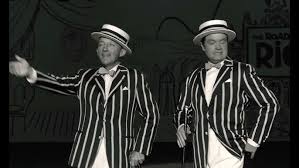
Vaudeville…in 1962? C’mon. I wonder who they voted for?
Asia-trolling con-men ‘Harry Turner’ (Crosby) and ‘Chester Babcock’ (Hope) out-dupe themselves by (a) falling for the same drop-dead dame (Joan Collins) and (b) getting ensnared in the world-conquest aims of ‘The Third Echelon’, her employer. It’s run by a brilliant but warped bazillionaire (Robert Morley) not content with vast wealth (army of henchmen, bevy of babes, undersea lair, missile capability) but planning on doing a moon-based rocket-launch attack on the cities of Earth. Why do mega-rich guys always want to break everyone else’s toys?

Directed & written by Norman Panama, concocted & produced by his partner-in-mirth Melvin Frank, the buffoonery only uses Hong Kong after stops in Calcutta, Tibet and ultimately…outer space. PC’ites will not be amused by the ‘ching-chong’ they-actually-did-this? Chinese stereotyping. In this case it’s not merely offensive: it’s just not funny. Both of them 58, the two stars were prodding the ‘beloved showbiz institution’ angle to the ouch-point. Over the next decade Hope’s feature films would grow lame & lamer and Bing basically cut out, apart from coasting thru The Rat Pack’s one decent outing, Robin and the 7 Hoods and being one of the few okay things about the rehash of Stagecoach. He’s harder to take than Bob in this one, since he has to try and convince us (himself) that he’d somehow make time with a bombshell like Joan Collins. A good, rarely deployed comedienne (hilarious in Rally Round The Flag, Boys), Collins—topped with a beehive that could hold one—is merely decorative frosting here. She was cast at Bing’s insistence because he thought the guy’s long-time gal pal Dorothy Lamour was past it at 47. Collins was 28. Hope managed to get Lamour in near the finale for what amounts to a glorified cameo.

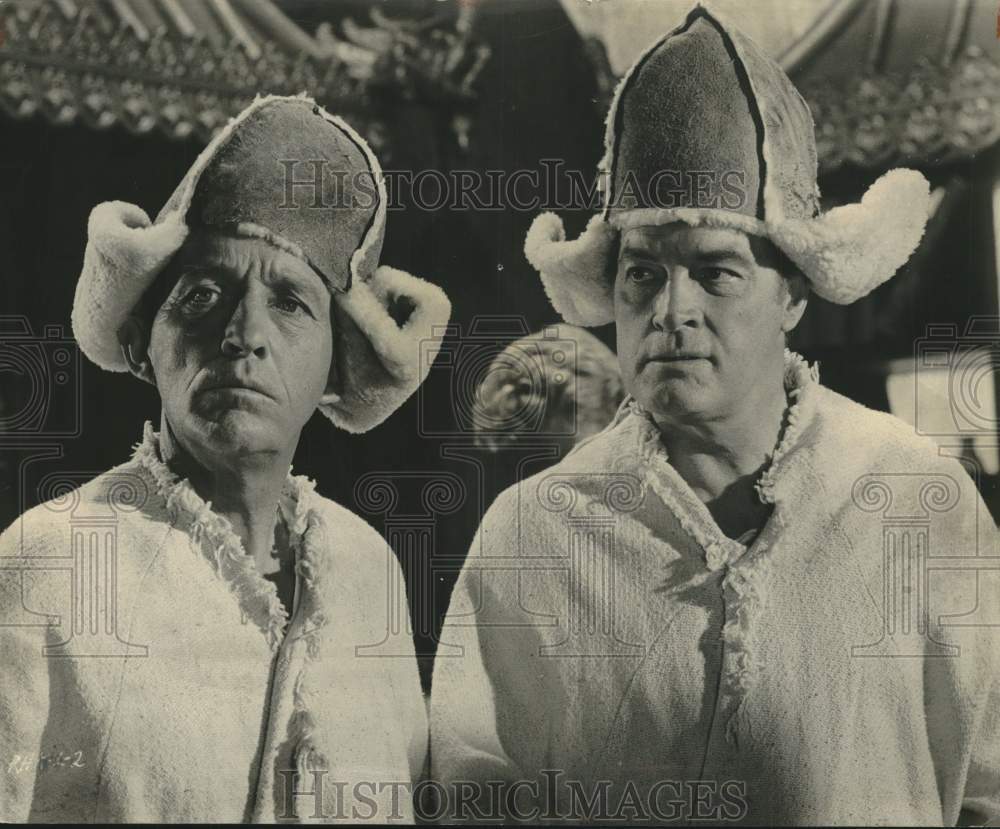
Croon me another one, gramps.
Others showing up for feeble gags: David Niven, Frank Sinatra and Dean Martin and Hope standby Jerry Colonna. The best thing this has going for it is an extended cameo near the start with Peter Sellers as a Bengali doctor. Again, PC trolls will revolt, but Sellers at least gets a few chuckles out of his sendup. There are also a half-dozen ghastly musical numbers to squirm thru.
With Walter Gotell (future 007 frequenter), Felix Aylmer, Roger Delgado, Mei Ling (‘Ming Toy’), and Yvonne Shima (somehow slipped by the censors as ‘Poon Soon’, we kid ye not). 91 minutes.

* Yes to No? Were the gagster-team of Norman Panama & Melvin Frank (Road To Utopia, The Court Jester) clued in by the 1958 publishing of “Dr. No”? ‘The Third Echelon’ bears a passing resemblance to SPECTRE and Morley’s supervillain is like those who’d seed chaos for Bond to cure. Character actor Walter Gotell would show up in seven 007 flicks, and bit player Yvonne Shima would play one of Dr. No‘s assistants. Miss Shima (1935-2023) also added exotica to a very good movie set and shot in Hong Kong, the hit 1960 romantic drama The World Of Suzie Wong. Our diligence, unbounded.
 Movies ala Mark