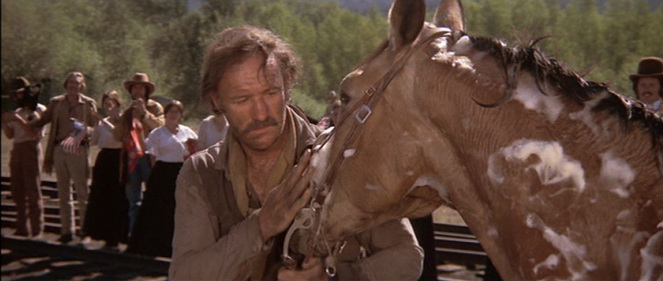
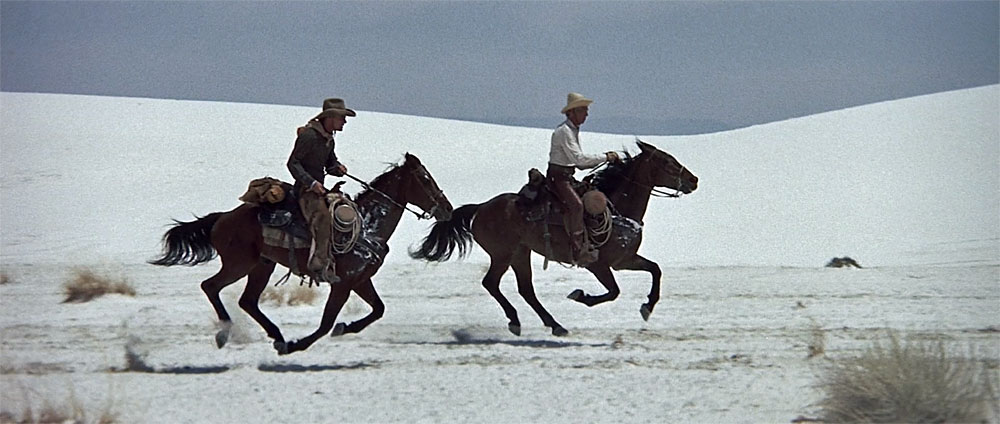
BITE THE BULLET offers up a grueling horse race in the ‘civilized’ West of the early 1900’s, adding its gallery of cynical dreamers, action stunts and wide-open scenic vistas to join 1975’s burst of old-fashioned, high-stakes adventure sagas, bracketed by The Wind And The Lion and The Man Who Would Be King. Those stirring epics were both set and shot abroad: this one, written & directed by Richard Brooks (The Last Hunt, The Professionals) was inspired by a 600-mile gallop for glory (and money) that took place in 1908, and it was filmed on rugged picturesque locations in Nevada, New Mexico, Arizona and Colorado. *

“I want you to tell me the story of your life. Just skip everything up till the last fifteen minutes.”
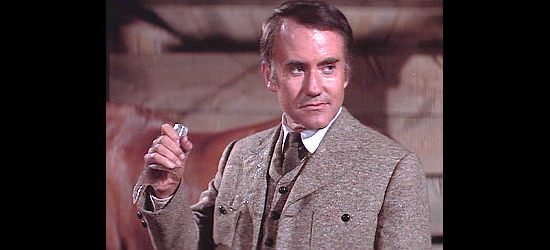
Pit your grit and the heart and stamina of your loyal horse against luck, the elements and other determined contestants after prize money and the shine of a “WIN!” that everyone from Cheyenne to Chicago will talk about, hoist drinks to or bet on. Tackling hundreds of miles of harsh terrain are pals and former Rough Rider’s ‘Sam Clayton’ (Gene Hackman) and ‘Luke Matthews’ (James Coburn), a forthright lady of mixed repute ‘Miss Jones’ (Candice Bergen), ailing cowhand ‘Mister’ (Ben Johnson), sporting Brit gentleman ‘Sir Harry Norfolk’ (Ian Bannen), mean-streak punk ‘Carbo’ (Jan-Michael Vincent) and a good-natured Mexican family man (Mario Arteaga) with a miserable toothache.
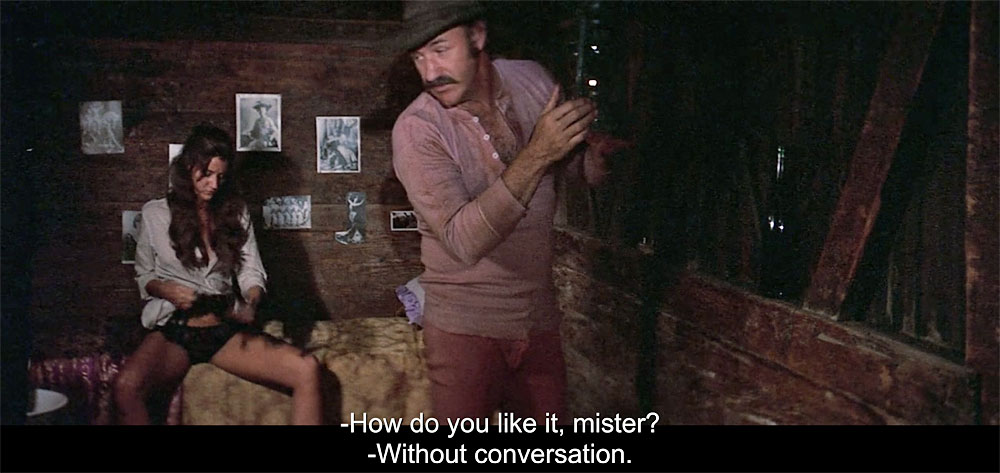
Brooks screenplay is ¾ successful, only running off in an third act tangent injecting a dustup with escaped convicts that bleeds away impact from the finale. Until then, it’s a salty meditation on character, creed, conduct and the allure of physical competition, with plenty of pungent dialogue and a chance for several in the cast, notably Hackman and Johnson, to indulge in some earthy monologues.
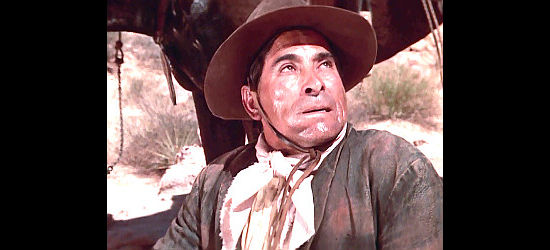
MISTER: “The prize is winning. Lose, you’re nothing. Who remembers a loser, or even cares? Win, you’re somebody. What you done, it’s printed, it’s in the newspaper. And when it’s printed, it ain’t brag, it’s real. Suddenly everybody knows you, or wants to. Strangers are shaking your hand. ‘Please to meet you. Have a drink. Have a cigar. Meet the wife.’ Everybody’s friendly and welcome. And I’ve got a lifetime hunger for being welcome. Ever prospected? Ever hit pay dirt? I’ve dug for gold, silver, lead, mercury. I’ve dug more holes than a whole regiment of gophers. I’ve never dug out a decent day’s wage yet. God, what ain’t I tried? Pony Express rider, Overland Stage driver, lawman, gambler, river man, rancher, rodeo rider, bar man, spittoon man, old man. Nothing much to remember. ‘Course, there ain’t nothing much to forget, neither. Nobody’s got much use for an old man. Can’t blame ’em much. That’s why I’m going to win me this here newspaper race. When I cross that finish line, I get to be the big man. Top man. A man to remember.”
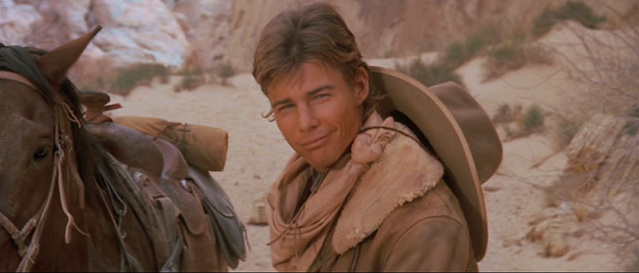
Hackman’s horse-gentle, human-skeptical veteran is a hardcase with soul (like his same year private eye in Night Moves); comrade Coburn is in relaxed devil-may-care mode (he scored one more neat ’75 part in another Americana ruckus, Hard Times). Bergen demonstrates skills equine and adversarial (her horsemanship and shotgun handling likewise demonstrated in The Wind And The Lion); Johnson gets a neat old-timer soliloquy (he was a bad guy in one of the year’s other westerns, Breakheart Pass—the whole cast was having a good day in the sun). Bannen’s a likable fair player, Vincent’s smirking hotshot his best role outside of his rowdy surfer in another man v. self & nature ode, the underrated Big Wednesday. In one of his few film jobs, (the only one where he was given billing) Arteaga makes a warm impression as the nicest fellow in the group, the vaquero plagued by a dental nightmare that’s literally encapsulated in the title.

A puzzling drawback is Alex North’s score, which swings between fittingly exuberant and downright corny; for this veteran composer (Spartacus, Cleopatra), it’s one least inspired soundtracks. Nevertheless, the work garnered him another of his 15 career Oscar nominations. In contrast, the cinematography from Harry Stradling Jr. (Little Big Man, The Way We Were) is uniformly excellent, framing the landscape sweep required for a western on this scale and capturing the often startling horse action including some falls that appear so brutal you’ll wince. Brooks adamantly maintained no animals were hurt, but horse lovers will find their sensitivity put to the test.

Reviews were mixed, Academy Award nominations were drawn for North’s score and the Sound squad, box office placed it ’75’s 43rd, with Cogerson citing $16,000,000 and other sources calling $11,000,000. Whichever, the $4,000,000 price tag was covered.
131 minutes, with Jean Willes (in her last big screen credit, the dependable ‘hard dame’ character actress allowed one of the best turns in her 33 year career), Robert Donner, Dabney Coleman, Robert Hoy, Paul Stewart, John McLiam and Sally Kirkland.
* Brooks’ inspiration, along with wanting to make a movie celebrating the essential American spirit rather than crapping on it like fellow maverick Robert Altman’s Nashville and Buffalo Bill And The Indians, came from a little 60-page non-fiction book written by Jack Schaefer (famed for “Shane”) called “The Great Endurance Horse Race”.
Brooks: “There are no bad guys in this story. There are only people according to their nature. I wanted to tell their story and say that we have our heritage in them, that they had a code of honor and a sense of ethics that had nothing to do with winning. Back then, there was the doing. That was what was important. And I wanted to make a picture about that.” “The actors worked from a twenty-page treatment. Often they had to learn their lines the night before. OK, I admit they trusted me. But then, they had no choice.”

 Movies ala Mark