
GREYSTOKE: THE LEGEND OF TARZAN, LORD OF THE APES shoots itself in the (bare & dirty) foot from the outset with the faux profundity of that title, nine words to basically say “Tarzan movie”. Discounting 1981’s monumentally insipid Bo Derek fiasco (Tarzan the Ape Man), this ballyhooed 1984 venture was the first ‘serious’ (and most serious, ever) Tarzan feature in sixteen years. By far the most expensive ($30,000,000), lengthiest (143 minutes) and pedigree-laden (director, screenwriter, supporting cast, cameraman, editor, makeup artist, awards recognition) it’s by turns impressive and absurd, displaying great technical skill, especially in the first half, vitiated (practically scuppered) in the second half by a laughable script and truncated editing. On top of it all, it’s brutal and resolutely joyless. *

Q: feed it or eat it? Apes, being our distant relatives, naturally make the wrong choice.
In the late 1880’s the orphaned baby boy of shipwreck survivors is found and raised in the Congolese jungle by a troop of ‘Mangani’ apes. After a hardy (to put it mildly) childhood the adult ‘John Clayton’ (Christopher Lambert) is again discovered, this time by Belgian explorer ‘Phillippe d’Arnot’ (Ian Holm), the only survivor of his expeditions massacre by pygmies. After a period of tutelage from the grateful, fascinated and sympathetic European, the man from the jungle is escorted back to his hereditary family estate in Scotland. There’s a lot to digest, including how best to entice and seduce ‘Jane Porter’ (Andie McDowell), American visitor and ward to the ‘Earl of Greystoke’ (Ralph Richardson), the returned man’s kindly grandfather.

Allow me to show you what I learned near the hippo swamp.
The Good—John Alcott’s lush cinematography, particularly the African portion, partially shot on location in Cameroon. The superb art direction, recreating a convincing jungle environment on elaborate sets. The superior makeup for the apes, and the dexterous imitations of their behaviors from an intricately trained group of unsung actors, circus performers and gymnasts. The final performance from Richardson, who passed away before the film was released: the old pro is remarkably spry. The always welcome Holm, bringing some relief from the repeated bouts of savagery in the African section.
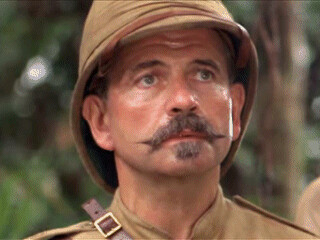
The Less Than Good—Hugh Hudson (Chariots of Fire, Revolution) applies stately coffee-table style direction that saps vitality. The essential tack of the frequently ridiculous script, trying to elevate fun pulp fiction make-believe into something ‘meaningful’, asking us to accept the jungle man’s—a clean-shaven, sentimental, multi-lingual, jack-of-all-trades sage and stud— wizardly learning curve through editing (Anne V. Coates of Lawrence Of Arabia) that vainly attempts to resuscitate a funereal pace: huge and sudden leaps in chronology make little spatial sense, let alone logic, which from the get-go requires leaps of imagination/disbelief as great as the simian boy’s vine-swings. The goofy fun of Tarzan’s past is gone, replaced by brooding solemnity. Lambert, 26 in his international debut, apparently was someone’s idea of endearing hero (next stop, the Highlander escapism); to each their own. The romance with Jane is downright silly, and the unfortunate McDowell (debut, 24) was cruelly kneecapped by being post-dubbed with the voice of another actress. The swelling music score done by John Scott has its fans.
Except for Richardson, continental envoy Holm and Miss Jane, the representatives of the top-this-sneer British Empire and “CIVILIZATION!” are a vain & vicious lot as suggested by James Fox, Ian Charleston, Nigel Davenport, David Suchet and Richard Griffiths.
Reviews were generally good (better than audience response) and the Academy Awards saw fit to bring nominations for Supporting Actor (Richardson, a nice gesture), Screenplay (oh, “ungawa!” already: started by Robert Towne, finished–or killed–by Michael Austin) and Makeup (terrific, from Rick Baker and Paul Engelin).
Though it came in 17th place in ’84, the $45,859,000 gross was a thud measured against the cost. No Tarzan yell—and none in the movie, either!

* Credit where due—fabulous physical mime work as apes, a limber troupe led by Peter Elliott, Ailsa Berk and John Alexander.
Credit who?—embarrassment in the jungle gym. Infamously, Andie McDowell’s too-Southern voice (she hailed from South Carolina) was dubbed by ‘more genteel’ Glenn Close. This drew mean-spirited flak like that of King Kong–pawed Jessica Lange, another model who made her debut with a love-smitten simian. Devastated by the switch, which came as a total surprise, McDowell, like Lange with Tootsie and Frances, would rally, in her case with Sex, Lies and Videotape, Groundhog Day and Four Weddings And A Funeral. Jane in real life.
Credit woof?—involved since conception in 1974, scribe Robert Towne was so ticked over the eventual tatterdemalion screenplay that he took his name off and sarcastically put his dog’s name (P.H. Vazak) on as credit. He later reflected “I have other regrets of things that I wanted to do that didn’t work out — most dramatically ‘Greystoke,’ which was then, is now, and always will be the biggest creative regret of my life.”

Farewell, your Lordship. Sir Ralph Richardson, 1902-1983
 Movies ala Mark