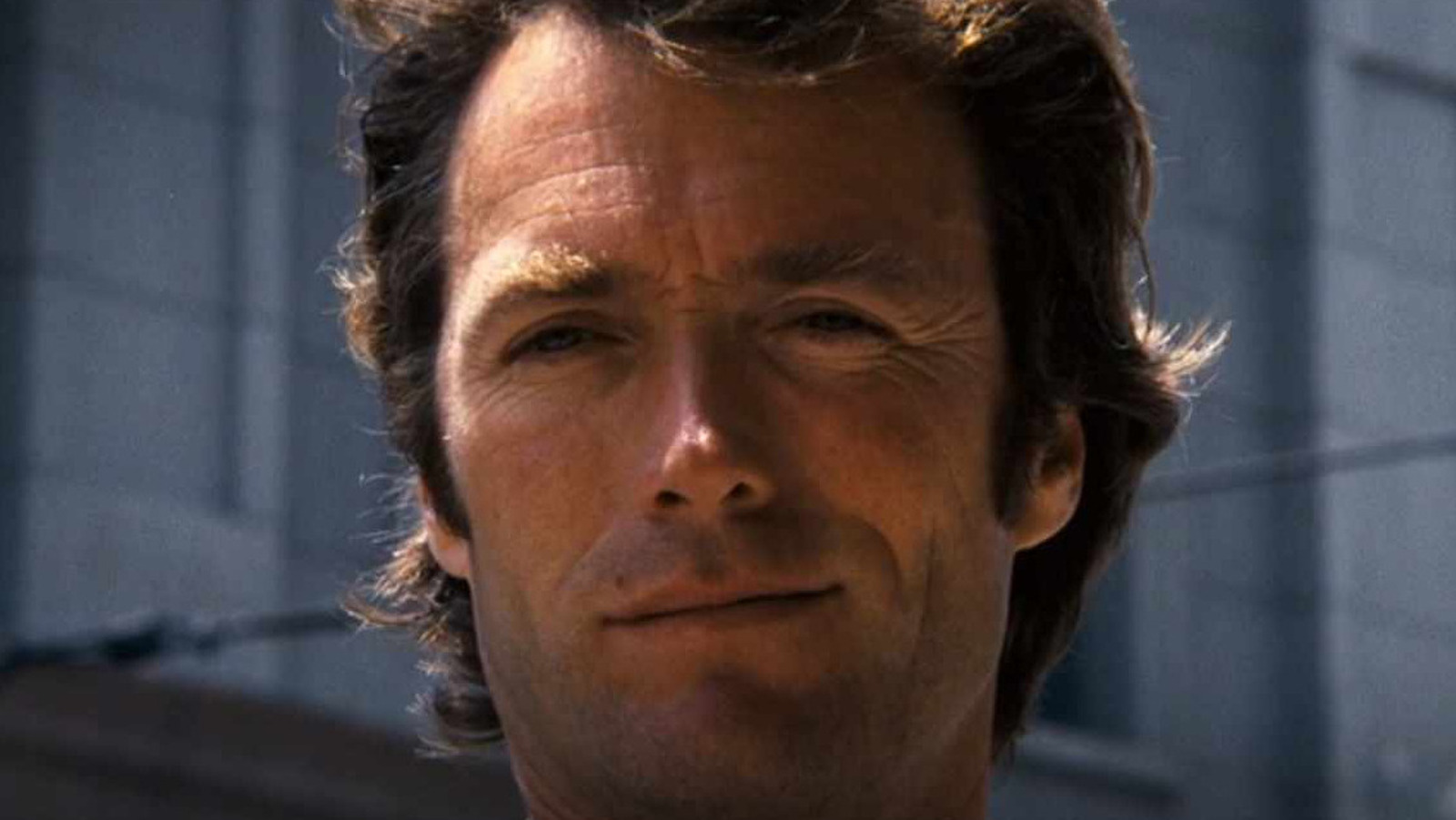
DIRTY HARRY, try as he might, didn’t ‘clean up’ San Francisco, as anyone who presently lives or visits there can sadly attest. But not for lack of trying, as this 1971 urban law & order classic answers, beginning with one of movie lore’s most famous badass pop quizzes, man on the street (literally) version—“You’ve got to ask yourself one question: ‘Do I feel lucky?’ Well, do ya, punk?” Under Don Siegel’s relentlessly taut direction, Clint Eastwood’s day was made, his growing fan legions providing covering fire from critics carping about content vs. intent. Whatever else ‘Inspector Harry Callahan’ accomplished, his methods gave Pauline Kael a brain ulcer: he gets a life pass on that alone. *
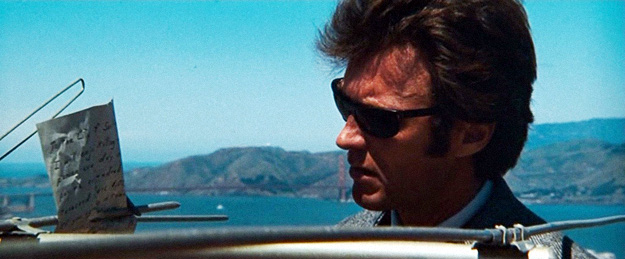
“My, that’s a big one.”
When a psychotic sniper’s spree threatens to hold San Francisco hostage, handling the maniac’s case falls to veteran homicide detective Harry Callahan (Eastwood, 40), calm, cynical and—when circumstance cries—cruel. Kid gloves are…for kids, and rampaging ‘Scorpio’ (Andy Robinson, 29) is no flower child.
Clint and director Siegel had a smooth working relationship, having knocked back Coogan’s Bluff, Two Mules For Sister Sara and The Beguiled (also 1971, as was Eastwood’s directorial debut Play Misty For Me); this unflinching cop-as-crusader (or judge, jury, executioner) vehicle locked in the actor’s iconic persona. Its quality, success, and ensuing controversy (with some critics anyway) such that Richard Schickel devotes 25 pages to it in his bio of Eastwood. John Milius and Terrence Malick did earlier drafts of the script which was ultimately credited to Harry Julian Fink (Major Dundee), R.M. Fink (Big Jake) and Dean Riesner (Play Misty For Me).

“No, don’t pass out on me now cop! No, no, no, no, no. Don’t pass out on me yet, you dirty, rotten oinker!”
Fitting the public perception that crime was out of control and societal safeguards were flapping in the victim-strewn breeze, the movie is gritty enough (and vicious enough) to feel real, even while being essentially a fantasy in terms of logic (procedural, behavioral); contorting context to match one’s particular political/philosophical persuasion invites over-analysis that most average moviegoers (that be us, Clyde, no “right turn“, thanks) will glaze past in order to settle down for couch catharsis (not the psychiatrist couch kind, but the living room & den variety that comes with beer and pizza), often the only type we get in a crazy country dead set on going to authoritarian hell—Harry, get me out of this paragraph!

Eastwood’s lone ranging Callahan may not be a role model for decorum or restaint, but he’s a great comic book character, form fit for the star’s outsized image—part traditional haunted hero (Cooper, Wayne, Bogart), part modern cool dude (Newman, McQueen, 007), enough at ease with confident masculinity to poke digs at it even while being emblematic. Maybe it helps to lug around a .44, and being able to precision hit miscreants a hundred yards away.
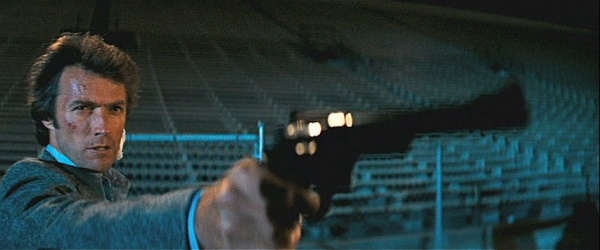
Lalo Schifrin’s unsettling score sets the tone, his ‘Scorpio’ theme is memorably eerie. Bruce Surtees neo-noir camerawork and Carl Pingatore’s editing make Siegel’s choices of locales in San Francisco (literally skyscraper high to alley & burrow low) integral to the grim chase (leavened by Harry’s dour wisecracks) and episodic mayhem. The supporting cast is stoked with hardies, but first and foremost is the splendidly over-the-top lunatic ripped from the otherwise peaceful id of Andy Robinson, a gifted young stage actor in his feature film debut. He was magnificently creepy, so charismatically compelling (in a horrific way) that it effectively killed his career in the crib; it was years before he could be cast (or even considered) in anything where he was not something akin to a fiend. He even left the profession for five years from 1978 to 1985. Find some of his frank and fun interviews: he’s a very interesting guy.

Siegel & company’s capturing of the fluid look was also accomplished with proficiency, costing a lean $4,000,000. The 8th most-attended picture of ’71 took in $39,600,000 just in North America alone. The (Magnum) Force is strong with this one.
With Harry Guardino, Reni Santoni, John Vernon, John Larch, John Mitchum, Ruth Kobart, Josef Sommer, Woodrow Parfrey, Albert Popwell (“I gots ta know…”), and Diana Davidson (pool victim in the shock opener, Jaws with a silencer). 102 minutes, followed by four progressively inferior sequels, carnage carnival Magnum Force by far the best.

* Mean Screen, 1971—The French Connection, A Clockwork Orange, Big Jake, Straw Dogs, Lawman, The Devils, Hannie Caulder, Get Carter, The Hunting Party.
 Movies ala Mark