
DRACULA has had the edge filed from its fangs after more than eight decades of faster, scarier horror films, and the pace of this antique ground-breaker often threatens a nap. But there is still—and for always—Bela Lugosi, as the Transylvanian gentleman with an appetite for arteries. Bela has been out-acted, but never duplicated. His courtly Count is creepy not because he’s vicious like Christopher Lee, slippery like Frank Langella or icky like Gary Oldham, but because he seems depraved. I mean, you can Twilight-it from here to eternity, but vampires want to slurp your blood, and if that’s sexy to you, you might want to experiment with something like a suntan or ice cream. While enjoying its good qualities and appreciating its place in genre and popular history, it’s also okay be amused: nearly every scene or saying begs to draw forth affectionate satire.
“Listen to them. Children of the night. What music they make.”

“I never drink…wine.”
“Swan Lake” plays quietly behind the opening credits, a piece of transformation that’s appropriate for the story and fitting for the suggested time period. There are nostalgically musty bites of Gothic European weirdness, a cobbywebby castle, baroque stairways, the silent appearance of Dracula’s brides. Lugosi has bizarre closeups that get progressively unsettling; his accent is irreplaceable. He does get syllable-strangling competition from Edward Van Sloan as ‘Van Helsing’, who speaks so slowly and with such a heavy ‘fake foreign’ tongue roll that it drags scenes down. Helen Chandler plays plasma-targeted ‘Mina’ and Frances Dade is poor silly ‘Lucy’. While Frye’s twerpy whiner ‘Renfield’ is mostly taxing, he does kick it into the fun hysteria zone with his gleeful-sicko laughter. There is a lot of stagy, stiffly delivered talk, and the finale is abrupt. Short, stopping with a thump at 75 minutes. Directed by Tod Browning, with a screenplay from Garrett Fort and a half dozen unaccredited contributors. Produced for $341,000, the gross of $4,300,000 tagged as the 8th most popular picture of 1931.
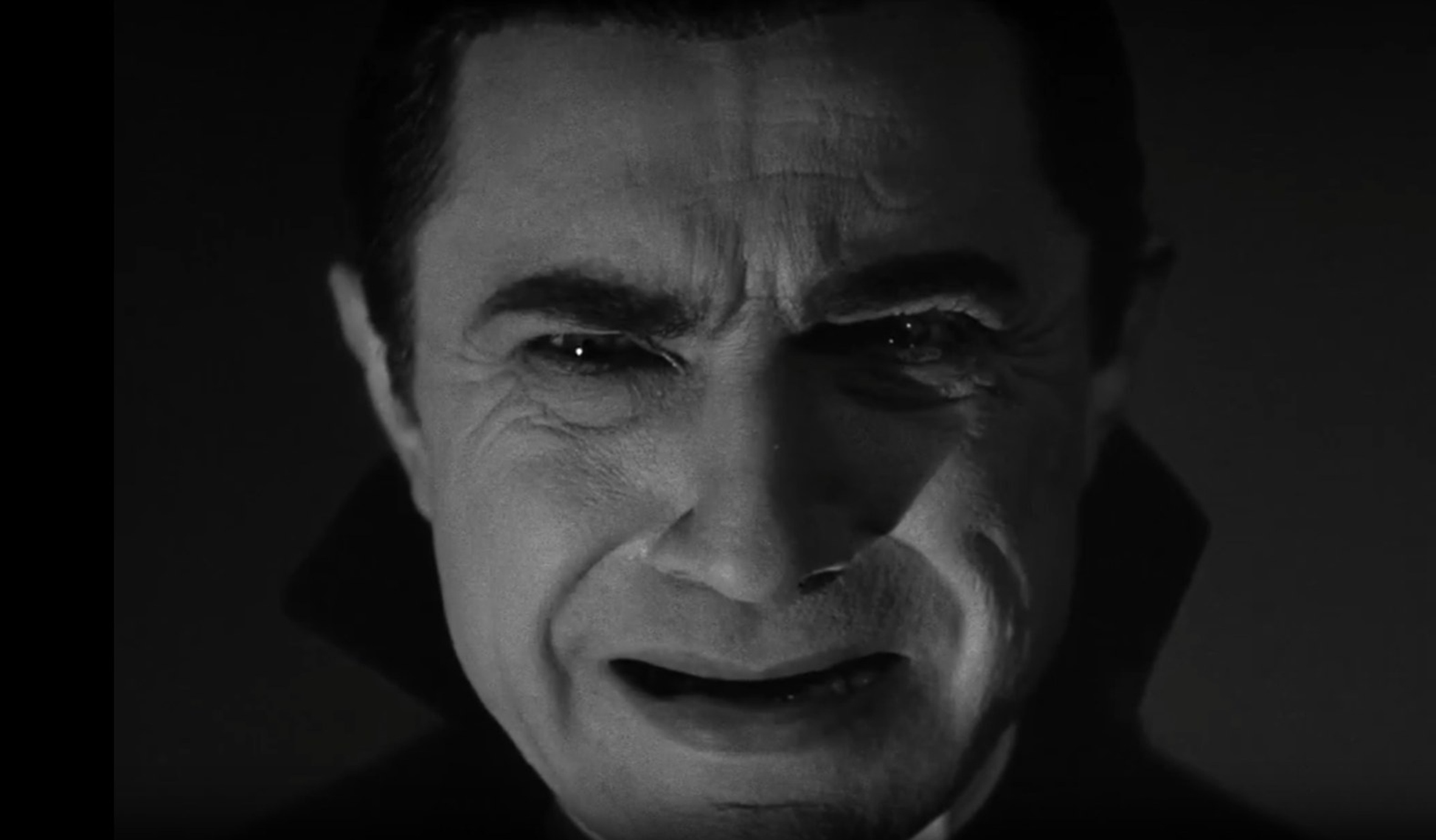
“My, what a big bat!”
Frankenstein, released later the same year, holds up better (and outpaced it, claiming #3), while joining the party in spot #15 was Dr. Jekyll and Mr. Hyde.
Bela speaks: “The studios were hell-bent on saving money–they even cut rubber erasers in offices in half–everything that Tod Browning wanted to do was queried. Couldn’t it be done cheaper? Wouldn’t it be just as effective if…? That sort of thing. It was most dispiriting. But we still enjoyed making it; the cast, technicians, everyone. It was a good deal of fun, if you can believe that of such a movie. We knew we wanted our public to scream with terror, as on a rollercoaster, and that’s what we aimed to do. There were a lot of movies like that at the time. I was lucky to be part of what you nowadays call a “genre”. I might have grown angry with the vampire forever putting me in such an evil mould, but it was a living–or a dying in its way. And in a way, though no Spencer Tracy, I was a kind of star.”


