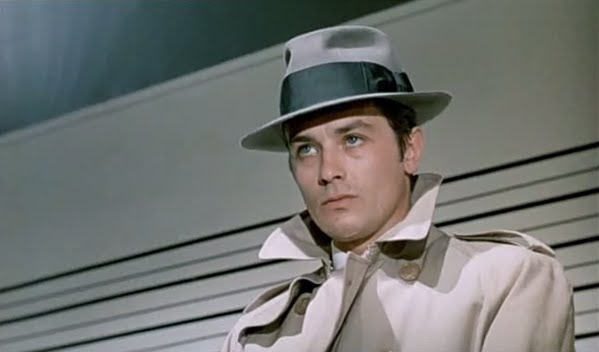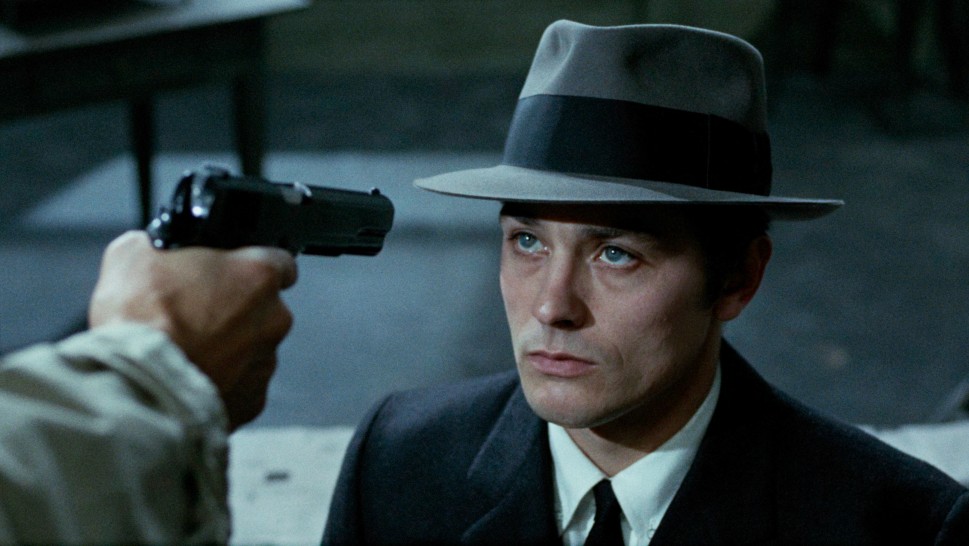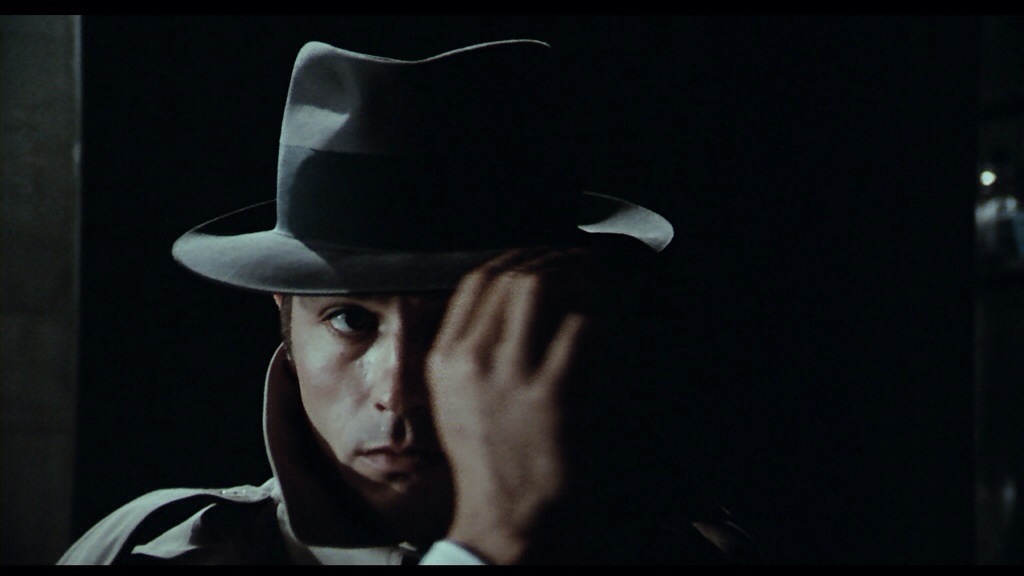
LE SAMOURAÏ, a messenger of Hit Man Uber-Cool from France in 1967, didn’t migrate to the States until 1972, finally slinking in under the who-cares? nom de guerre The Godson. The delayed release date situation was a feature of nearly all of the fourteen movies directed by Jean-Pierre Melville; plus, when they arrived, to minimal distribution, not only were the titles changed but frequently their running times were truncated. Re-releases and retrospective praise from style-impressed/obsessed critics (“I said auteur before you did!”) and inspired emulators have secured high-echelon ranking for this sleek peek at homicidal chic. *
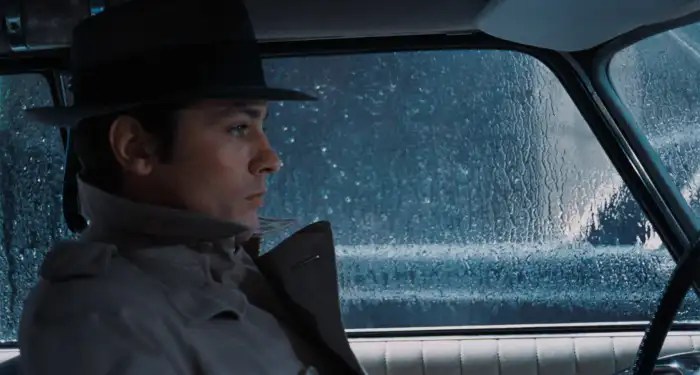
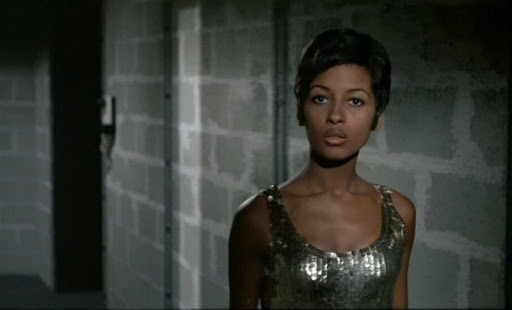
‘Jef Costello’ (Alain Delon, 31) lives and works in Paris. He lives like a monk Spartan, in a barely furnished apartment with a caged bird for company, the bulfinch serving more as an alarm sentry rather than a companion. The bare-bones digs are so austere they may as well be a prison cell, but Jef’s sartorial style is precise and elegant—sharp tailored business suit with trenchcoat—as is his private trademark of flick-straitening his grey felt fedora in a mirror before heading out to work. The work: he’s an independent professional assassin with a rigid Bushido code as implacable as his blue ice manner in fulfilling a contract. His lover–of a sort–‘Jane’ (Nathalie Delon, 26, debut, Alain’s wife at the time) provides alibis, and her loyalty frustrates the calm and dogged police Commissiare (François Périer, 47) who knows Jef cancelled a nightclub owner’s ticket. Witnesses disagree about who they saw; they include ‘Valerie’ (Cathy Rosier, 21, debut), a svelte jazz pianist who has some kept-to-herself reason for not dropping the dime on the chilly Costello. There’s a double cross at work, motives are mixed, the police judiciaire are as determined to nail Jef as he is to find out who’s setting him up for early retirement without a pension.
While large American audiences in 1967 mulled the seemingly post-morbid mobility of Lee Marvin in emergent director John Foreman’s sharp gangster exercise Point Blank, only a few connected critics were aware that across the Atlantic a similarly ghost-like figure was methodically adding to the non-accidental death rate in Paris. Nabobs of the reviewer elite noticed, but outside of France common moviegoers were unaware of writer-director Jean-Pierre Melville, formerly of his country’s WW2 Resistance, a stylist who had influenced the French New Wave with a number of noir sagas like Bob le flambeur (made in 1956, it didn’t hit the States until 1982). He first favored Jean-Paul Belmondo, then switched focus to Alain Delon with Le Samouraï, followed by Le Cercle Rouge and Un flic. Icy killers on film were hardly a new thing but Melville’s creation and Delon’s presentation locked in the cinematic realm of the ‘existentialist assassin’, an alternate reality zone that’s since been so well traveled it could be added to maps as a sovereign country. Long before John Wick let guns do his talking for him, the impassive Jef Costello paved the way for a well-armed division of imitators, too numerous to detail without alerting Interpol and the IMF—that is if SPECTRE and The High Table don’t find you first.
Like most of those fictional outfits (Interpol may as well be) the hit man as mythic marauder and/or the blokes who are licensed to kill between seductions, Melville’s silent but deadly (and absurdly handsome) Costello exists in a stylized Fantasyville, but what’s also neat about this classic is that alongside the unfazeable Jef the storyline plays straight with the lawman side of the equation; the detailed sequences involving the methodical police interrogations, surveillance tactics and pursuits add another level of slow-burn tension to the Who & Why mystery. Repeat viewings are in order.
With Michel Boisrand, Jacques Leroy, Robert Flavert and Catherine Jourdan. 105 minutes.
* Hunting fees by Franc bucks—in 1967 Le Samouraï sold 1,944,395 tickets in France. ‘The Numbers’ reports its 1972 US appearance as The Godson eked what amounted to a cheap tip, $214,946. An iconic star in France, Delon’s international/Hollywood run drew more attention for his unfairly good looks than the quality of the projects. The trifling The Yellow Rolls Royce and insipid Texas Across The River made money, but Once A Thief, Lost Command and Is Paris Burning? didn’t register. If you’re Alain-in-English desperate there’s Red Sun and The Assassination Of Trotsky. Let’s all decline to book The Concorde…Airport ’79. In all of these, other than picking the scripts, he remains blameless (Is Paris Burning? is underrated and he only has a cameo). Go for the French and European lineup, which not only sports Le Samouraï and numerous gangster coups, but also fields Rocco And His Brothers, Purple Noon, L’Eclisse and—best of all—The Leopard.
Alain explained—“I am not a star. I am an actor. I have been fighting for years to make people forget that I am just a pretty boy with a beautiful face. It’s a hard fight, but I will win it. I want the public to realize that above all I am an actor, a very professional one who loves every minute of being in front of the camera. But one who becomes very miserable the instant the director shouts, ‘Cut!'” “I think we’re all loners, to differing degrees.”