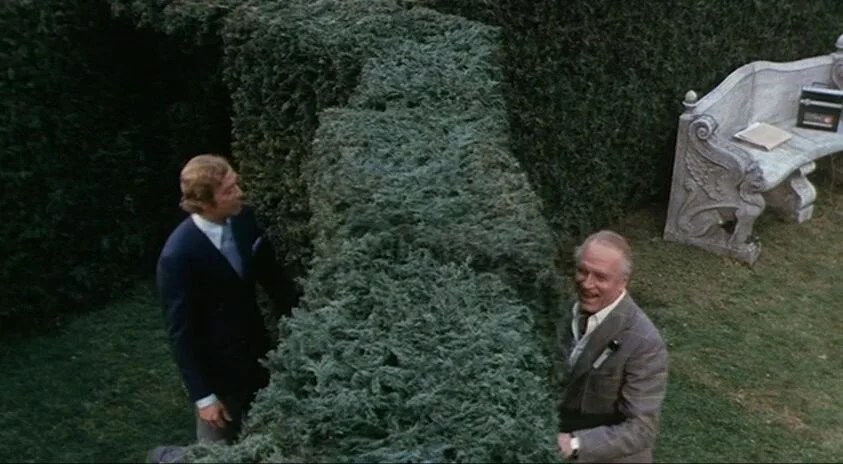
SLEUTH, diabolically fun mystery thriller elbowed its sophisticated way past most of 1972’s coarser crime entrees, showing that there was still an audience for civilized misbehavior in the midst of a torrent of swearwords, squib charges and sadism. The last film from venerated director Joseph L. Mankiewicz had him go out with a winner, scoring with critics, at the box office and in peer esteem, tagging his fourth Oscar nomination for direction, the film drawing three more.
“It’s sex! Sex is the game! Marriage is the penalty. Round and round we jog towards each futile anniversary. Pass “Go”. Collect 200 rows, 200 silences, 200 scars in the deep places.”
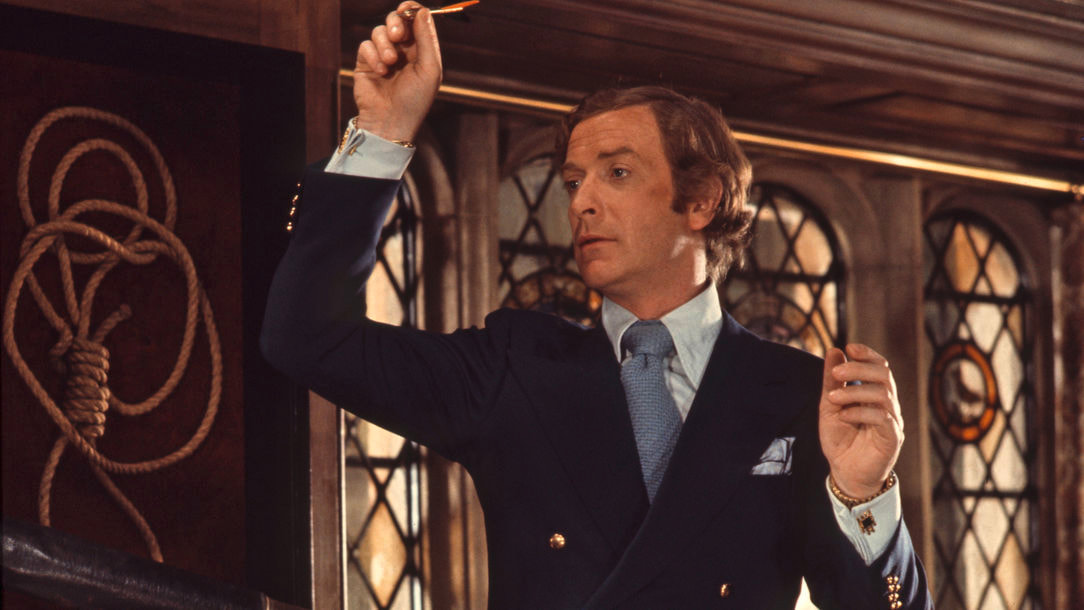
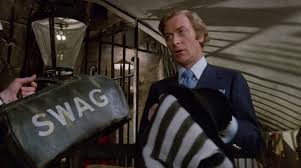
Famed crime fiction author ‘Andrew Wyke’ (Laurence Olivier) invites hair salon owner ‘Milo Tindle’ (Michael Caine) to his decorously appointed country house to propose something mutually beneficial. Andrew prefers his mistress ‘Tea’ over his shrewish wife ‘Marguerite’, whom the younger Milo has been having it on with. He suggests staging a robbery: Milo ‘steals’ his wife’s jewels, Andrew covering the loss thru insurance, Milo using the money to support Marguerite and expand his business while Andrew and Tea can live more happily ever after. But there’s a catch, several. Tables are turned, then turned again. Who’s in charge of this alternately merry and malicious chase, what are the real reasons for playing and what may be the results?
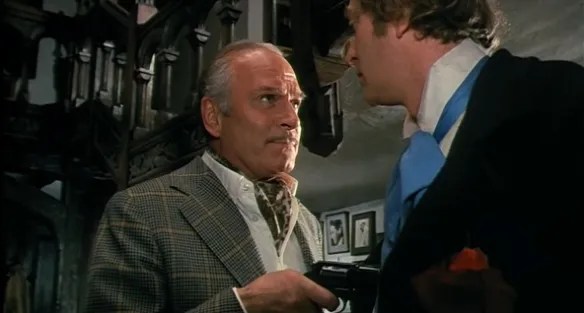
“Property’s always been more highly regarded in this country than people.”
Though he was noted for writing the scripts he directed, this time Mankiewicz ceded that chore to Anthony Shaffer (screenwriter for Frenzy, The Wicker Man and Death On The Nile) who adapted his own Tony-winning play. On Broadway, it ran 1,222 performances, with Anthony Quayle and Keith Baxter. Able as they were, they weren’t going to have any pull at the box office: enter Mike & Larry.
“You’re a jumped up pantry boy who doesn’t know his place!”
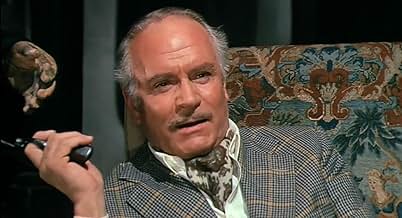
Caine, 39, bracketed this two-character chamber piece puzzler between a pair of epics, The Last Valley (greatly underrated) and The Man Who Would Be King (a classic). For a number of years Olivier, 65, had been more focused on the stage, his film work mostly prestige cameos (The Shoes Of The Fisherman, Battle Of Britain, Nicholas And Alexandra); the rich wit in this piece too tempting to pass up. The dueling interplay between the two is a delight, with Olivier having a slight edge; it’s one of his most spirited (and quite funny) performances, easily his best big screen turn since Spartacus in 1960. *
“Never speak ill of the deadly. If I choose to say that my wife converses like a child of six… and makes love like an extinct shellfish, I shall, and I don’t need to ask her lover’s permission to do so either.”
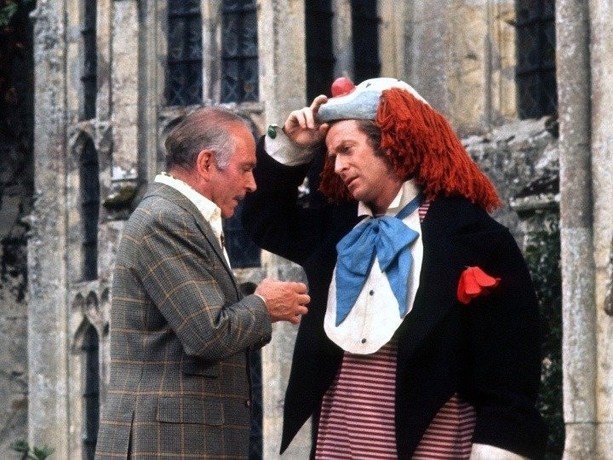
Like their director, both received Academy Award nominations, Olivier’s seventh of eight for Best Actor (winning in 1949 for Hamlet), Caine’s second of four (he won twice in the Supporting category). John Addison’s whimsical music score went up as well. For Mankiewicz, 63, the reviewer and trophy applause along with the box office—23rd place, $17,400,000 gross against a $3,500,000 tab— made for champagne time. He’d taken a hit from the problem plagued Cleopatra and his subsequent works, The Honey Pot and There Was A Crooked Man…good qualities aside, had failed both critically and commercially. Though he continued to mull possible projects, this was his last time behind the camera. The only quibble on Sleuth is that at 138 minutes it’s drawn out a wee too long.
“Wit in the face of adversity! Good! You’ve learned something from the English.”
Remade in 2007, with Caine in Olivier’s role and Jude Law (good choice) as his duelist.
*Role play— I’m not fond of Olivier’s Oscar-nominated The Entertainer from 1960, preferring his chilly proto-fascist Roman in Spartacus. He was also nominated for the lead in the 1965 version of Othello, but it was little seen (the US boxoffice doing a little less than Ski Party and a tad more than Voyage To The Prehistoric Planet—so much for culture) and drew/draws controversy over his makeup choices. That also bothers some with his Mahdi in Khartoum—I think he’s fine in that underrated spectacle.
Awe turned to “Awesome!”—Caine related he was initially so nervous around Olivier that he didn’t even know how to address him. He finally flat out asked. Olivier came back with “Well, I am the Lord Olivier and you are Mr. Michael Caine. Of course, that’s only for the first time you address me. After that I am Larry, and you are Mike.” Cool meets Cool.

Click on pic for enlargement and clarity
 Movies ala Mark