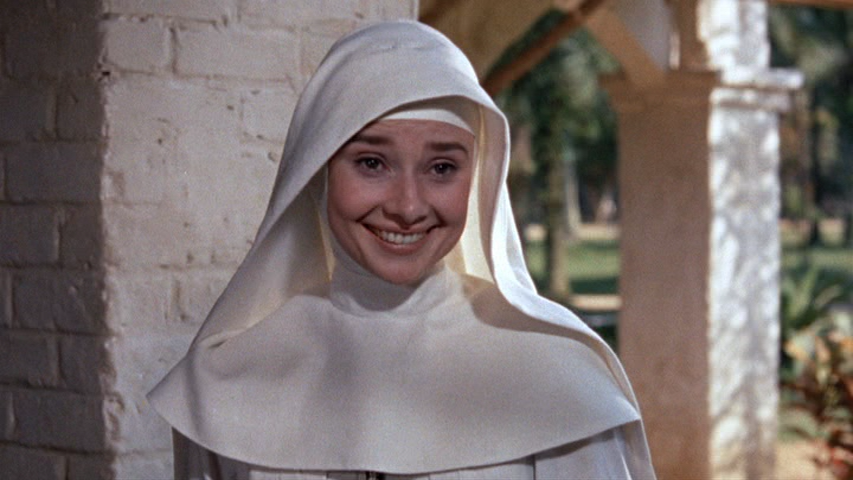
THE NUN’S STORY has Audrey Hepburn giving one of her finest performances, directed with consummate skill by Fred Zinnemann in one of 1959’s top tier dramas. Robert Anderson (Tea and Sympathy, The Sand Pebbles, I Never Sang For My Father) wrote the screenplay, based on the best-seller novel from Katherine Hulme. Critics applauded, peers saluted and the public lined up to make it the 12th most popular film of the year. *
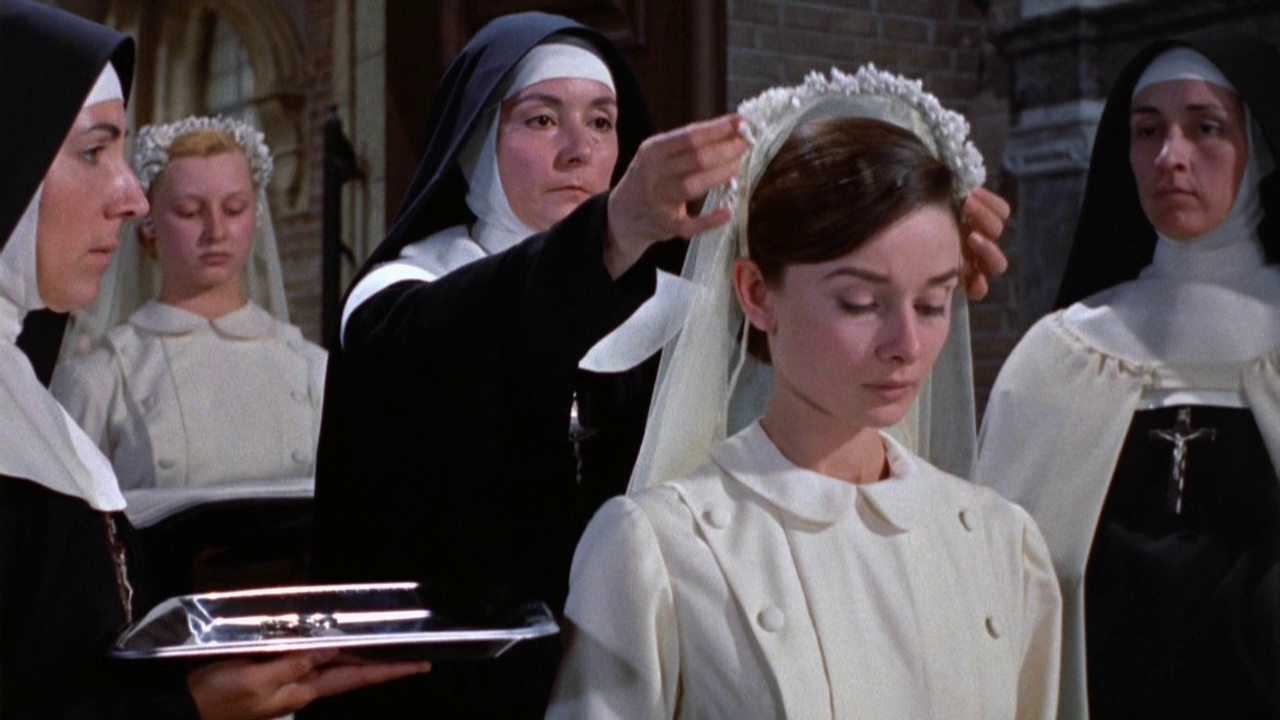
“Dear Lord, forgive me, I cannot obey anymore. What I do from now on is between You and me alone.”
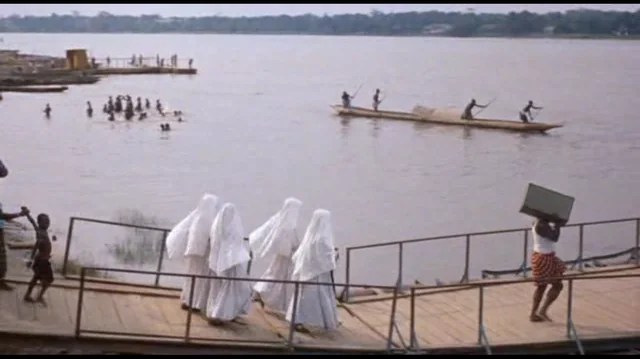
Belgium, 1927. ‘Gabrielle van der Mal’ (Hepburn) leaves behind her family and worldly goods, and takes on a new name as she enters a new life—as a nun in the Sisters of Charity of Jesus and Mary, a convent training nurses. Her father (Dean Jagger) is a prominent surgeon specializing in tropical medicine, and as ‘Sister Luke’ she hopes to follow in that field and use her skills in Belgium’s colony in Africa, the Congo. Over the course of 17 years Sister Luke will train and excel as a nurse as she dutifully learns, patiently follows and continually adjusts to the strictures of daily conduct demanded by her order and the decisions it makes regarding her assignments. Her service takes her to work in a mental hospital in Brussels, eventually to an arduous stretch in the Belgian Congo, finally back to Belgium during the Nazi occupation in World War Two. During all this, beneath her habit the remade Sister Luke is still Gabrielle, and Gaby’s sense of self and independence are repeatedly strained by doubt and disappointment, duty vs. conscience, adherence vs. submission, faith vs. calling.

Measured at 149 minutes, Zinnemann’s careful pacing and Anderson’s thoughtful writing take a clearly respectful but decidedly impartial approach. Gratefully, the presentation isn’t padded with melodramatics or dulled by didacticism, crucial in winning over the dogma or deity averse (I just pled my case) not to ‘The Church’—in this case Catholicism, but it could just as well be another one-size-fits-all-except-those-it-excludes religion—but to the strength and resilience of the human spirit exemplified by the decency of Gabrielle/Luke in the person of a captivating actress. Getting literally preachy would have been a real turn-off for those who risk thinking for themselves. Instead it’s revealing (the rituals of training), moving (the personal losses are keenly felt), disturbing (the segment in the mental hospital is harrowing and creepy), fascinating (the you-are-there-and-sweating Congo episode), ultimately inspiring (war and decision). Esteemed reviewer (and friend) Glenn Erickson bears the cross with “It’s the kind of movie we get dragged to see … which then becomes a respected favorite.” We concur.
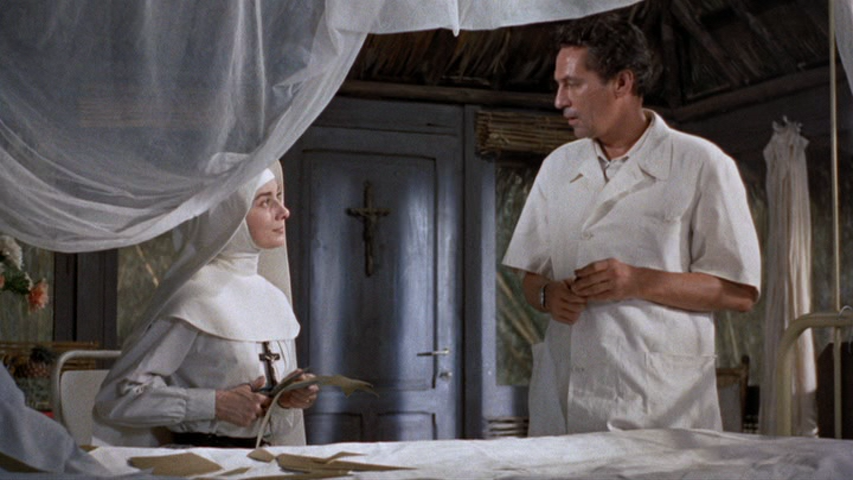
Oscar nominations went up for Best Picture, Actress (Hepburn), Director, Screenplay, Cinematography, Film Editing, Music Score and Sound. The mighty Ben-Hur justifiably swept six of those. In a tough call the script was outvoted by Room At The Top and that movie’s Simone Signoret was a surprise win as Best Actress. Taking nothing away from her stellar work, we’d opt for Hepburn, 29 and at her very best, in a larger part, dealing with a greater range of dramatic settings and choices, ethical v. practical, sensual v. spiritual, dutiful v. moral. All done in restrictive apparel and a vocation-enforced constraint on demonstrative displays of excitement or distress, requiring her to telegraph powerful, often conflicting emotions in minute and subtle flashes, that signature beaming smile subservient to those luminously expressive eyes. Standing out in the superb supporting cast is Peter Finch as the roughly charming ‘Dr. Fortunati’, who Luke works with in Africa, a full-bodied character key not just to her greater understanding of her long-suppressed needs and true value as a healer but to her actual corporeal survival.
Beautifully scored by Franz Waxman, with the cinematography from Franz Planer (Letter From An Unknown Woman, The Pride And The Passion, The Big Country) redolent in serving up the locations in Belgium (Brugges and Antwerp) and, most strikingly, the Belgian Congo. Production costs came to $3,500,000, more than quadrupled by grosses tallying $16,000,000.

With skilled teamwork from Edith Evans (the Mother Superior), Peggy Ashcroft, Mildred Dunnock, Beatrice Straight, Patricia Collinge, Rosalie Crutchley, Ruth White, Barbara O’Neil, Patricia Bosworth, Lionel Jeffries, Niall MacGinnis, Colleen Dewhurst (debut, 34, as the insane ‘Archangel’), Diana Lambert, Errol John, Orlando Martins.
* The 339-page novel was based in part on the experiences of Belgian nurse and ex-nun Marie Louise Habets (of the Sisters of Charity of Jesus and Mary). Hepburn and Habets met prior to the film, and Marie later aided Audrey in her recovery from a critical horse-riding mishap that happened during the filming of The Unforgiven.
Hepburn’s other 1959 entry was the bollixed adventure Green Mansions, a critical and financial dud (but a real camp hoot). She later cited The Nun’s Story as her favorite work. The filmmakers timing was fortuitous: after 75 years of Belgian theft and tyranny colonial rule Congo became independent the year after this was released; the ensuing tide of horrific violence would have made filming there more than perilous.
Taking things seriously in 1959—Anatomy Of A Murder, On The Beach, The Diary Of Anne Frank, Pork Chop Hill, Compulsion, Look Back In Anger, Room At The Top, Black Orpheus, The Bridge, The 400 Blows.


 Movies ala Mark
It’s so good. Personally I think Audrey gave her best screen performance in this.
Hope all good with you.
Maddy
Hi Maddy, agree on Audrey; she’s superb in the film. I’m OK, although besieged with family traumas that I can’t do much about and of course horrified by the larger picture. When in doubt, take a trip, which I plan to do in October. How have you been? Mark